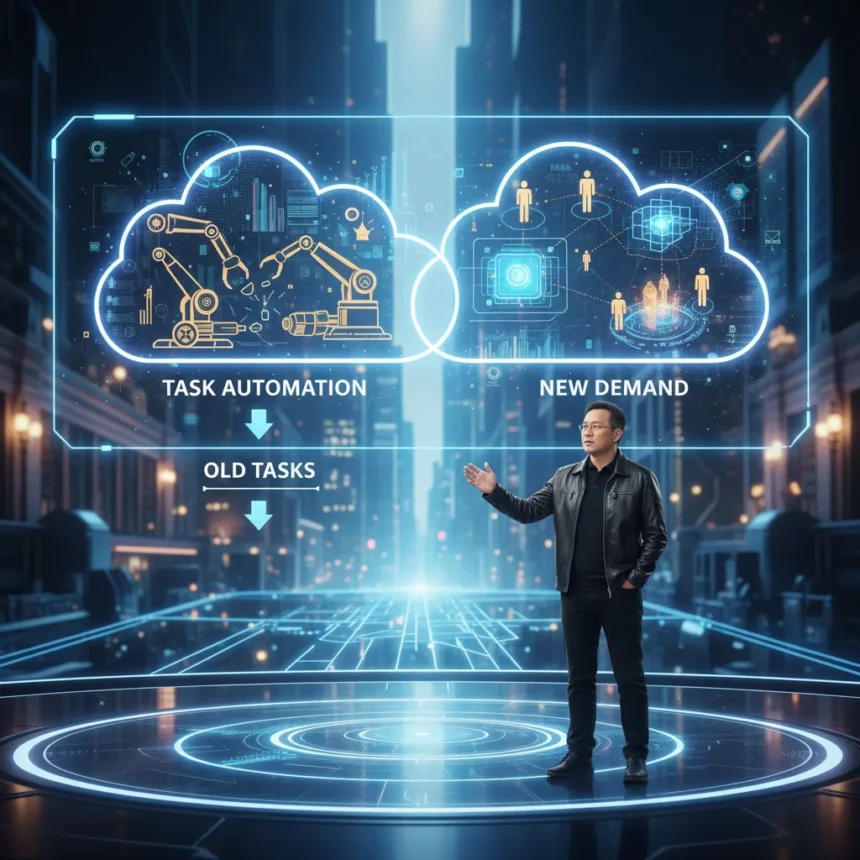
AI job displacement fears dominate tech headlines, but Nvidia CEO Jensen Huang offers a contrarian perspective: the real threat isn’t technology, it’s leadership. Speaking on the distinction between task automation and job purpose, Huang argues that separating these two concepts reveals why AI creates opportunity rather than widespread unemployment.
Key Takeaways
- Huang separates task automation from job purpose—AI handles image analysis, but radiologists’ core mission of helping patients diagnose disease remains critical.
- US salaries for chip factory and AI infrastructure jobs have nearly doubled to six-figure levels amid severe worker shortages.
- The largest infrastructure buildout in history is creating jobs across energy, power, land, and construction sectors.
- Huang blames recent tech layoffs on “visionless leadership” focused on cost-cutting rather than growth through innovation.
- Without new ideas, productivity gains eliminate jobs; with innovation, they expand employment and lift society.
Why AI Task Automation Doesn’t Equal Job Loss
The radiologist panic exemplifies how AI fears conflate task replacement with job elimination. Huang’s core argument is straightforward: yes, AI can analyze medical images faster than humans. But that’s not the radiologist’s entire job. The real purpose—helping doctors and patients diagnose diseases—doesn’t disappear with AI. It becomes more important. This distinction matters because it reframes the narrative from “AI replaces workers” to “AI enhances worker capacity.” When you remove the tedious image-scanning work, radiologists can focus on patient consultation, complex case analysis, and treatment planning—work that requires human judgment and empathy.
The same logic applies across industries. Manufacturing workers aren’t being displaced by robots because robots arrived; they’re being displaced by companies that lack the vision to redeploy them. A truck driver’s job isn’t just steering—it’s logistics, customer service, safety, and problem-solving on the road. Automation handles the steering; it doesn’t handle the purpose.
Labor Shortages Prove AI Creates Demand, Not Surplus
Huang’s argument gains credibility from a simple economic fact: the US faces acute labor shortages despite high overall employment. Millions of truck drivers are needed. Tens of millions of manufacturing workers are in short supply. These gaps exist in a world where AI and automation have been advancing for years. If technology was eliminating jobs faster than society could adapt, these shortages wouldn’t exist. Instead, they reveal that companies struggle to find enough workers to meet demand—a sign the economy is expanding, not contracting.



The AI infrastructure buildout amplifies this dynamic. Building chip factories, computer facilities, and AI infrastructure represents the largest infrastructure project in history, creating jobs in energy, infrastructure, land acquisition, power generation, and shell construction. These aren’t hypothetical future roles. US salaries for workers building these facilities have nearly doubled, reaching six-figure levels, yet shortages persist. Companies can’t find enough people to fill these positions at any price—a clear signal that AI is generating more employment demand than it’s destroying.
Leadership, Not Technology, Determines Job Outcomes
Huang’s most provocative claim targets corporate decision-makers directly: “The problem is not AI. The problem is leadership”. Tech companies laying off workers while citing AI productivity aren’t victims of technological disruption—they’re making strategic choices. These layoffs stem from what Huang calls “visionless leadership” focused on cost-cutting rather than growth. A company that automates a process and cuts staff is choosing efficiency over expansion. A company that automates a process and reinvests savings into new products and services is choosing growth.



This distinction matters because it shows job outcomes depend on economic decisions, not technological inevitability. “If the world runs out of ideas, then productivity gains translates to job loss,” Huang stated. Conversely, if companies and economies continue innovating, productivity gains create new industries, new roles, and new opportunities. The technology itself is neutral; human strategy determines whether it concentrates wealth or distributes opportunity.
The Counterargument: AI Could Spike Unemployment
Not everyone shares Huang’s optimism. Anthropic CEO Dario Amodei has warned that AI could eliminate half of entry-level white-collar jobs and spike unemployment to 20 percent within five years. This represents a fundamentally different view: that AI’s displacement speed will outpace job creation, leaving millions unable to transition. Huang doesn’t dismiss this risk entirely. “Everybody’s jobs will be affected. Some jobs will be lost. Many jobs will be created,” he acknowledged. His bet is that innovation and infrastructure demand will create more jobs than are lost—but this remains a prediction, not a guarantee.
The difference between these views hinges on assumptions about leadership, innovation, and social adaptation. Huang assumes companies will continue investing in growth and new ideas. Amodei assumes companies will optimize for efficiency and cost reduction. History shows both patterns have occurred in past technological transitions—some economies adapted well, others struggled.
What Happens If Innovation Stops
Huang’s framework reveals a critical vulnerability in his argument: it depends on continuous innovation and visionary leadership. If companies and governments fail to invest in new ideas, if cost-cutting becomes the dominant corporate strategy, if infrastructure investment stalls, then his optimistic scenario collapses. “Because you’re out of imagination,” he said, explaining why companies cut jobs despite AI productivity gains. This isn’t a technological problem—it’s a leadership and cultural problem. But it’s a real one.



AI is the greatest technology equalizer ever created, Huang argues, because it lifts people who don’t understand technology. A radiologist without coding skills can use AI tools. A factory worker can operate AI-powered systems. This democratization could broaden opportunity. Or, if access and training are unequal, it could deepen inequality. The technology itself doesn’t determine the outcome.
Does AI eliminate more jobs than it creates?
Not necessarily. Huang argues AI creates more jobs than it eliminates when companies invest in innovation and growth rather than pure cost-cutting. The US labor shortage—millions of unfilled positions despite high employment—suggests demand currently exceeds supply. However, this depends on sustained investment in infrastructure and new industries, which is not guaranteed.
Will radiologists lose their jobs to AI?
Huang says no. AI handles image analysis, but the radiologist’s core purpose—helping doctors and patients diagnose disease—remains and becomes more important. The job changes, but doesn’t disappear. This assumes employers redeploy radiologists to higher-value work rather than simply cutting positions.
What’s the difference between Huang and Amodei on AI job losses?
Huang believes innovation and infrastructure demand will create more jobs than AI displaces. Amodei warns AI could eliminate entry-level white-collar jobs faster than replacements emerge, potentially spiking unemployment to 20 percent. Huang’s case rests on visionary leadership; Amodei’s concern assumes cost-cutting dominance.
Huang’s argument is compelling but conditional. AI doesn’t inherently create or destroy jobs—leadership decisions do. The infrastructure buildout and labor shortages he cites suggest opportunity exists. But that opportunity only materializes if companies choose growth over efficiency, if governments invest in transition support, and if innovation continues. Whether those conditions hold is the real question—not whether the technology can eliminate jobs, but whether society will choose to use it to create them instead.
Edited by the All Things Geek team.
Source: TechRadar