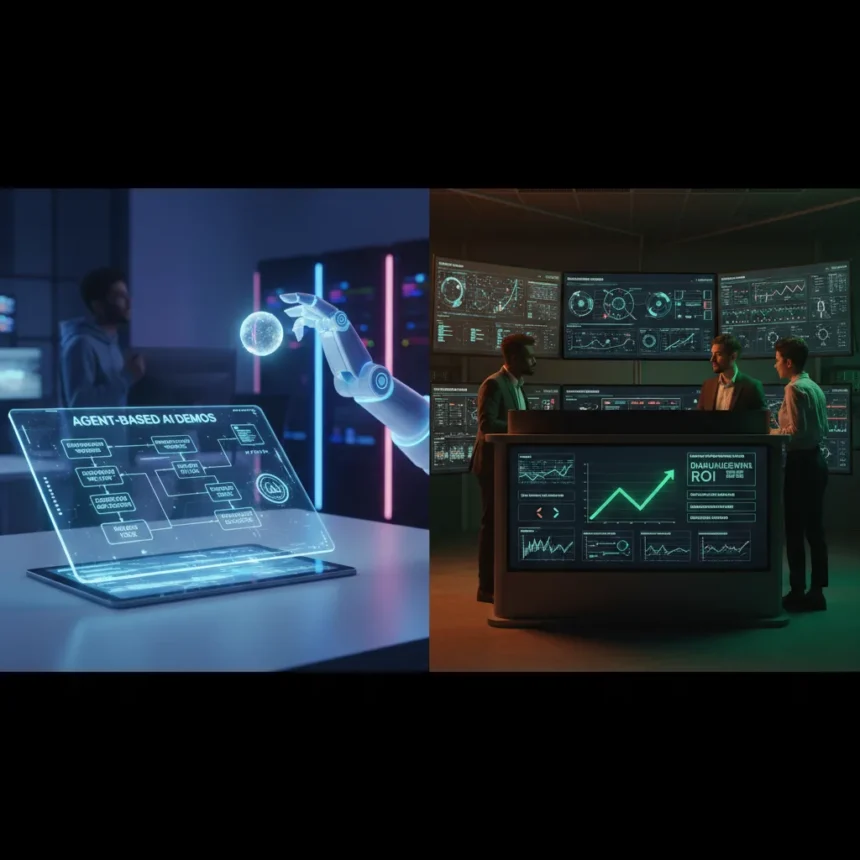
Agent-based AI production systems face a critical credibility gap. While agentic AI demos excel at capturing attention with polished one-off tasks, the transition from showcase to sustainable enterprise operation reveals a harsh reality: most pilots fail to deliver measurable business value without deep workflow integration. The pilot phase for enterprise AI is over, yet organizations are only beginning to understand what agent-based AI production actually demands.
Key Takeaways
- Agent-based AI production requires autonomous operation, multi-step task execution, and continuous background processes—not one-time demonstrations.
- Only 5% of organizations achieve sustained value from AI without core workflow integration, despite 92% planning increased investments.
- 78% of agentic AI automation projects deliver real value when designed as coordinated platforms rather than isolated tools.
- Gartner forecasts 15% of daily business decisions will be autonomous by 2028, but over 40% of agentic AI projects risk failure due to unclear ROI.
- Microsoft estimates 1.3 billion AI agents will be operational by 2028, signaling rapid scaling amid organizational struggles with integration.
The Demo Illusion vs. Production Reality
Agent-based AI production and demo-stage AI are fundamentally different beasts. Demos showcase single, controlled tasks—a chatbot generating marketing copy, an agent summarizing a report, a system drafting an email. These moments dazzle stakeholders and justify budgets. But production demands something far more demanding: autonomous systems operating continuously without human prompts, executing multi-step workflows across departments, reconciling data across systems, and generating incremental ROI that compounds over time. A demo task completes in minutes and shows immediate results. A production system must run invisibly in the background, handling exception cases, integrating with legacy systems, and proving its value through sustained operational gains rather than flashy single outputs.
The gap between agent-based AI production expectations and reality is widening as organizations scale beyond pilots. A 2025 MIT study found that while GenAI adoption exploded, few organizations track measurable outcomes without embedding AI into core workflows. Ninety-two percent of companies plan to increase AI investments over the next three years, yet only 5% achieve sustained value. That chasm exists because demos never test the infrastructure, governance, and organizational change required for production systems to function reliably at scale.
What Agent-Based AI Production Actually Requires
Real agent-based AI production systems must deliver autonomous analysis, cross-system reconciliation, and coordinated multi-agent orchestration—capabilities that go far beyond what a single LLM can provide in isolation. Rather than treating AI as a black box that answers individual queries, production systems treat AI as a platform that coordinates multiple specialized agents, each accessing unique data sources and acting on business systems directly. This architectural shift is not a minor engineering detail; it is the difference between a proof-of-concept and a revenue-generating operation.



The data on this shift is clear: 78% of agentic AI automation projects deliver real value when designed as coordinated platforms. This statistic cuts through the noise around agent-based AI production. Projects that succeed do not treat agents as isolated tools; they embed them into end-to-end workflows where one agent’s output feeds another’s input, and the entire system connects to the business processes that actually matter. A single agent generating content is a demo. Multiple agents coordinating analysis, validation, and action across departments is production. The ROI compounds because the system reduces manual work at every stage, not just one.
By 2028, Gartner forecasts that 15% of daily business decisions will be made autonomously by agentic AI, and 33% of enterprise applications will embed it. Microsoft estimates 1.3 billion AI agents will be operational by that time. These numbers reflect a genuine shift toward production-grade systems, but they also carry a warning: Gartner predicts over 40% of agentic AI projects could fail or be discontinued by 2027 due to unclear ROI and cost escalation. The gap between hype and execution remains enormous.



Integration and Governance: The Hidden Production Costs
Agent-based AI production systems demand integration into core workflows, and that integration is where most projects stumble. Connecting an AI agent to a legacy ERP system, ensuring it handles exceptions gracefully, building governance controls so it does not make catastrophic errors, and training employees to trust its decisions—these are not engineering problems alone. They are organizational problems that require change management, process redesign, and sustained commitment. A demo runs in a sandbox. Production runs in the real world, where every decision has consequences and every failure is visible.
Early agentic AI tools like OpenClaw showcase the ambition of the space—multi-agent code pipelines with programmer, reviewer, and tester agents working in concert. Yet these same tools carry real security risks that organizations must address before deploying them at scale. The gap between latest capability and production readiness remains substantial. Governance frameworks, audit trails, rollback mechanisms, and human oversight checkpoints are non-negotiable for agent-based AI production systems handling sensitive operations, yet many organizations skip these steps to move faster.
The ROI Equation That Separates Success From Failure
Agent-based AI production succeeds when it enables ROI through autonomous analysis, reconciliation across systems, and incremental gains that add to bottom-line impact. This is not about replacing workers or chasing headlines about AI. It is about reducing manual work in processes that matter—reconciling invoices across systems, analyzing customer feedback at scale, scheduling resources across departments, or validating compliance across documents. Each task saved compounds, and the value emerges not in a single dramatic moment but across thousands of small automations.
The organizations that achieve this understand that agent-based AI production is not a technology problem; it is a workflow problem. They map their highest-friction, highest-cost manual processes, identify where agentic AI can genuinely reduce human effort, and design systems to integrate smoothly into existing operations. They measure success not by the sophistication of the AI but by the reduction in manual work and the consistency of the output. This approach is less glamorous than demos that wow boards, but it is the only approach that delivers sustained value.



Can Agent-Based AI Production Scale Responsibly?
The forecasts for agent-based AI production are ambitious—1.3 billion agents by 2028, 15% of business decisions autonomous, 33% of enterprise applications embedding AI. Yet the failure rate is equally sobering: over 40% of projects at risk of discontinuation by 2027. This tension reflects a real challenge in the industry. Organizations want to scale agentic AI, but they lack the governance frameworks, integration expertise, and organizational readiness to do so reliably. The gap between what agent-based AI production can theoretically do and what it can safely do at enterprise scale remains substantial.
Success requires moving past the demo mentality entirely. It means treating agentic AI as a long-term platform investment, not a quick win. It means building integration infrastructure before deploying agents. It means establishing governance and audit mechanisms. It means training teams to work alongside AI systems rather than simply replacing human judgment. These are not exciting messages for boards seeking transformation, but they are the truth about what agent-based AI production actually demands.
Is agent-based AI production ready for enterprise deployment?
Agent-based AI production is ready in specific, well-defined use cases where workflows are mature, data is clean, and integration points are clear. Seventy-eight percent of coordinated agentic AI automation projects deliver real value. However, 40% of projects risk failure due to unclear ROI and cost escalation. The technology exists; the organizational and infrastructural readiness does not always follow.
What makes agent-based AI production different from standard AI tools?
Standard AI tools like content generators or summarizers produce outputs that require manual follow-through. Agent-based AI production systems execute autonomously, coordinate across multiple agents, integrate with business systems directly, and operate continuously without human prompts. The difference is autonomy and integration, not just capability.
Why do so many agent-based AI production pilots fail?
Pilots fail because demos test capability in isolation, not integration into real workflows. A 2025 MIT study found that only 5% of organizations achieve sustained value without embedding AI into core processes. Most projects focus on technology rather than workflow redesign, governance, and organizational change—the factors that actually determine production success.
The future of agent-based AI production belongs to organizations that stop chasing demos and start building platforms. The technology is advancing rapidly, but execution discipline—integration, governance, workflow redesign, and sustained measurement—remains the real bottleneck. By 2028, billions of agents will be operational, but most will run inside organizations that learned this lesson the hard way.
Edited by the All Things Geek team.
Source: TechRadar