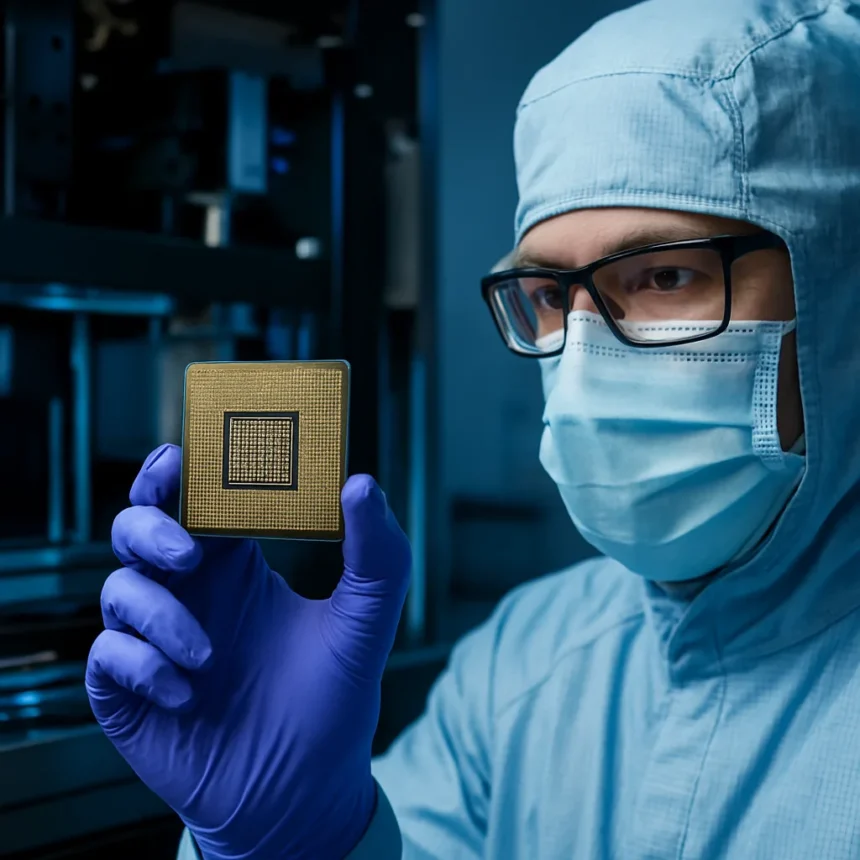
Micron has entered high-volume production of HBM4 memory, shipping samples to customers with pin speeds exceeding 11 Gb/s and delivering a 36GB 12H stack configuration capable of greater than 2.8 TB/s bandwidth. The company delivered HBM4 a quarter earlier than previously forecast, yet this early win masks a far more troubling reality: Micron has been locked out of Nvidia’s Vera Rubin flagship accelerators, where the real money flows.
TL;DR: Micron’s HBM4 memory production launched ahead of schedule with 2.3x bandwidth improvement and 20% power efficiency gains, but the company remains excluded from Nvidia’s premium Vera Rubin supply chain. SK Hynix and Samsung now control the high-margin HBM4 market for Nvidia’s most advanced AI accelerators, leaving Micron to compete in lower-tier segments.
HBM4 memory production reaches high-volume output
Micron’s HBM4 memory has entered mass production with confidence. The company’s CFO Mark Murphy stated that HBM4 yield is on track and the product delivers over 11 gigabits per second speeds, with high confidence in performance, quality, and reliability. The 36GB 12H stack configuration provides greater than 2.8 TB/s of bandwidth—a 2.3x improvement over prior HBM generations—while boosting power efficiency by 20%. Micron has pre-sold all producible HBM4 chips for 2026, signaling strong demand despite market headwinds.
The early production timeline is significant. HBM4 mass production was initially delayed to the end of Q1 2026 due to Nvidia specification revisions requiring per-pin speeds above 11 Gbps and the company’s prioritization of Blackwell demand. Micron’s ability to ship samples ahead of this revised schedule demonstrates manufacturing discipline, yet the timing cannot mask supply chain realities. Samsung claims to have shipped HBM4 first, passing Nvidia tests at both 10 Gbps and 11 Gbps speeds. SK Hynix, though not yet publicly announcing HBM4 production, is expected to control more than 50% of Nvidia’s HBM supply in 2026, with Samsung holding 28%.



Vera Rubin exclusion reveals deeper competitive weakness
Micron’s exclusion from Nvidia’s Vera Rubin flagship HBM4 supply represents a strategic defeat with financial consequences. Vera Rubin accelerators, including the VR200 NVL72 rack configuration with 72 GPUs planned for Q2 2026 launch, rely heavily on HBM4 to achieve greater than 22 TB/s system bandwidth. This is where Nvidia’s most demanding customers—hyperscalers and AI research facilities—will purchase their next-generation compute capacity. Micron is not part of that supply chain.
Instead, Micron may supply HBM4 to Rubin CPX, a mid-tier variant with lower revenue density than flagship Vera Rubin systems. The company’s stock price reflected this reality, declining 6.74% following announcements of its Vera Rubin exclusion. For a memory supplier, losing access to the highest-margin segment of Nvidia’s product roadmap is a strategic setback that early production timelines cannot fully offset. Micron continues to supply HBM3E for Hopper and Blackwell platforms and LPDDR5X for some Rubin roles, but these are lower-margin alternatives.



Supply chain turbulence threatens 2026 HBM4 availability
The HBM4 market faces production headwinds that extend beyond Micron’s competitive position. HBM4 output shortfalls, potential cuts to Rubin wafer production, and TSMC’s reallocation of capacity from H200 to Rubin support may delay shipments by as much as one quarter. Samsung and SK Hynix are racing to meet Nvidia’s escalating specifications—the company raised HBM4 speed requirements to 10 Gbps and above in response to AMD’s MI450 Helios accelerators—while managing yield challenges inherent in latest memory stacks.
Micron’s pre-sold 2026 output ensures revenue certainty, but the company faces a secondary problem: losing China DRAM share to CXMT, a domestic Chinese manufacturer, further narrows its addressable market. The semiconductor memory business rewards scale and ecosystem access. Micron possesses scale but has lost ecosystem access to Nvidia’s most important product launch. This is not a problem that early production or technical excellence can fully solve.
What HBM4 memory means for AI infrastructure in 2026
HBM4 memory is not merely a faster version of HBM3E. The 2.3x bandwidth improvement and 20% power efficiency gains directly translate to higher training throughput and lower operational costs for large language models and other AI workloads. Vera Rubin accelerators, powered primarily by SK Hynix and Samsung HBM4 supplies, will set the standard for AI compute efficiency in 2026 and beyond. Customers choosing between Vera Rubin and AMD Instinct will be comparing systems built on different HBM supply chains, each with distinct performance and availability profiles.
For enterprises and research institutions planning 2026 AI infrastructure investments, this matters. Vera Rubin systems will be available, but supply constraints are real. Micron’s early HBM4 production demonstrates the company has not fallen behind technically, yet technical parity without supply chain inclusion is a hollow victory. The company must now convince customers that mid-tier Rubin CPX systems, powered by Micron HBM4, offer sufficient value despite lacking access to the flagship platform.


Is Micron’s HBM4 production a success or a setback?
Micron’s early HBM4 production is a technical success but a strategic setback. The company delivered samples ahead of schedule and pre-sold its entire 2026 output, demonstrating manufacturing competence and market demand. However, exclusion from Vera Rubin flagship supply limits the financial upside. Micron is producing HBM4 memory for a market where it is not the preferred supplier to Nvidia’s most important customer segment.
Why did Micron lose Vera Rubin HBM4 supply to SK Hynix and Samsung?
The research brief does not explicitly state the reasons for Micron’s exclusion from Vera Rubin HBM4 supply. SK Hynix’s historical dominance in Nvidia HBM supply (expected to hold over 50% in 2026) and Samsung’s claim of first HBM4 shipping likely secured their positions through existing relationships, proven reliability, and capacity commitments. Micron, as a newer entrant to high-bandwidth memory, may have lacked the established supply agreements or production capacity to compete for flagship allocation.
When will Vera Rubin accelerators ship with HBM4 memory?
Vera Rubin accelerators are planned for Q2 2026 launch, though some reports indicate a second-half 2026 timeline. HBM4 mass production was delayed to the end of Q1 2026 due to Nvidia specification revisions and Blackwell demand prioritization, creating potential for further shipment delays. Supply chain constraints, including TSMC capacity reallocation and HBM4 output shortfalls, may push Vera Rubin availability into late summer or later in 2026.
Micron’s HBM4 memory production is real, early, and technically sound. But in the AI accelerator market, technical achievement without ecosystem inclusion is a consolation prize. The company has built the right product at the right time—just for the wrong customer segment. SK Hynix and Samsung will power Nvidia’s flagship Vera Rubin systems in 2026, while Micron supplies the supporting cast. That distinction will define Micron’s AI memory business for years to come.
Edited by the All Things Geek team.
Source: Tom's Hardware