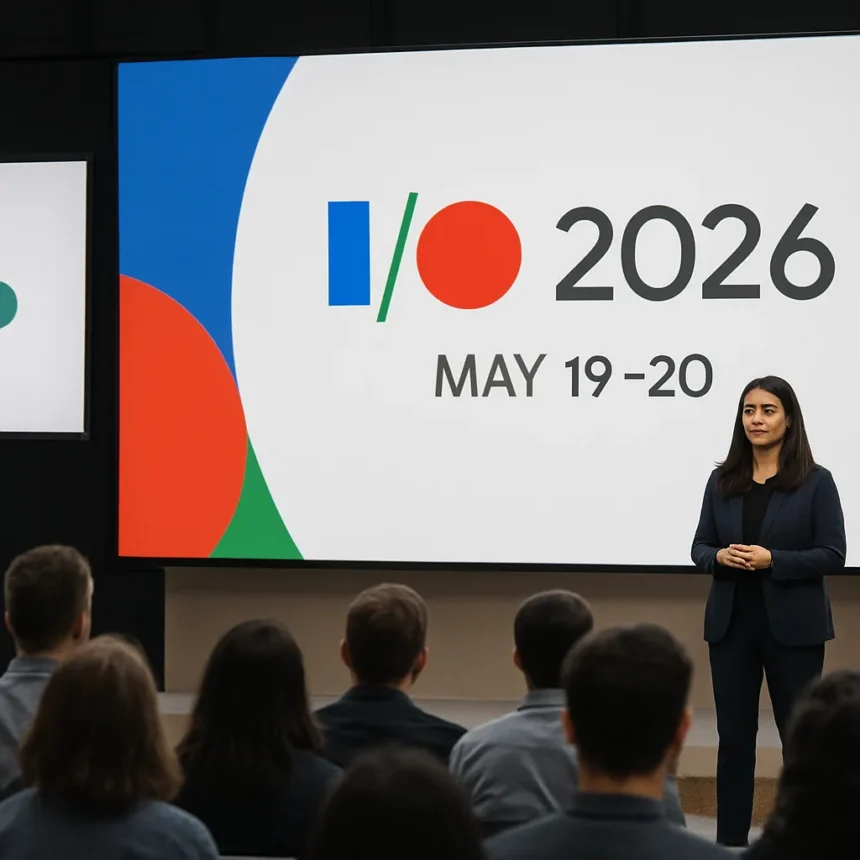
Google I/O 2026 is the company’s annual developer conference scheduled for May 19-20 at Shoreline Amphitheatre in Mountain View, California, and online via livestream at io.google. The event kicks off with keynotes at 10am PT on May 19, featuring announcements on AI breakthroughs, Gemini model updates, Android, Chrome, Cloud, and agentic coding—Google’s push toward AI agents that can autonomously handle complex development tasks.
TL;DR: Google I/O 2026 runs May 19-20 with in-person and online attendance options. Expect major AI and Gemini announcements, interactive developer sessions, and a save-the-date experience featuring AI-powered puzzle games built with Gemini. Registration opens at io.google.
When and where is Google I/O 2026?
Google I/O 2026 takes place May 19-20, 2026, at Shoreline Amphitheatre in Mountain View, California, with simultaneous online access. Keynotes begin at 10am PT on May 19. Developers can attend in-person or register online for livestreams of keynotes, product demos, and sessions across both days. The event is free to access online via io.google, though in-person attendance details remain unspecified.
What are the main focus areas for Google I/O 2026?
Google I/O 2026 centers on AI advancements and developer tools. The agenda emphasizes latest AI breakthroughs, Gemini model updates, Android platform news, Chrome developments, Google Cloud announcements, and agentic coding—a significant shift toward AI systems that autonomously write, test, and deploy code. The conference will feature keynote addresses from Google leaders, fireside chats with industry thinkers, product demonstrations, and Dialogues sessions exploring AI’s future impact. This positioning signals Google’s bet that AI agents, not just AI assistants, will reshape how developers build software.



What’s the save-the-date experience and how does it use Gemini?
Google released an interactive save-the-date experience at io.google featuring five AI-powered puzzle games built entirely with Gemini. The games—Nonogram, Stretchy Cat, Word Wheel, and two others—showcase how Gemini generates game logic and levels dynamically. In Nonogram, level one is a fixed puzzle; levels two and three generate unique boards via Gemini each time you play. Stretchy Cat uses Gemini to create solvable level layouts based on Hamiltonian pathing algorithms, ensuring randomness without unsolvable designs. Word Wheel generates 100 different word-based levels. After completing all five games, players unlock Dino Pal, a virtual pet that Gemini assigns unique personality traits to based on your play style.
The development process reveals how Google uses its own AI tools. The team prototyped games in Google AI Studio, a no-code/low-code environment for non-technical designers to experiment with AI-powered mechanics. They then transitioned to Google Antigravity for agentic development—letting AI handle code generation and refinement at scale. For Dino Pal’s game designer mode, Google AI Studio allowed designers to fine-tune difficulty, game length, and reward systems without touching code. This hands-on demonstration of Gemini’s capabilities in game development directly previews themes the May conference will explore in depth.



How do I register and what sessions are available?
Registration opens at io.google, where developers can sign up for livestream access, view session schedules, and receive updates. The conference offers keynote addresses, product demonstrations, self-directed codelabs (hands-on coding tutorials), guided workshops led by Googlers, and community groups for networking. Attendees can customize their experience by selecting sessions aligned with their interests—whether Android development, Cloud infrastructure, or AI tooling. Online registration is free; in-person ticketing details have not yet been announced.
Why should developers care about Google I/O 2026 right now?
Google I/O 2026 arrives at a critical moment for AI in software development. The save-the-date experience demonstrates that Gemini has matured beyond chat—it now powers level generation, game logic, and adaptive AI behavior in real applications. Agentic coding, the conference’s focal point, represents a shift from AI assistants that suggest code to AI agents that autonomously design, write, test, and deploy entire features. For developers currently using ChatGPT, Claude, or Copilot, Google’s agentic approach could offer a fundamentally different workflow. The conference will detail how Google AI Studio and Antigravity fit into production pipelines, pricing, and competitive advantages over existing tools.
Can I attend Google I/O 2026 online?
Yes. Google I/O 2026 streams entirely online via io.google, making it accessible globally. You can watch keynotes, product demos, and many sessions live from anywhere. Registration is free for online access. In-person attendance at Shoreline Amphitheatre is also available, though specific ticketing and capacity information has not been released.
What makes agentic coding different from AI coding assistants?
Agentic coding refers to AI systems that autonomously handle multi-step development tasks—not just suggesting the next line of code, but planning architecture, writing entire modules, running tests, and even deploying to production. Traditional AI coding assistants like GitHub Copilot excel at single-file completions and function suggestions. Agentic systems operate at a higher level of abstraction, making architectural decisions and executing complex workflows with minimal human intervention. Google I/O 2026 will reveal how Gemini and tools like Antigravity implement this approach and where human oversight remains essential.



What’s new about Google AI Studio and Antigravity?
Google AI Studio is a no-code environment where non-technical team members—designers, product managers, game creators—can experiment with AI-powered mechanics without writing code. Antigravity is Google’s agentic development platform, designed for code generation, refinement, and production deployment at scale. The save-the-date experience used both: AI Studio for prototyping and game design, Antigravity for production-grade agentic development. At Google I/O 2026, expect detailed sessions on integrating these tools into your development workflow, pricing, and how they compare to alternatives in the market.
Google I/O 2026 matters because it signals where Google believes AI development is heading: toward autonomous agents, away from chat-based assistants. The May conference will show whether that bet pays off, and whether Gemini’s agentic capabilities can compete with OpenAI’s o1 and Anthropic’s Claude in real-world engineering scenarios. Developers should register now to catch the keynotes live and secure spots in high-demand workshops on agentic coding and Gemini integration.
Edited by the All Things Geek team.
Source: Android Central