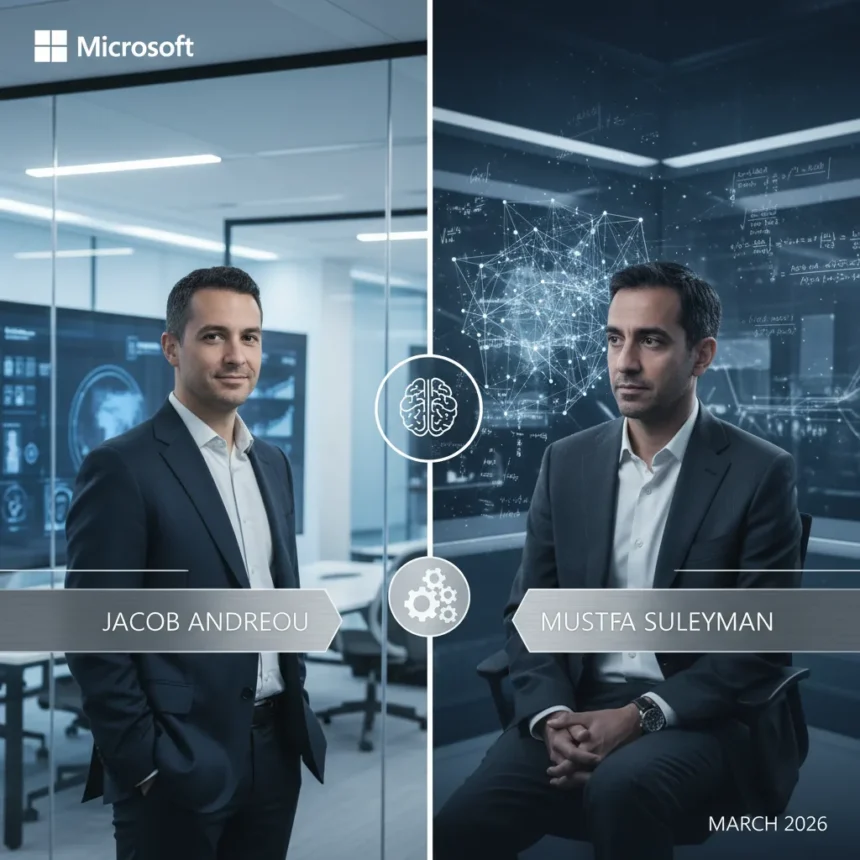
Microsoft’s Copilot leadership reorganization, announced March 17, 2026, reshuffles the company’s AI hierarchy to accelerate superintelligence development while consolidating consumer and commercial Copilot experiences under unified leadership. The restructuring represents a critical inflection point: Mustafa Suleyman, Microsoft’s AI chief, steps back from day-to-day Copilot operations to focus entirely on building world-class models and superintelligence research over the next five years, while Jacob Andreou—formerly at Snap and Microsoft’s product division—takes the reins as Executive Vice President of Copilot.
Key Takeaways
- Jacob Andreou promoted to EVP of Copilot, overseeing design, product, growth, and engineering across consumer and commercial experiences.
- Mustafa Suleyman refocuses on superintelligence, model science, and delivering enterprise-tuned AI lineages for Microsoft.
- Ryan Roslansky, Charles Lamanna, and Perry Clarke lead Microsoft 365 apps and Copilot platform alongside Suleyman’s model-focused work.
- Microsoft’s in-house model development signals a shift away from heavy OpenAI reliance toward independent AI infrastructure.
- Reorganization aligns teams for fiscal year 2027, supporting agentic AI and AI-first product strategy.
Why Microsoft Copilot Leadership Reorganization Matters Now
The timing is everything. As AI agents reshape enterprise software and superintelligence becomes the industry’s obsession, Microsoft needed to untangle its leadership structure. Suleyman has been stretched across both operational Copilot decisions and long-term model research—a split focus that slows progress on either front. By promoting Andreou to handle Copilot’s day-to-day product and experience, Microsoft frees Suleyman to pursue what the company calls “the foundation for our future as a company”: superintelligence. This is not a demotion; it is a reorientation toward where Microsoft believes the real competition will be won.
The reorganization also signals that Microsoft is building toward independence from OpenAI. For years, Microsoft relied on OpenAI’s models to power Copilot. Now, the company is investing heavily in developing its own “enterprise tuned lineages”—custom AI models built specifically for business workflows. That shift requires a dedicated leader focused purely on model science and infrastructure, not product roadmaps or user experience design. Suleyman, with his background at DeepMind and Inflection AI, is the obvious choice for that role.
The New Copilot Leadership Structure Explained
Under the new structure, Microsoft Copilot leadership is organized around four pillars: Copilot experience, Copilot platform, Microsoft 365 apps, and AI models. Jacob Andreou leads the Copilot experience pillar, unifying design, product, growth, and engineering across both consumer and commercial products. This consolidation eliminates the previous split between consumer Copilot (like Copilot.com) and enterprise Copilot (embedded in Office and Microsoft 365), bringing them under one strategic vision.



Ryan Roslansky, who has led LinkedIn since Microsoft’s $27 billion acquisition in 2016 and doubled the platform’s revenue and membership to 1.2 billion users, now oversees Microsoft 365 apps and the Copilot platform alongside Charles Lamanna and Perry Clarke. Roslansky’s appointment signals that Microsoft views Copilot integration into productivity apps as a business-critical priority. Mustafa Suleyman anchors the AI models pillar, focusing on superintelligence research and enterprise-tuned model development. According to Satya Nadella, “Our org boundaries will simply reflect system architecture and product shape such that we can deliver more coherent and competitive experiences that continue to evolve with model capabilities”.
Microsoft’s Shift Toward Independent AI Development
Perhaps the most consequential aspect of this reorganization is what it reveals about Microsoft’s AI strategy. The company is no longer content to be OpenAI’s primary customer. By creating a dedicated leadership structure around in-house model development, Microsoft is building the infrastructure to compete directly in the models space. Suleyman’s singular focus on superintelligence and enterprise-tuned lineages reflects a company-wide bet that the future belongs to organizations that control their own AI foundation models.



This is a departure from Microsoft’s earlier strategy, which treated OpenAI models as the core engine for Copilot. Now, Microsoft is investing in its own research, hiring top talent, and restructuring leadership to ensure that model development is not subordinate to product timelines or commercial pressures. Nadella stated that Suleyman “will continue to lead this high ambition work, reporting to me,” signaling that superintelligence is now a board-level priority. For enterprises considering Copilot adoption, this shift means Microsoft will have greater control over model behavior, pricing, and roadmap alignment with business needs—a potential advantage over relying on external AI providers.
How This Affects Microsoft’s AI-First Strategy
The reorganization is timed for fiscal year 2027, minimizing disruption while maintaining momentum on Microsoft’s AI-first product strategy and agentic AI initiatives. Microsoft is betting that the next wave of competitive advantage will come from AI agents—autonomous systems that can plan, execute, and reason across enterprise workflows. This reorganization ensures that model science, product experience, and platform infrastructure are aligned toward that goal. Instead of competing for resources and priority, the four pillars now report into a unified Copilot Leadership Team that aligns brand strategy, product roadmap, models, and infrastructure.
this reshuffle coincides with Rajesh Jha’s retirement. Jha, who led Experiences and Devices (covering Microsoft 365 and Windows) since 2015, steps down July 1, 2026, with his responsibilities distributed among four new EVPs, including Roslansky, Clarke, Lamanna, and Pavan Davuluri. That broader restructuring suggests Microsoft is rethinking how product divisions interact with AI capabilities. Rather than AI being an add-on to existing products, it is now central to how Microsoft organizes its business.
FAQ: Microsoft Copilot Leadership Reorganization
What is the main reason for Microsoft’s Copilot leadership changes?
Microsoft reorganized Copilot leadership to free Mustafa Suleyman to focus on superintelligence and enterprise-tuned model development, while consolidating consumer and commercial Copilot experiences under unified leadership. The restructuring aligns teams around four pillars—experience, platform, Microsoft 365 apps, and models—to accelerate AI-first strategy and model independence from OpenAI.



Who is Jacob Andreou and why was he promoted?
Jacob Andreou, promoted to Executive Vice President of Copilot, previously served as Chief Vice President of Product and Growth at Microsoft AI and as Senior Vice President at Snap. He now leads Copilot experience across design, product, growth, and engineering for both consumer and commercial products, unifying what were previously separate teams.
Does this mean Microsoft is moving away from OpenAI?
Yes. By creating a dedicated leadership structure around in-house model development and enterprise-tuned lineages, Microsoft is reducing reliance on OpenAI and building toward an “OpenAI-free future”. Mustafa Suleyman’s singular focus on superintelligence and model science signals that Microsoft now prioritizes developing its own foundational AI models.
Closing Takeaway
Microsoft’s March 2026 Copilot leadership reorganization is not just a reshuffle—it is a strategic pivot. By promoting Jacob Andreou to unify Copilot product and experience while freeing Mustafa Suleyman to focus on superintelligence and enterprise-tuned models, Microsoft is signaling that the next phase of AI competition will be won by companies that control their own models. For enterprises evaluating Copilot adoption, this restructuring suggests Microsoft will have greater autonomy, control, and long-term investment in AI capabilities. For the broader AI industry, it signals that even Microsoft—long dependent on OpenAI—is moving toward independence. That shift reshapes the competitive landscape and forces other tech giants to reconsider their own AI strategies.
Edited by the All Things Geek team.
Source: TechRadar