





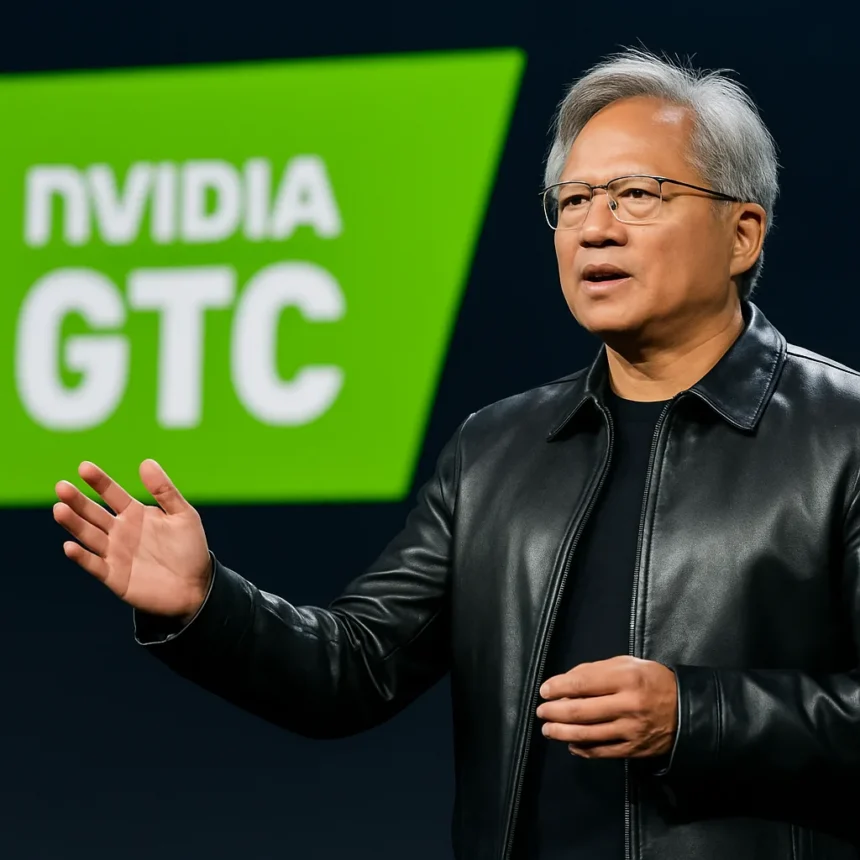
Nvidia GTC 2026 is the annual GPU Technology Conference where Nvidia CEO Jensen Huang sets the agenda for the AI industry. The keynote, scheduled for March 16, 2026, at 11:00 AM Pacific Time in San Jose, was expected to run approximately two hours and cover chips, software, models, and applications across the full AI stack. It is, at this point, the closest thing the tech world has to a state-of-the-union address for artificial intelligence.
TL;DR: Nvidia GTC 2026 positioned Jensen Huang as the industry’s loudest voice on physical AI, agentic AI, and AI factories. The conference drew around 39,000 attendees, signalling that the industry treats these keynotes as must-watch events — not just product launches.
What is Nvidia GTC 2026 and why does it matter?
Nvidia GTC 2026 refers to the 2026 edition of Nvidia’s flagship developer and research conference, held in San Jose. It matters because Huang does not just announce products — he defines the vocabulary the industry will spend the next year arguing about. When he says “AI factories” or “physical AI,” those phrases end up in every competitor’s press release within weeks.
The conference drew approximately 39,000 attendees, a figure that underlines how far Nvidia has moved from being a graphics card company to being the infrastructure backbone of the global AI build-out. Rival events from AMD, Intel, and Qualcomm draw significant crowds, but none currently command the same level of cross-industry attention as GTC. That’s not hype — it’s a reflection of where the money is flowing.



What did Jensen Huang focus on at Nvidia GTC 2026?
Jensen Huang’s keynote at Nvidia GTC 2026 was structured around four core themes: physical AI, AI factories, agentic AI, and inference. Each represents a distinct layer of where Nvidia sees the next wave of AI deployment — not just in data centres, but in robots, autonomous systems, and enterprise workflows that act without direct human instruction.
Physical AI is the most ambitious of the four. It refers to AI systems that interact with and reason about the physical world — think robotics, autonomous vehicles, and industrial automation. This is territory where Nvidia’s hardware advantages are most defensible, because physical AI demands real-time processing at the edge, not just cloud inference. Agentic AI, meanwhile, describes systems that chain together decisions and actions autonomously, without a human approving each step. That’s a significant architectural shift from the chatbot-style AI most consumers have encountered so far.



The emphasis on inference is telling. Training large models is increasingly a solved problem for well-resourced labs, but running those models cheaply and quickly at scale — inference — is where the real commercial battle is being fought. Nvidia’s positioning here is deliberate.
How does Nvidia GTC 2026 compare to previous years?
Compared to earlier GTC events, the 2026 edition signals a maturation of Nvidia’s ambitions. Previous keynotes leaned heavily on raw chip performance announcements and research milestones. The 2026 agenda, with its explicit focus on AI factories and agentic systems, suggests Nvidia is now selling outcomes and infrastructure, not just silicon.
That’s a meaningful shift. AMD has been closing the gap on raw GPU performance for AI workloads, and cloud providers like AWS, Google, and Microsoft are developing their own custom AI chips. Nvidia’s response, visible in the GTC 2026 framing, is to move up the stack — to make Nvidia synonymous with the entire AI deployment pipeline, not just the accelerator inside it. Whether that strategy holds as custom silicon matures is the central question the industry will spend 2026 debating.
Is Nvidia GTC 2026 worth watching for enterprise buyers?
For enterprise buyers, Nvidia GTC 2026 is worth watching precisely because of the agentic AI and AI factory themes. These are not research concepts — they are the architectural decisions that will determine infrastructure spending over the next three to five years. Any organisation planning AI deployments at scale needs to understand the direction Nvidia is pushing, even if they ultimately choose competing hardware.



The two-hour keynote format also signals that Huang is not delivering a product slide deck — he’s making a case for a worldview. That’s either visionary or overreaching, depending on how the next eighteen months of AI deployment actually unfolds.
What is physical AI, and why is Nvidia betting on it?
Physical AI refers to AI systems designed to perceive, reason about, and act within the physical world, as opposed to purely digital or language-based tasks. Nvidia highlighted physical AI as a central pillar of GTC 2026, reflecting the company’s long-standing investment in robotics platforms and autonomous vehicle technology. The bet is that the next major AI market is not another chatbot — it’s machines that do things in the real world.
How many people attended Nvidia GTC 2026?
Nvidia GTC 2026 drew approximately 39,000 attendees, making it one of the largest dedicated AI and GPU technology conferences in the world. That scale reflects the degree to which Nvidia’s roadmap now directly affects hardware buyers, software developers, enterprise architects, and investors across the global tech industry.
When was the Nvidia GTC 2026 keynote?
The Nvidia GTC 2026 keynote was scheduled for March 16, 2026, at 11:00 AM Pacific Time in San Jose. The presentation was expected to last approximately two hours, covering chips, software, models, and applications across Nvidia’s AI portfolio.
Nvidia GTC 2026 is less a product launch and more a statement of intent. Jensen Huang is telling the industry that the next chapter of AI is physical, agentic, and built on infrastructure that Nvidia wants to own end-to-end. Whether competitors can respond fast enough — and whether enterprise buyers will follow Nvidia’s roadmap or hedge with custom silicon — will define the AI hardware market for years to come. The keynote is worth your time, but the real verdict arrives when the products ship.
Edited by the All Things Geek team.
Source: Tom's Hardware




