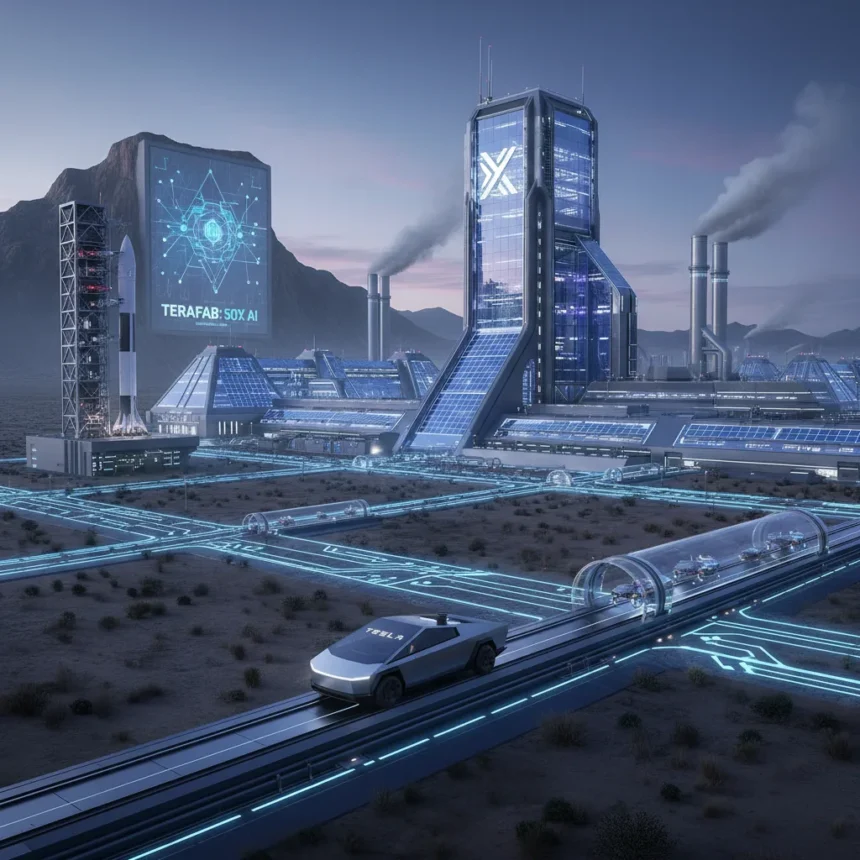
Terafab chip manufacturing represents Elon Musk’s boldest answer to a critical bottleneck: the world simply cannot produce enough AI chips. On March 21, 2026, Musk announced the venture as a joint effort between Tesla, SpaceX, and xAI—unveiled via livestream from a defunct power plant in downtown Austin, Texas. The facility targets one terawatt of annual compute output, roughly 50 times the current global AI chip production from TSMC and Samsung combined.
Key Takeaways
- Terafab chip manufacturing announced March 2026 as Tesla-SpaceX-xAI joint venture targeting 1 terawatt annual compute output
- Facility will consolidate chip design, lithography, fabrication, packaging, and testing under one roof for rapid iteration
- Produces 100-200 billion custom AI and memory chips yearly, 50x TSMC and Samsung’s current AI chip output
- Requires ~100 million square feet (15 Pentagons), far exceeding Giga Texas campus; $20-25 billion total cost
- 80% output destined for space-based AI satellites; 20% for ground robotics including Tesla vehicles and Optimus humanoids
Why Terafab chip manufacturing matters now
Current chip suppliers cannot keep pace with demand. Musk stated the problem bluntly: “That rate [global chip expansion] is much less than we’d like. We either build the TeraFab, or we don’t have the chips, and we need the chips, so we build the TeraFab.” TSMC and Samsung produce roughly 20 gigawatts of AI chip capacity annually. Terafab’s target of 1,000 gigawatts represents not an incremental improvement but a fundamental shift in computing infrastructure. Without it, Musk argues, the scaling ambitions for Tesla’s Full Self-Driving, Cybercab robotaxis, Optimus humanoid robots, and SpaceX orbital data centers simply cannot materialize.
The announcement arrives amid the February 2026 acquisition of xAI by SpaceX, merging three of Musk’s most ambitious technology ventures into a single compute-production ecosystem. This consolidation is not accidental—it reflects a strategic belief that controlling the entire silicon pipeline, from design through packaging, is essential for rapid iteration and custom optimization.
Terafab chip manufacturing: vertical integration at unprecedented scale
What distinguishes Terafab from existing fabs is architectural consolidation. Most semiconductor manufacturing outsources multiple stages to different facilities worldwide. Terafab claims to consolidate chip design, lithography mask production, logic and memory fabrication, packaging, and testing under a single roof. This vertical integration promises design-to-test cycles measured in days rather than months—a competitive advantage for custom silicon tailored to Tesla’s vehicles, SpaceX’s satellites, and xAI’s models.



The facility will produce two distinct chip types. The first optimizes for edge inference in Tesla vehicles, Full Self-Driving systems, Cybercab robotaxis, and Optimus humanoid robots—silicon designed to run efficiently on battery-constrained platforms. The second targets space-hardened applications, engineered to withstand high-energy ions, photons, and electron buildup in orbit, running hotter to minimize radiator mass on satellites and orbital data centers. This dual-track approach reflects Musk’s vision of simultaneous terrestrial and orbital AI scaling.
Scale and infrastructure challenges
Terafab’s sheer footprint exceeds Giga Texas’s capacity. The initial advanced technology fab will occupy Giga Texas North Campus in eastern Travis County, Austin, but the full-scale facility requires thousands of acres—approximately 100 million square feet, equivalent to 15 Pentagons or 3 Central Parks. Production will scale from 100,000 wafer starts per month initially to 1 million monthly, generating 100-200 billion custom AI and memory chips annually.



Power consumption alone presents a constraint. Musk has not publicly disclosed exact power requirements, but a facility targeting 1 terawatt of output will demand infrastructure exceeding 10 gigawatts of electricity—comparable to a large nuclear power plant’s output. Texas’s power grid, despite its scale, will face pressure to accommodate this demand. The project entered funded diligence in March 2026, with geotechnical borings and regulatory meetings underway. Critically, all three proposed projects remain fully funded regardless of diligence outcomes, signaling unwavering commitment despite technical and logistical unknowns.
Orbital compute and the galactic vision
Terafab’s most audacious target is space. Musk envisions 80 percent of output destined for orbital AI satellites with solar panels 5 times Earth’s surface area and vacuum-based heat rejection, while 20 percent serves ground-based robotics. The economics hinge on a near-term prediction: orbital compute will become cheaper than terrestrial compute within 2-3 years due to superior thermal efficiency and renewable solar power. If true, this reshapes where AI inference runs globally.
This orbital focus reflects Musk’s broader vision, articulated as “We’re starting a galactic civilization.” Terafab chip manufacturing is positioned as infrastructure for a multi-planet species, enabling compute scaling through physics and manufacturing efficiency rather than marginal improvements to existing process nodes. It is a rhetorical leap—from semiconductor facility to existential tool—but it frames the project’s ambition beyond quarterly earnings.
Comparison to current suppliers and constraints
TSMC, Samsung, and Micron will remain suppliers to Tesla, SpaceX, and xAI, but Musk argues their expansion rates are insufficient. TSMC’s leading-edge fabs operate at latest process nodes (currently around 3 nanometers in production), but their capacity is constrained by capital intensity, geopolitical risk, and customer diversity. Samsung faces similar pressures. Terafab’s vertical integration and custom-silicon focus offer a different value proposition: rapid iteration and optimization for Musk’s ecosystem rather than serving dozens of competing customers. However, this vertical strategy introduces execution risk—building and operating the world’s largest fab while simultaneously managing Tesla, SpaceX, and xAI is unprecedented in scope.


Timeline and funding reality
No production timeline has been announced. Early reports suggested a “seven days” launch, but this likely referred to the diligence phase, not chip production. Scaling from initial production to 1 million wafers per month typically requires 3-5 years for conventional fabs; Terafab’s unprecedented scale and custom tooling could extend this timeline. The project’s total cost of $20-25 billion has not yet been incorporated into Tesla’s 2026 capex plan, which already exceeds $20 billion. Funding mechanisms and timeline remain opaque, creating uncertainty for investors tracking capital allocation.
Is Terafab chip manufacturing realistic?
Musk called it “the most epic chip building exercise in history by far,” and hyperbole is a trademark of his announcements. Terafab targets are aggressive: 1 terawatt of annual output, 50x current global AI chip production, vertical integration across design-to-test, and space-hardened silicon for orbital deployment. The facility requires skilled labor, regulatory approval, power infrastructure, and flawless execution across multiple complex domains. Musk’s history of optimistic timelines—from Full Self-Driving’s “two years away” to Mars colonization schedules—suggests caution. Yet the funding commitment and xAI-SpaceX merger indicate serious intent, not vaporware.
What happens if Terafab succeeds?
Compute abundance reshapes AI economics. If Terafab delivers even 20 percent of its target, it floods the market with custom silicon optimized for Musk’s ventures while undercutting TSMC and Samsung on cost per inference. Orbital AI compute becomes viable. Optimus humanoid robots scale globally because edge inference chips are available and cheap. Tesla’s autonomous vehicles run full-stack AI inference on-device. SpaceX’s orbital data centers become the default for latency-sensitive inference. This is not incremental progress—it is infrastructure-level disruption.
FAQ
What is Terafab chip manufacturing?
Terafab is a joint venture between Tesla, SpaceX, and xAI announced in March 2026 to manufacture semiconductors at unprecedented scale. It consolidates chip design, fabrication, packaging, and testing in a single facility targeting 1 terawatt of annual compute output, roughly 50 times current global AI chip production.
When will Terafab chip manufacturing start producing chips?
No production timeline has been publicly announced. The project entered funded diligence in March 2026 with geotechnical and regulatory assessments underway. Scaling a conventional fab to full capacity typically requires 3-5 years; Terafab’s unprecedented scale and custom processes could extend this timeline significantly.
How much will Terafab chip manufacturing cost?
The project’s total cost is estimated at $20-25 billion. This has not yet been incorporated into Tesla’s 2026 capex budget. Funding mechanisms and capital allocation timelines remain undisclosed.
Terafab chip manufacturing represents a bet that vertical integration, custom silicon, and sheer production scale can overcome the global AI compute bottleneck. Whether Musk’s vision becomes reality or joins the long list of ambitious announcements that missed their targets remains an open question. What is certain: if it succeeds, the semiconductor industry will never be the same.
Edited by the All Things Geek team.
Source: TechRadar