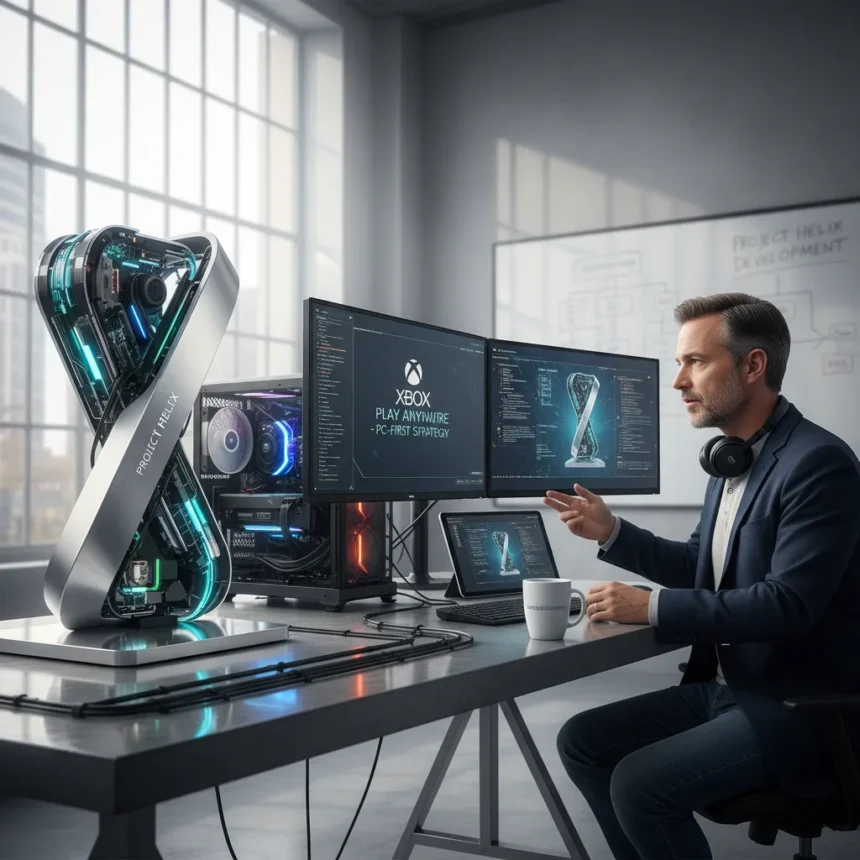
Project Helix console development is shifting how game makers should approach the next generation of Xbox hardware. Microsoft’s publishing leadership is now advising developers to prepare for the console by building directly for Xbox on PC and ensuring their games support Xbox Play Anywhere, a move that signals a fundamental change in how the company views ecosystem compatibility.
Key Takeaways
- Developers should build for Xbox on PC and support Xbox Play Anywhere to ensure native Project Helix compatibility
- Project Helix is powered by a custom AMD SoC with RDNA 5 GPU architecture
- Alpha hardware dev kits ship to developers beginning in 2027; consumer launch expected 2028 or later
- FSR Diamond (next-gen upscaling) is natively integrated into the Game Development Kit
- Unified GDK simplifies development across Xbox console, PC, and Windows platforms
What Project Helix Console Development Means for Developers
The strategy behind Project Helix console development represents a deliberate pivot away from traditional console-exclusive development pipelines. By encouraging developers to build for Xbox on PC first, Microsoft is positioning Windows as the foundational platform for next-generation gaming rather than treating it as an afterthought to console development. This approach reduces friction across storefronts and allows studios to leverage a single codebase across multiple form factors.
The unified Game Development Kit (GDK) sits at the center of this strategy. It simplifies compilation for current-gen Xbox Series X/S while unlocking next-generation features exclusive to Project Helix hardware. Developers can debug graphics directly on Windows PC using console-like tools, such as DirectX file dumps, eliminating the need for expensive hardware-specific workflows. This is a significant departure from past console generations, where PC development and console development often required separate technical pipelines.
Project Helix Console Development Hardware and Architecture
Project Helix console development is built on a custom AMD SoC that delivers what Microsoft describes as an order of magnitude leap in performance and efficiency. The GPU architecture uses RDNA 5, which enables dramatically improved ray tracing performance and power efficiency compared to the current Xbox Series X/S generation. This architectural jump is not merely an iterative refresh—it represents a fundamental rethinking of how console graphics should scale.

The hardware also integrates next-generation DirectX features, including work graphs for GPU-driven code execution and neural texture compression. These technologies are not yet fully supported on current Xbox Series consoles, making them exclusive to Project Helix. Additionally, DirectStorage with Zstd compression accelerates data transfer from SSD directly to GPU, reducing CPU bottlenecks that have limited previous-generation console performance. FSR Diamond (AMD’s next-gen upscaling technology) is deeply baked into the platform, enabling machine learning-based upscaling, ray regeneration for ray and path tracing, and multi-frame generation natively optimized in the GDK.
Xbox Play Anywhere and Ecosystem Convergence
Xbox Play Anywhere is the linchpin of Microsoft’s Project Helix console development strategy. By supporting this feature, developers ensure that games run natively on both Xbox consoles and Windows PCs without requiring separate ports or diminished experiences. This convergence is already being tested on Windows 11 through Xbox Mode, a feature that debuted on Asus ROG Xbox Ally handhelds and is rolling out to Windows 11 starting April 2026 in select markets. Xbox Mode optimizes controller handling and leverages Windows openness while delivering a console-like experience, bridging the gap between traditional console gaming and PC flexibility.
The backward compatibility built into Project Helix console development ensures that the existing Xbox game library continues to function on the new hardware. This is not a given in console transitions—many generational shifts have left previous titles behind or required costly remasters. By maintaining compatibility while unlocking new capabilities, Microsoft is creating a smoother upgrade path for both players and developers.
Timeline and Developer Kit Availability
Project Helix console development is moving into its hardware phase. Microsoft plans to ship alpha versions of the hardware to developers beginning in 2027, with consumer availability expected in 2028 or later. This timeline gives studios roughly a year to familiarize themselves with the hardware before it reaches consumers, a relatively short window compared to previous console generations. The emphasis on PC-first development during this pre-release period is strategic—it allows developers to begin optimizing for Project Helix architecture immediately using the unified GDK, rather than waiting for physical hardware to arrive.
The staggered rollout also reflects the complexity of next-generation console development. Alpha kits are notoriously limited in availability and often come with strict confidentiality agreements. By encouraging PC-based development in parallel, Microsoft is democratizing access to Project Helix console development tools and allowing a broader range of studios to prepare, not just the largest publishers with established hardware relationships.
Why This Matters for the Industry
The shift toward PC-first Project Helix console development is a signal that the traditional console-versus-PC divide is collapsing. Microsoft is essentially saying: build for Windows, optimize for Project Helix hardware, and your game automatically works across Xbox consoles and PCs. This unified approach contrasts sharply with Sony’s PlayStation ecosystem, which still maintains a clearer separation between console and PC development. For independent developers and mid-tier studios, this reduction in friction could lower barriers to next-generation console support.


The emphasis on Xbox Play Anywhere also positions Game Pass as a platform-agnostic service. As more games run natively across Xbox and Windows, the appeal of Game Pass subscription grows—players can start a game on their console and continue on their PC without repurchasing or waiting for ports. This ecosystem lock-in is more valuable than raw hardware performance, and it is precisely what Project Helix console development is designed to enable.
Is Project Helix backward compatible with current Xbox games?
Yes, Project Helix maintains backward compatibility with the existing Xbox game library. This ensures that players’ current collections will work on the next-generation console without requiring remasters or replacements, though some titles may benefit from enhanced performance and graphics when optimized for the new hardware.
When will Project Helix developer kits ship?
Microsoft plans to ship alpha hardware dev kits to developers beginning in 2027. Consumer availability is expected in 2028 or later, giving studios time to optimize games during the alpha and beta phases before public launch.
What is FSR Diamond and why does it matter for Project Helix?
FSR Diamond is AMD’s next-generation upscaling technology natively integrated into Project Helix’s Game Development Kit. It uses machine learning to enable upscaling, ray regeneration for ray and path tracing, and multi-frame generation, delivering higher visual quality at better performance than previous upscaling methods. This deep integration means developers can leverage advanced upscaling without building custom implementations.
The shift toward Project Helix console development represents a watershed moment for the gaming industry. Microsoft is not just building a more powerful console—it is fundamentally restructuring how developers think about platform-agnostic game creation. By prioritizing PC development, embracing Xbox Play Anywhere, and unifying the GDK, the company is betting that the future of console gaming looks less like isolated hardware silos and more like a seamless ecosystem where your code runs everywhere. For developers willing to embrace this approach, the path to next-generation success has never been clearer.
Where to Buy
Edited by the All Things Geek team.
Source: Windows Central