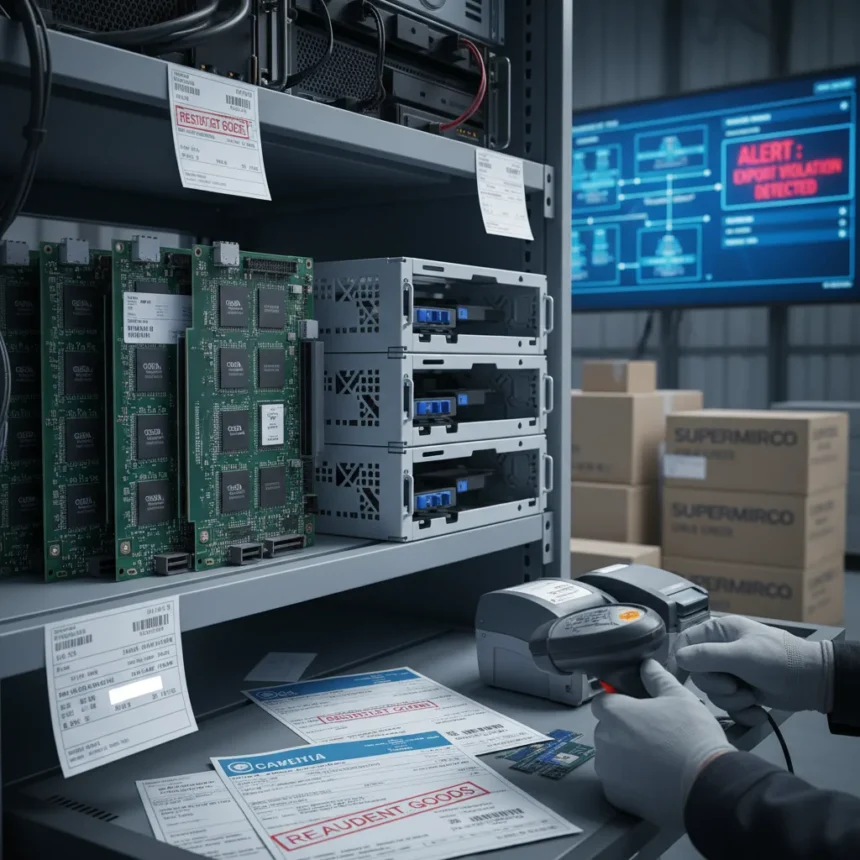
The biggest industrial espionage case in the US-China chip war just became public: three individuals tied to Super Micro Computer face federal charges for orchestrating a sophisticated chip smuggling to China operation that moved restricted Nvidia AI processors through a labyrinth of dummy servers, fake labels, and shell companies, totaling $2.5 billion.
Key Takeaways
- Three Supermicro-linked individuals charged with conspiracy to smuggle restricted Nvidia H100, H200, and B200 chips to China
- Scheme used thousands of non-functional dummy servers to deceive US compliance inspections while real servers shipped covertly
- Surveillance video captured workers using hair dryers to remove labels from real servers and apply them to dummy replicas
- Servers routed through Taiwan and Southeast Asia before reaching China; Supermicro stock fell 8% after charges announced
- US officials described the operation as brazen, exposing gaps in AI chip export enforcement amid escalating tech trade tensions
How the Chip Smuggling to China Operation Worked
The scheme operated with theatrical precision. Servers assembled in US facilities were shipped to Supermicro operations in Taiwan, then transferred to other Southeast Asian countries where they were repackaged in unmarked boxes and diverted to China. The deception layer was equally elaborate: thousands of dummy servers—non-functional replicas—were staged at US manufacturer facilities to satisfy compliance inspections. Real servers, stripped of identifying labels using hair dryers caught on surveillance video, were swapped with the dummies before inspection teams arrived. Once inspectors signed off, the genuine units continued their covert journey to China.
This wasn’t amateur hour. The operation required coordination across multiple jurisdictions, timing precision, and insider knowledge of compliance procedures. Workers understood exactly when inspectors would arrive, how long they would stay, and what documentation would satisfy them. That level of operational sophistication suggests either deep institutional knowledge or external guidance—details prosecutors have not yet disclosed publicly.
Supermicro’s Response and Market Impact
Super Micro Computer moved quickly once charges were announced, placing two employees (Liaw and Chang) on leave and terminating its relationship with contractor Sun. The stock market reacted harshly: Supermicro shares fell 8 percent in after-hours trading. For a company that supplies servers to major cloud providers and AI infrastructure builders globally, even the appearance of complicity in export violations carries existential risk.



Nvidia, which dominates the AI chip market and supplies processors to Supermicro and other server makers, issued a statement emphasizing strict compliance with export laws and warning that unlawful diversion of controlled computers to China is unproductive—the company does not provide service or support for diverted systems, and enforcement mechanisms are rigorous. That language signals both confidence in enforcement and nervousness about supply chain integrity.
What This Reveals About Chip Export Enforcement
The charges arrive against a backdrop of escalating US-China technology restrictions. A 2024 Reuters investigation documented that China had already acquired banned Nvidia chips through Supermicro servers and other channels. This new case suggests that despite tightened regulations and export controls, sophisticated actors continue to find pathways around them.



The brazen nature of the operation—using dummy servers and hair dryer label removal—indicates either confidence that enforcement was weak or desperation to secure AI chips despite restrictions. Nvidia’s H100, H200, and B200 processors are among the most powerful AI accelerators available and command premium prices. For Chinese AI research, cloud providers, and chip development programs, access to these systems represents a critical competitive advantage. The $2.5 billion valuation attached to this scheme suggests the economic stakes justify extraordinary operational complexity.
What remains unclear is whether this case represents an isolated criminal conspiracy or a symptom of systemic vulnerability in how the US monitors chip exports through server manufacturers. Supermicro operates globally and assembles systems across multiple countries. If three individuals could orchestrate this level of diversion, how many other smuggling operations might exist undetected?
Why This Matters Beyond the Courtroom
This enforcement action sends a message, but the message is ambiguous. On one hand, it demonstrates that US authorities are actively investigating and prosecuting chip smuggling to China. On the other hand, the fact that this scheme operated long enough to move $2.5 billion worth of chips suggests detection came late. Export controls are only effective if they actually prevent the controlled goods from leaving—not if they catch smugglers after the fact.
For Supermicro, the reputational damage extends beyond stock price. Cloud providers and enterprise customers now face a choice: trust that the company’s compliance remediation is genuine, or diversify to competing server manufacturers. That competitive pressure benefits other server makers, particularly those without public smuggling scandals attached to their names.


Is Supermicro complicit or a victim of internal conspiracy?
Supermicro has not been charged with crimes; the charges target three individuals. The company’s rapid response—placing employees on leave and terminating the contractor—suggests it views this as an internal breach rather than institutional policy. However, the sophistication of the scheme and its scale raise questions about whether three people alone could have executed it without broader organizational awareness or tacit approval from management. Those details will likely emerge during prosecution.
What happens to the smuggled chips already in China?
Once Nvidia H100, H200, and B200 chips reach China, they are nearly impossible to retrieve. Nvidia stated it provides no service or support for diverted systems, meaning those chips operate in isolation from software updates, technical support, and ecosystem integration. That limitation reduces their utility but does not eliminate it—a restricted AI chip in China is still a restricted AI chip, advancing Chinese AI research regardless of support status. Prosecution may deter future smuggling, but it cannot reverse the chips already delivered.
Could this happen again?
Yes. The fundamental tension remains: Nvidia chips are extraordinarily valuable, export controls are restrictive, and the profit incentive for smuggling is enormous. As long as US restrictions prevent China from purchasing these chips legally, illegal diversion will remain attractive to actors willing to accept prosecution risk. The real test of enforcement is whether this case and others like it raise the cost of smuggling high enough to deter it—or whether it simply moves the operation to different people, companies, and routes.
The Supermicro chip smuggling to China case exposes both the sophistication of modern technology espionage and the difficulty of enforcing export controls in a globalized supply chain. Three individuals, dummy servers, and hair dryers moved $2.5 billion worth of restricted AI processors across borders. That they were caught is progress. That they got as far as they did suggests the real work of enforcement has only begun.
Edited by the All Things Geek team.
Source: TechRadar