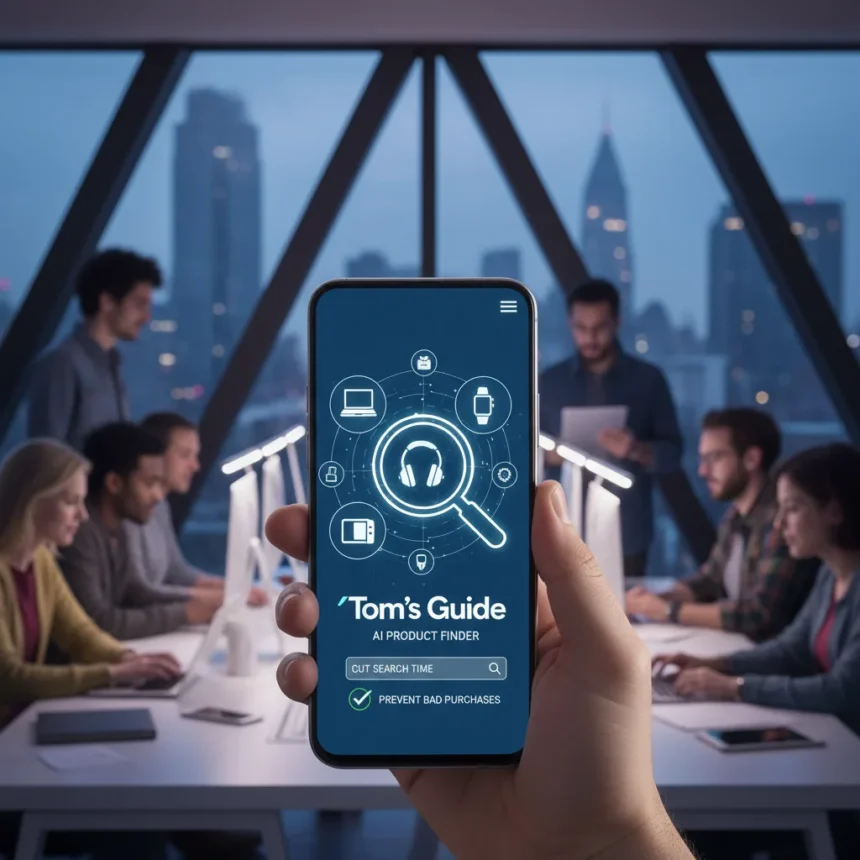
Tom’s Guide launched its biggest relaunch in over a decade, introducing an AI product finder tool designed to solve one of shopping’s most persistent problems: wasting hours finding the right product only to regret the purchase. The new AI product finder uses editorial testing data to filter products specifically for value, starting with an interactive TV selector that cuts through marketing noise and retailer confusion.
Key Takeaways
- Tom’s Guide’s AI product finder filters TVs and other products based on editorial testing and value metrics
- Leap-O-Meter compares owned devices to show upgrade value and live deals
- New design emphasizes smarter shopping, expert answers, and clarity to avoid bad purchases
- TikTok integration streams 400,000+ followers’ unboxings and buy/don’t-buy opinions on homepage
- Partnership with OpenAI provides ChatGPT content access and AI-powered article recommendations
Why Tom’s Guide Built an AI Product Finder
Shopping online has become exhausting. Endless product listings, conflicting reviews, and aggressive marketing make it nearly impossible to distinguish genuine value from hype. Tom’s Guide’s Editor in Chief, who has led the publication since 2013, framed the relaunch as a direct response to this friction: “This is by far the biggest relaunch in our history”. The AI product finder targets this exact pain point by combining artificial intelligence with years of hands-on editorial testing.
The tool doesn’t simply recommend products—it filters them through Tom’s Guide’s established review methodology, which uses a five-star scale where one star means very poor and five stars means best of the best. This means recommendations come with editorial credibility, not just algorithmic ranking. The AI product finder initially launches with TVs, but the infrastructure suggests broader product categories will follow.
How the AI Product Finder Compares to Existing Shopping Shortcuts
Shoppers already use AI to make better purchasing decisions. Some screenshot Amazon product pages and ask ChatGPT to analyze pros and cons or compare value across multiple listings. However, ChatGPT cannot read live web pages in real time, so users must manually copy review text and specifications—a process that defeats the purpose of saving time. Perplexity has earned praise among AI shoppers for finding deals more efficiently, though it lacks the editorial testing foundation that Tom’s Guide brings to its AI product finder.



Tom’s Guide’s advantage lies in combining AI filtering with pre-tested products. Rather than relying on algorithmic ranking or user-generated reviews, the AI product finder weights recommendations based on Tom’s Guide’s own testing results. This creates a middle ground between generic AI shopping assistants and traditional product review sites.
The Leap-O-Meter and Upgrade Clarity
Beyond the AI product finder, Tom’s Guide introduced the Leap-O-Meter, a tool that compares devices you currently own (say, an iPhone 14) against newer models to show whether an upgrade is worth the cost. The tool generates a “Leap Score,” upgrade summaries, and displays live deals for both the device you own and its successor. This directly addresses upgrade fatigue—the tendency to buy new tech unnecessarily when the old device still works fine.



The Leap-O-Meter is particularly useful for consumers paralyzed by choice. Instead of researching whether moving from one generation to the next justifies the expense, the tool automates the comparison and surfaces real-time pricing, removing guesswork from upgrade decisions.
Redesign Includes TikTok and Specialty Newsletters
Tom’s Guide’s relaunch extends beyond the AI product finder. The homepage now streams TikTok videos from the publication’s 400,000+ followers, showcasing unboxings, tests, and candid buy/don’t-buy opinions. This reflects how younger audiences consume tech content and signals that Tom’s Guide is adapting its distribution beyond traditional articles.
The publication also relaunched its daily newsletter and introduced specialty editions, including “AI Insider,” a newsletter focused on demystifying AI innovations for mainstream audiences. These moves position Tom’s Guide as a concierge service rather than just a review archive.
OpenAI Partnership and AI-Powered Recommendations
In December 2024, Tom’s Guide partnered with OpenAI to access ChatGPT content and integrate AI-powered article recommendations into its site. The publication uses an “Advisor” tool, built on OpenAI’s language model, to analyze articles and suggest relevant reads to visitors. This automation helps readers navigate Tom’s Guide’s expanding coverage of fitness, home appliances, smart home, streaming, and AI—categories the site has expanded into beyond traditional gadgets.


Will the AI Product Finder Actually Change How People Shop?
The real test is whether the AI product finder reduces decision fatigue in practice. Tom’s Guide’s claim that the tool connects readers “with the experts and information you need to upgrade your life” is ambitious, but the underlying logic is sound: editorial testing data, when filtered through AI, can surface value that algorithmic ranking misses. The initial focus on TVs—a category where confusion between picture quality, refresh rates, and price is genuinely high—is a smart starting point.
However, the AI product finder’s success depends on whether Tom’s Guide keeps its testing standards transparent and its recommendations free from commercial bias. A tool that appears to favor high-margin products over genuine value would undermine the entire premise.
Does the AI product finder work for all product categories?
The AI product finder currently focuses on TVs, though Tom’s Guide’s infrastructure suggests expansion to other categories is planned. The tool’s effectiveness depends on having sufficient editorial testing data for each category, which means rollout will likely be gradual.
How does the AI product finder differ from ChatGPT shopping advice?
ChatGPT requires users to manually copy product information and cannot read live web pages, making it slower and less current than Tom’s Guide’s AI product finder, which integrates real-time pricing and editorial test results. The AI product finder is purpose-built for shopping, while ChatGPT is a general-purpose tool.
Is the Leap-O-Meter available now?
The Leap-O-Meter is described as a developing tool as part of Tom’s Guide’s relaunch, suggesting it may not be fully live across all device categories yet. Readers should check Tom’s Guide directly for current availability.
Tom’s Guide’s relaunch signals a shift in how tech publications add value in an AI-saturated world. Rather than competing on review volume or speed to publish, the publication is betting that combining editorial expertise with AI filtering creates something neither humans nor algorithms can achieve alone. Whether that bet pays off depends on execution—and whether readers trust that the AI product finder prioritizes their interests over commercial partnerships. For now, the AI product finder represents a genuine attempt to solve a real shopping problem, even if its long-term impact remains uncertain.
Edited by the All Things Geek team.
Source: T3