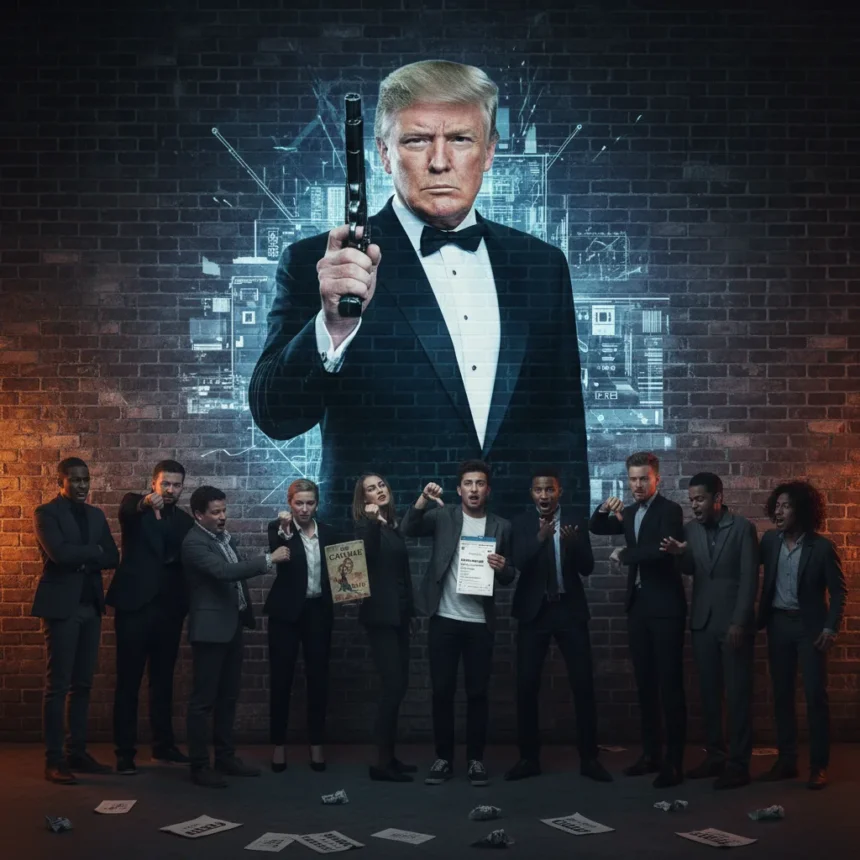
The Trump AI James Bond image represents something far worse than a bad meme—it’s a calculated political stunt that weaponizes generative AI to blur the line between satire and propaganda. When the White House shared an AI-generated image of Donald Trump dressed as 007, complete with spy thriller aesthetics, the goal was obvious: provoke, distract, and own the narrative around AI imagery in politics. As a design and culture observer, what offends isn’t the image itself—it’s what it reveals about how political teams now treat iconic cultural properties.
Key Takeaways
- The White House released an AI-generated image depicting Trump as James Bond to spark viral engagement and political messaging.
- The Trump AI James Bond image appropriates Bond iconography without consent from the franchise or creative community.
- Design critics argue the stunt trivializes both the Bond mythos and the serious conversation about AI-generated political imagery.
- This follows a pattern of White House AI stunts designed to provoke rather than communicate policy.
- The image demonstrates how political teams use generative AI as a tool for cultural appropriation and narrative control.
Why the Trump AI James Bond image matters right now
Political AI imagery is no longer a fringe experiment—it’s a mainstream tactic. The Trump AI James Bond image isn’t the first time the White House has deployed generative AI for political messaging, and it won’t be the last. What makes this moment significant is the brazenness. By inserting Trump into one of cinema’s most recognizable franchises, the stunt doesn’t just create a meme—it stakes a claim on cultural property itself. The image trades on decades of Bond brand equity without permission, without irony, and without acknowledging that James Bond is, fundamentally, the opposite of Trump: a character defined by restraint, intelligence, and moral complexity.
The timing is deliberate. In an era where AI-generated imagery dominates social media discourse, dropping a Trump-as-Bond image guarantees viral spread and heated debate. That’s the entire point. Political teams now understand that controversy itself is the product—the image doesn’t need to be good or clever. It just needs to be provocative enough to dominate the news cycle and force critics to engage on the stunt’s terms.
The Trump AI James Bond image trivializes both Bond and AI discourse
Here’s what bothers design and culture critics about the Trump AI James Bond image: it treats both the Bond franchise and generative AI as tools for political theater rather than as things worthy of serious engagement. Bond fandom is built on a specific aesthetic and narrative tradition. The character represents a particular vision of espionage, style, and moral authority. Dropping Trump into that context doesn’t create clever commentary—it just creates noise. It’s appropriation masquerading as meme culture.



At the same time, the Trump AI James Bond image weaponizes generative AI in a way that should concern anyone paying attention to how this technology gets deployed. When political teams use AI to create imagery designed to provoke and distract, they’re not advancing the conversation about AI’s potential or risks. They’re using it as a propaganda tool. The image becomes a case study in how generative AI can be weaponized for narrative control, not innovation or insight.
Trump AI James Bond image sits in a larger pattern of political AI stunts
The Trump AI James Bond image didn’t emerge in a vacuum. It’s part of a deliberate strategy by Trump’s political apparatus to normalize AI-generated political imagery and use it as a weapon against critics. Each stunt—whether it’s AI artwork, deepfakes, or manipulated imagery—serves the same purpose: desensitize the public to AI-generated content and establish plausible deniability around its authenticity. By the time voters encounter genuinely misleading AI imagery, they’ll already be conditioned to shrug and move on.



What makes the Trump AI James Bond image particularly cynical is that it works on multiple levels. For supporters, it’s a fun, powerful image that shows Trump as a cool action hero. For critics, it’s a transparent attempt to appropriate cultural icons for political gain. For the broader public, it’s just another viral image to scroll past. That multiplicity of interpretation is exactly what makes it effective propaganda.
Should design professionals be concerned about the Trump AI James Bond image?
Yes. The Trump AI James Bond image represents a direct threat to creative professionals and intellectual property. When political entities can generate imagery that appropriates cultural properties without permission or compensation, it sets a dangerous precedent. It signals that generative AI can be deployed to exploit the work of designers, filmmakers, and artists without accountability. The Bond visual language—the tuxedos, the gun barrel sequence, the sleek typography—represents decades of creative work. Appropriating it for a political stunt dismisses that labor entirely.
For designers and creatives, the Trump AI James Bond image is a warning. If political teams can get away with using AI to appropriate iconic cultural properties for messaging, what’s to stop corporations, bad actors, or other political entities from doing the same? The image is a test case in how far you can push AI appropriation before facing meaningful pushback. So far, the answer appears to be: very far indeed.
Does the James Bond franchise have any say in the Trump AI James Bond image?
The source material does not specify whether the James Bond franchise or its parent company EON Productions issued any official response to the Trump AI James Bond image. What is clear is that the image was created and distributed by the White House without any apparent collaboration with or consent from the Bond franchise. This silence—whether strategic or legal—speaks volumes about the power imbalance between political entities wielding AI tools and cultural institutions trying to protect their intellectual property.


Why is the Trump AI James Bond image getting so much attention?
The Trump AI James Bond image is designed to be attention-grabbing, and it succeeds. It combines three elements that guarantee engagement: a controversial political figure, an iconic cultural property, and latest AI technology. The image forces viewers to take a position: either you find it funny and powerful, or you find it offensive and cynical. There’s no neutral ground. That’s exactly why it was created. Political teams understand that in the attention economy, controversy is currency. The Trump AI James Bond image doesn’t need to persuade anyone—it just needs to be talked about.
The real issue with the Trump AI James Bond image isn’t that it exists—it’s what its existence signals about the future of political messaging. When AI-generated imagery becomes normalized as a tool for political theater, we’ve crossed a threshold. We’re no longer debating whether generative AI should be used for political purposes. We’re watching it become standard practice. The Trump AI James Bond image is just the beginning of a much larger problem.
Edited by the All Things Geek team.
Source: Creativebloq