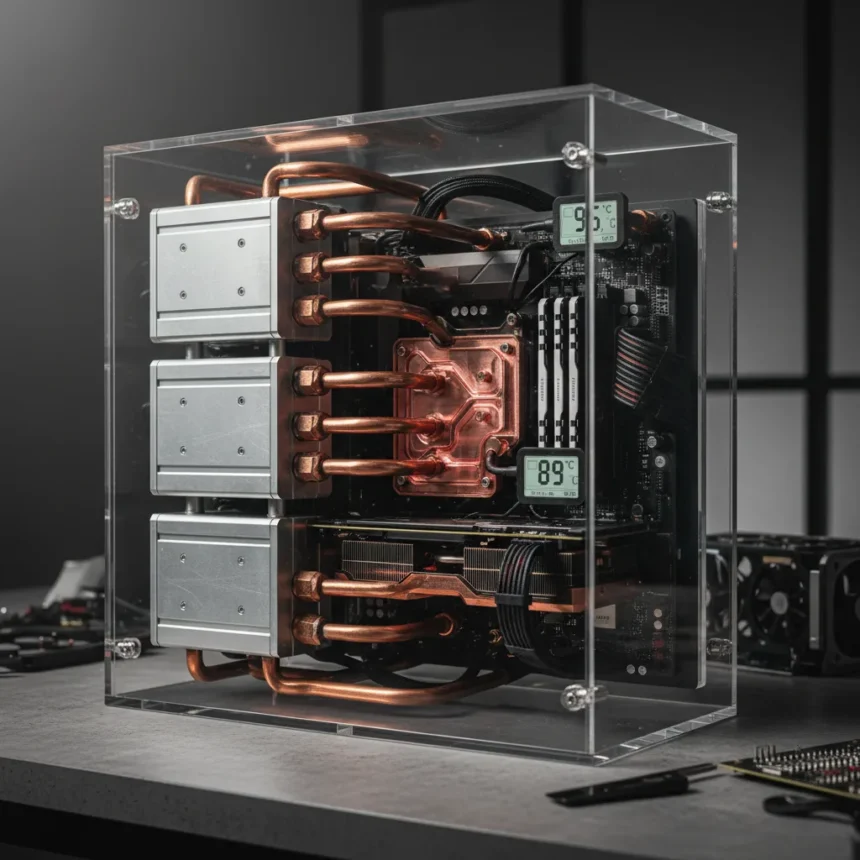
A passive water-cooled PC built by London-based Billet Labs demonstrates both the ambition and the hard limits of fanless cooling in modern gaming hardware. The system features a Ryzen 9800X3D processor paired with an NVIDIA GeForce RTX 5080, cooled entirely by natural convection through a custom triple-stacked radiator arrangement—no fans, no active airflow, just physics and copper.
Key Takeaways
- Billet Labs created a completely fanless gaming build using passive water cooling and a chimney-effect radiator stack.
- The system relies on natural convection through copper radiators stacked vertically to move heat upward.
- Despite the engineering effort, the build struggles to maintain acceptable temperatures under gaming loads.
- Passive cooling works for low-power systems but breaks down with high-end CPUs and GPUs like the 9800X3D and RTX 5080.
- The project showcases innovative cooling architecture but reveals why active cooling remains essential for performance gaming.
How the Passive Water-Cooled PC Actually Works
The passive water-cooled PC uses a design principle that relies on the chimney effect—heat absorbed by the liquid in the cooling loop causes it to become less dense and rise naturally through the system. The three stacked radiators are arranged vertically so that hot coolant flows upward through them, shedding heat to the surrounding air through convection alone. No pump noise, no fan hum, just silent thermal dissipation powered by temperature differentials.
The entire loop is constructed from copper, a material chosen for its superior thermal conductivity compared to aluminum. Copper transfers heat away from the CPU and GPU die more efficiently, giving the passive design its best possible chance. The vertical stack arrangement maximizes surface area exposure while taking advantage of natural airflow patterns that develop as warm air rises away from the radiators. This architectural choice is the core innovation—stacking radiators to create a tall thermal chimney rather than spreading them horizontally.
Why Passive Water-Cooled PC Designs Fail Under Real Gaming Loads
The critical weakness emerges when the system actually has to dissipate the heat a 9800X3D and RTX 5080 generate under sustained gaming. Both components are high-performance chips designed to run hot, and their thermal output exceeds what natural convection can reasonably handle. The passive water-cooled PC struggles to keep temperatures down because the amount of heat energy being produced outpaces the rate at which passive convection can move it away from the hardware.


Passive cooling works acceptably for low-power systems—a silent office PC or a light workstation benefits from fanless operation because the thermal load is modest. But gaming demands sustained high clock speeds and power draw. The RTX 5080 alone can dissipate 320 watts under load, and the 9800X3D adds another 120+ watts. A passive water-cooled PC simply cannot move that much heat fast enough without active airflow. The chimney effect helps, but it is not enough. Thermal throttling becomes inevitable, performance drops, and the entire premise of a high-end gaming build breaks down.
Passive Water-Cooled PC vs. Active Cooling: Why This Matters
Traditional gaming PCs use multiple case fans and GPU fans to force air through radiators at high velocity, dramatically increasing heat transfer rates. A single 120mm case fan can move 50-100 cubic feet of air per minute; a passive system has zero. The temperature delta between a passive water-cooled PC and an actively cooled equivalent running the same hardware can easily exceed 20-30 degrees Celsius under load. That difference is the difference between stable gameplay and throttled performance.



The trade-off is silence. An actively cooled system produces audible fan noise, even with quality components. The passive water-cooled PC offers complete silence—a genuinely appealing goal for enthusiasts who prioritize acoustics. But that silence comes at a price: you cannot run high-end gaming hardware without accepting thermal limitations. Billet Labs’ project is honest about this. The build is presented as a showcase of what is technically possible, not as a practical recommendation for anyone who wants their 9800X3D and RTX 5080 to perform at full potential.
Can Passive Cooling Ever Work for Gaming?
Passive cooling remains viable only in narrow use cases. A passive water-cooled PC makes sense for a silent media server, a low-power workstation, or a retro gaming emulation box. It does not work for modern AAA gaming at high frame rates and settings. The physics simply do not align. You can engineer the most elegant chimney-effect radiator stack on earth, use the best copper components available, and optimize every thermal pathway—and you still cannot overcome the fundamental limitation that natural convection is slow compared to forced airflow.
Enthusiasts sometimes pursue passive cooling as a design challenge or artistic statement rather than a practical goal. Billet Labs’ build falls into this category. The engineering is sophisticated, the execution is clean, and the visual presentation is likely striking. But the honest assessment is that the system compromises gaming performance to achieve silence. For most users, that trade-off does not make sense when a well-designed active cooling solution can deliver both quiet operation and thermal stability.
What Would It Take to Make Passive Cooling Viable?
To make a passive water-cooled PC work with high-end gaming hardware, you would need either dramatically lower-power components or an absurdly large radiator array. A passive system built around a mid-range processor and a lower-power GPU might succeed. Or, you could build radiators the size of a small refrigerator—but then you have sacrificed practical case design for thermal performance, defeating the purpose of going fanless in the first place.



The reality is that passive cooling and gaming-tier performance are fundamentally at odds. The Billet Labs project proves this by attempting it anyway and hitting the thermal ceiling. That is valuable information for the enthusiast community. It shows where the boundary lies and why active cooling has remained the standard for nearly three decades.
Does passive cooling work for gaming PCs?
Passive cooling does not work reliably for gaming PCs with modern high-performance CPUs and GPUs. Systems like the 9800X3D and RTX 5080 generate too much heat for natural convection to handle. Passive designs excel in low-power applications but cause thermal throttling and performance loss in gaming scenarios.
What is the chimney effect in PC cooling?
The chimney effect is a passive cooling principle where hot liquid becomes less dense and rises naturally through vertical radiators, carrying heat away without a pump or fans. It relies on temperature differentials to create airflow, but the effect is slow and only works for low-thermal-load systems.
Why did Billet Labs build a fanless PC if it struggles?
Billet Labs built the passive water-cooled PC as a technical showcase and proof-of-concept, not as a practical gaming solution. The project demonstrates the limits of fanless cooling architecture and serves as an honest assessment of what is and is not possible with natural convection, even with premium copper construction and clever radiator stacking.
The passive water-cooled PC is a fascinating engineering exercise that ultimately reinforces why active cooling dominates gaming builds. Silence is appealing, but not at the cost of performance. Billet Labs’ ambitious design proves that some engineering challenges cannot be solved with clever architecture alone—sometimes the laws of thermodynamics simply win.
Edited by the All Things Geek team.
Source: Tom's Hardware