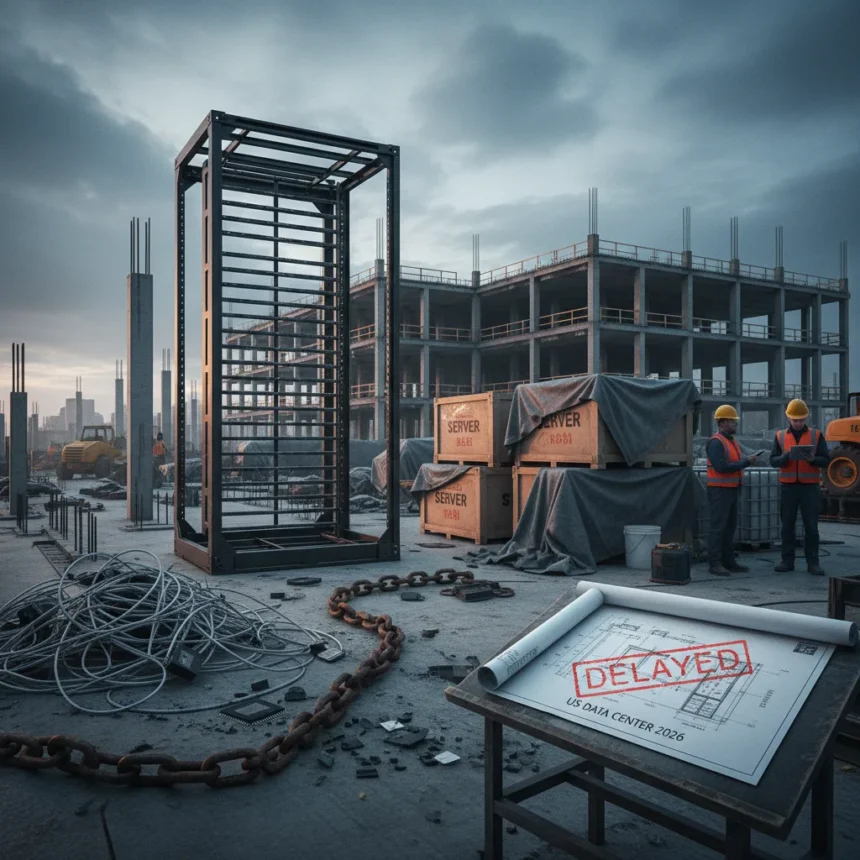
US data center delays have reached a crisis point. Nearly half of all data centers planned for 2026 have been canceled or delayed, according to supply chain analysis, as a cascade of logistics failures threatens the infrastructure backbone of the AI boom. The core problem is brutal in its simplicity: if one piece of your supply chain is delayed, then your whole project can’t deliver.
Key Takeaways
- Nearly 50% of US data centers planned for 2026 have been canceled or delayed due to supply chain failures.
- A single component delay—materials, transport, or manufacturing—halts the entire project delivery.
- Transport delays compound across all trades, cutting labor utilization and straining inventory strategies.
- Manufacturer delays stem from human error, faulty machinery, tariffs, and geopolitical shocks.
- Conditions are expected to worsen without improved contingency planning and supplier diversification.
Why US Data Center Delays Matter Right Now
The data center expansion race is not theoretical. AI companies, hyperscalers, and enterprise operators are racing to build compute capacity, and every month of delay costs millions. Yet nearly half of 2026 projects are stalling before they even break ground. This is not a minor logistics hiccup—it signals that the infrastructure required to power the next generation of AI services is fragile, undiversified, and vulnerable to cascading failure.
The problem is structural. When a single supplier fails to deliver a critical component on time, the entire project stalls. Manufacturers, shippers, and construction crews all sit idle, waiting. Labor costs mount. Schedules slip. Other projects compete for the same constrained resources, driving prices higher. What begins as a two-week delay in one shipment becomes a three-month delay across the whole site.
How Supply Chain Fragility Breaks Data Center Projects
Transport delays alone create a domino effect that touches every part of a data center build. Late material deliveries slow site progress, increase downtime across trades, weaken procurement planning, drop labor utilization, and strain inventory strategies. A contractor who planned to pour concrete in week four now waits until week seven. The crew assigned to that task moves to another project. When the materials finally arrive, those workers are unavailable, forcing another delay.


Manufacturer delays compound the problem. Human errors in production, faulty machinery, tariffs imposed on critical components, and global externalities like geopolitical tensions all trigger domino effects across the supply chain. A semiconductor fab in Taiwan delays shipments by a month due to power rationing. The data center operator in Virginia who ordered those chips now cannot install their networking equipment. The project slips.
Construction supply chains fail for three primary reasons: lack of contingency planning, primary supplier difficulties (delays, quality issues, capacity problems), and communication breakdowns. Most data center operators work with a small number of trusted suppliers to control costs and maintain consistency. When one of those suppliers falters, there is no backup. Diversifying suppliers takes time and money that operators assumed they did not need to spend.



Logistics Risks Are Accelerating
Port closures, carrier capacity constraints, and unpredictable transit times have become routine. Freight costs are rising. Missed deliveries are multiplying. A container of cooling equipment scheduled to arrive in Los Angeles gets rerouted to Oakland due to port congestion. The delay cascades backward through the supply chain. Manufacturers hold inventory longer. Shippers lose capacity to other customers. By the time the equipment reaches the data center site, the project schedule is broken.
Supply chain delays impact all participants—manufacturers, suppliers, shippers, and customers. Some delays are internal: inefficient processes, human error, or cyberattacks on logistics networks. Others are external: weather events, labor strikes, or geopolitical disruptions. A data center operator cannot control a hurricane that shuts down a port for two weeks. But they can plan for it, and most do not.
Why Things Could Get Worse
The prognosis is troubling. Conditions are expected to worsen without structural changes to how data center supply chains are built. Tariff pressures, semiconductor shortages, and competition for constrained logistics capacity all point to tighter conditions ahead. As more data centers race to be built simultaneously, suppliers face impossible demand. Prices rise. Lead times stretch. Projects fail.
The solution requires contingency planning, supplier diversification, and transparent communication across the entire supply chain. But these measures cost money upfront and take time to implement. In a race to deploy AI infrastructure, operators are tempted to cut corners, rely on single suppliers, and assume the best. Nearly half of 2026 projects are paying the price for that gamble.



What Does This Mean for the AI Infrastructure Race?
The US data center delays reveal a hard truth: infrastructure cannot scale as fast as demand. AI companies need compute capacity now. But building data centers requires reliable supply chains, and those chains are broken. The projects that survive 2026 will be those with diversified suppliers, contingency plans, and realistic timelines. The rest will slip into 2027, 2028, and beyond.
This is not just a problem for data center operators. It is a problem for every company waiting for AI infrastructure to scale. Delays in data center buildout translate to delayed AI service launches, higher compute costs, and competitive disadvantages for companies that cannot secure capacity. The supply chain crisis is the infrastructure crisis.
Can Supply Chain Fragility Be Fixed?
Yes, but it requires investment and discipline. Operators need to map their entire supply chains, identify single points of failure, and build redundancy. They need to work with suppliers to establish realistic timelines and communicate transparently about risks. They need to hold contingency budgets for the inevitable disruptions. Most importantly, they need to stop treating supply chain resilience as a cost center and start treating it as a competitive advantage.
The data center operators who will succeed in 2026 and beyond are those who accept that perfect execution is impossible and plan accordingly. Those who assume smooth sailing will be the ones explaining delays to frustrated customers.
Why are nearly half of US data centers planned for 2026 delayed?
Nearly half of US data centers planned for 2026 have been canceled or delayed due to supply chain disruptions. A single delay in any component—materials, transport, or manufacturing—stops the entire project. Without contingency planning and supplier diversification, operators have no buffer when disruptions occur.
What happens when one part of the supply chain fails?
When one piece of the supply chain is delayed, the whole project stalls. Construction crews sit idle. Labor utilization drops. Other projects compete for the same resources, driving costs higher. A two-week delay in materials can become a three-month delay in project completion.
How can data center operators reduce supply chain risk?
Operators should diversify suppliers to eliminate single points of failure, build contingency budgets for disruptions, map their entire supply chains to identify vulnerabilities, and maintain transparent communication with all partners. Treating supply chain resilience as a strategic priority—not a cost center—is essential for meeting 2026 timelines.
The US data center delays are a warning. Infrastructure scales slowly. Supply chains are fragile. Companies that plan for disruption will build on schedule. Those that do not will watch their competitors pull ahead.
Edited by the All Things Geek team.
Source: TechRadar