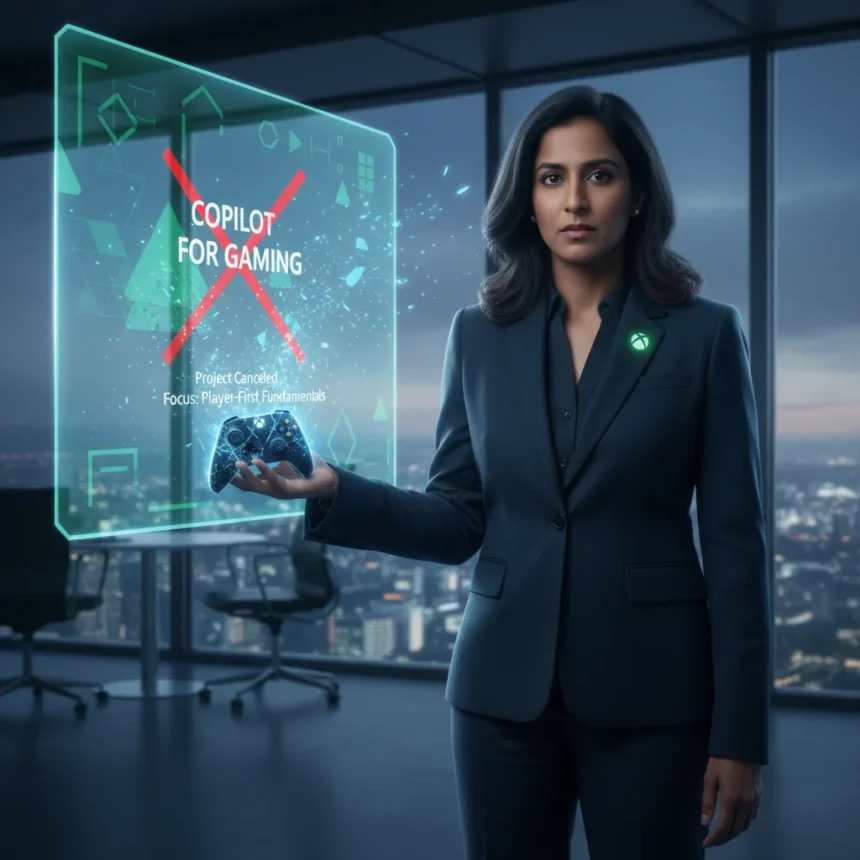
Xbox Copilot for Gaming is dead. On May 5, 2026, newly appointed Xbox CEO Asha Sharma announced that Microsoft will wind down Copilot on mobile and stop all development of the feature for Xbox consoles. This reversal marks the most dramatic signal yet that Xbox’s leadership has fundamentally rejected the AI-first approach that dominated Microsoft’s gaming strategy just months ago.
Key Takeaways
- Xbox Copilot for Gaming launched in May 2025 but will be wound down following poor adoption and strategic misalignment.
- Asha Sharma became Xbox CEO in February 2026, replacing retiring Phil Spencer after 38 years at Microsoft.
- The leadership overhaul brings four senior executives from Microsoft’s CoreAI group into Xbox roles.
- Sharma’s new strategy refocuses AI on player problems like graphics enhancement and personalization, not chatbot interfaces.
- The shutdown reverses a March 2026 plan to bring Copilot to current-generation Xbox hardware.
Why Xbox Copilot for Gaming Failed
The Xbox Copilot for Gaming feature debuted roughly a year ago as a centerpiece of Microsoft’s gaming AI ambitions. The chatbot-style tool was designed to assist players through the Xbox mobile app, positioning AI as a core differentiator for the platform. Instead, it became a cautionary tale about mistaking technological capability for user demand. Copilot for Gaming solved no pressing player problem. It did not enhance performance, improve discovery in a cluttered Game Pass library, or deepen the connection between players and their favorite titles. It was AI for AI’s sake—a feature that felt grafted onto gaming rather than woven into it.
Sharma’s internal memo laid bare the organizational dysfunction that allowed such a misaligned product to persist: “Right now, it is too hard to ship impact quickly. We spend too much time inward instead of with the community, and we lack the depth we need in some of the fundamentals”. Copilot for Gaming exemplified this inward focus. The feature prioritized Microsoft’s broader AI narrative over Xbox’s survival needs. Under Sharma, that calculus has flipped entirely.
Xbox Copilot for Gaming Versus AI Done Right
Sharma’s April 30 X post previewed the philosophical shift: Xbox would focus on “solving player problems like enhancing real-time graphics, improving discovery, and deepening personalization”. The contrast with Copilot for Gaming is stark. Automatic Super Resolution—a feature that silently boosts image quality and frame rates in the background—embodies this player-first approach. It works without requiring player interaction, delivering tangible value that players notice immediately. Copilot for Gaming required players to open an app, type questions, and wait for responses. One solves friction. The other creates it.



This distinction matters beyond Xbox. It signals that Microsoft’s broader AI ambitions and gaming’s specific survival strategy have diverged. The company can pursue generative AI across its enterprise and consumer products while recognizing that gaming audiences do not want to chat with an AI assistant mid-gameplay or in their downtime. They want faster load times, better graphics, smarter matchmaking, and easier ways to find games worth playing.
Leadership Overhaul Signals Deeper Restructuring
Killing Copilot for Gaming is only part of Sharma’s reset. Her leadership overhaul brings internal Xbox leaders into expanded roles while recruiting four senior executives from Microsoft’s CoreAI division, including David Schloss, who previously led product growth at Instacart and now heads subscriptions and cloud at Xbox. This hiring pattern is revealing. Sharma is not doubling down on AI integration—she is importing operational talent from a division where AI is central to the product roadmap, then redirecting that expertise toward Xbox’s core business mechanics: subscriptions, cloud infrastructure, and player retention.


Sharma’s own background amplifies the signal. She led Microsoft’s CoreAI Product division for two years before becoming Xbox CEO in February 2026, replacing Phil Spencer, who retired after 38 years at Microsoft. Her transition from CoreAI to Xbox is not a vote of confidence in gaming AI—it is a rescue operation. She understands both worlds and has chosen to prioritize the latter.
What Happens to Copilot on Xbox PC and ROG Ally?
The announcement addressed mobile and console versions of Xbox Copilot for Gaming, but the status of the feature on the Xbox PC app and the ASUS ROG Ally handheld remains unclear. Given the broader wind-down, expect both to follow. Microsoft is unlikely to maintain the feature on secondary platforms while discontinuing it on primary ones.
Is Xbox Copilot for Gaming coming back in any form?
No. Sharma framed the shutdown as part of a permanent strategic realignment, not a temporary pause. The feature does not fit Xbox’s refocused AI philosophy, which prioritizes invisible, outcome-driven tools over conversational interfaces.
What does killing Copilot for Gaming mean for Xbox’s AI strategy?
It means Xbox will pursue AI as a means to solve specific player problems—graphics, discovery, personalization—rather than as a distribution channel for Microsoft’s broader AI capabilities. This is a retreat from the idea that gaming is a natural home for generative AI assistants.



Sharma’s first 100 days as Xbox CEO have been unsparing. She has killed a high-profile feature, restructured leadership, acknowledged unmet growth targets, and signaled that Xbox will move faster and focus inward less. Whether this reset can reverse Xbox’s momentum remains an open question. But one thing is clear: the era of AI-first gaming strategy at Microsoft is over.
Edited by the All Things Geek team.
Source: Tom's Hardware