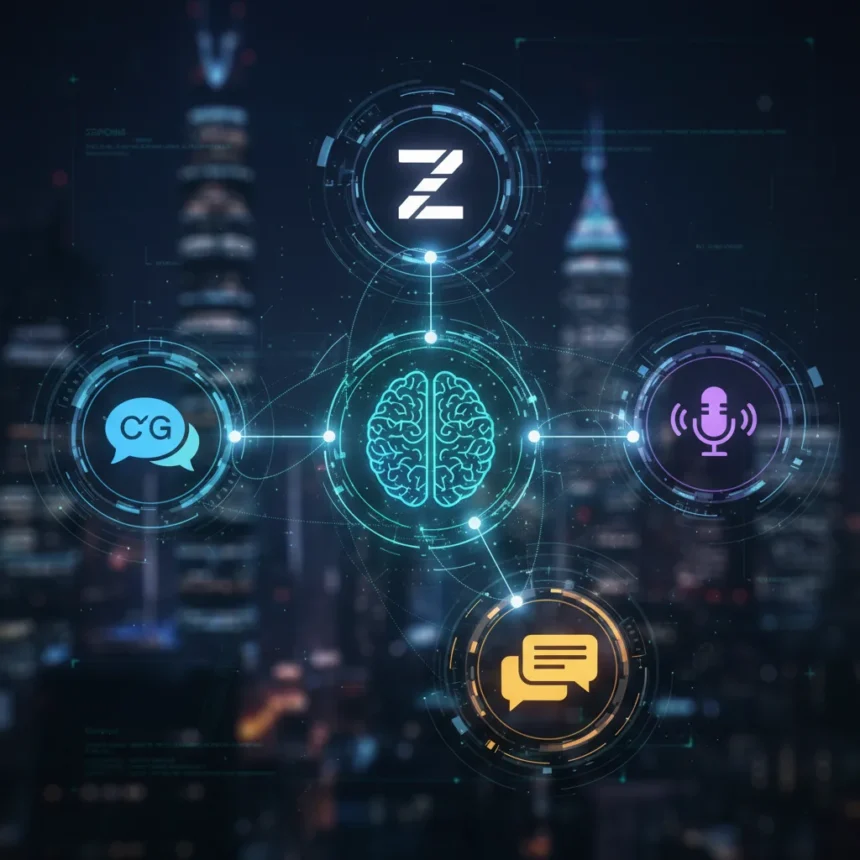
Zendesk AI agents are expanding far beyond the company’s own platform, now operating across ChatGPT, Gemini, voice, messaging, and email channels. This shift represents a fundamental repositioning of Zendesk’s customer service strategy, moving away from traditional support bots that simply deflect tickets toward what the company calls an “Autonomous Service Workforce” capable of handling front, middle, and back office operations.
Key Takeaways
- Zendesk AI agents now operate across multiple third-party AI platforms including ChatGPT and Gemini, not just Zendesk-owned channels.
- Voice AI Agents support more than 60 languages with context preservation during language switching within a single conversation.
- Zendesk expanded Knowledge Graph connectors to include SharePoint, Google Drive, Notion, Guru, Contentful, and Document360.
- Model Context Protocol (MCP) support allows Zendesk agents and Agent Copilot to connect to external business systems in a governed way.
- The platform maintains shared context across messaging, email, voice, and third-party AI interactions.
Zendesk AI Agents Break Free From Platform Lock-In
The core innovation behind Zendesk AI agents is their ability to operate independently of Zendesk’s proprietary ecosystem. Rather than forcing customers to choose between Zendesk or ChatGPT or Gemini, the company has designed agents that work across all three, allowing businesses to deploy customer service automation wherever their teams already operate. This is a deliberate departure from the traditional customer service software model, where vendors lock functionality into their own platforms.
Previous generations of customer service automation focused narrowly on ticket deflection—handling simple FAQs and routing complex issues to humans. Zendesk AI agents claim a broader mandate: handling specialized workflows across departments, maintaining conversation history across channels, and integrating with external business systems. The difference matters because it means a single agent can follow a customer from a ChatGPT conversation into email, preserving context the entire way.
Voice Support and Multilingual Capabilities Reshape Contact Centers
Zendesk’s Voice AI Agents represent one of the most concrete expansions announced. These agents support more than 60 languages and can switch between languages during a single conversation while maintaining full context. For multinational enterprises, this eliminates the need for separate language-specific workflows or the friction of transferring customers between language-based teams.



The voice offering is built on Amazon Connect, Zendesk’s contact center platform. What distinguishes it from generic voice AI is the integration with Zendesk’s broader agent ecosystem—a voice conversation can hand off to a messaging agent or email agent without losing context, and the same agent can manage multiple brands simultaneously. This multi-brand capability reduces operational overhead for companies managing customer service across subsidiary brands or regional divisions.
External Data Integration Through Expanded Connectors
Zendesk also announced expanded connectors for its Knowledge Graph, now supporting SharePoint, Google Drive, Notion, Guru, Contentful, and Document360. This matters because customer service agents are only as good as the information they can access. By connecting to the tools where companies already store documentation, Zendesk agents gain access to real-time knowledge without requiring data migration or manual synchronization.



The Knowledge Graph expansion addresses a real pain point in enterprise AI deployment: fragmented information. Most large organizations maintain documentation across multiple platforms—some teams use SharePoint, others prefer Notion, design teams might use Contentful. A unified agent that can search across all these sources at once reduces the chance of serving outdated or incomplete information to customers.
Model Context Protocol Opens the Ecosystem
Perhaps the most significant technical shift is Zendesk’s support for Model Context Protocol (MCP), which allows Zendesk AI Agents and Agent Copilot to connect to external business systems. MCP is an emerging standard for connecting AI systems to external tools and data sources in a standardized way. By adopting it, Zendesk is positioning itself as a service layer that can integrate with any MCP-compatible system—databases, CRM platforms, accounting software, inventory systems.
This also works in reverse. Zendesk says businesses can now make Zendesk tickets, knowledge bases, and other data available to external AI systems in a governed way. This means a company could use ChatGPT or Claude for internal analysis while allowing those systems to query Zendesk data through controlled APIs. It’s a significant shift from Zendesk as a walled garden to Zendesk as a node in a larger AI ecosystem.
How Does This Compare to Traditional Customer Service Bots?
The gap between Zendesk’s new agents and older chatbot technology is architectural. Legacy bots operate within a single channel and typically lack context about previous interactions. They excel at handling scripted responses to common questions but fail when customers ask anything outside their narrow training set. Zendesk AI agents maintain shared context across channels and integrate with external systems, meaning they can access real-time business data, understand customer history, and escalate intelligently when needed.


Forethought, which Zendesk acquired, contributed to this capability. The acquisition gave Zendesk access to specialized agent technology that could operate across multiple platforms rather than being confined to a single vendor’s infrastructure.
What Does “Autonomous Service Workforce” Actually Mean?
Zendesk’s framing of its agents as an “Autonomous Service Workforce” is marketing language, but it points to a real strategic shift. The company is arguing that AI agents should handle not just customer-facing support but also internal workflows—approvals, data processing, documentation updates. A single agent could handle a customer inquiry, update the relevant knowledge base article, and notify the product team about a feature request, all without human intervention.
This ambition is larger than what any current AI system can reliably do. But it’s also the direction Zendesk is betting on, and the multi-platform, multi-channel architecture supports that vision more than a single-vendor chatbot ever could.
Is Zendesk Replacing Human Customer Service?
No. Zendesk AI agents are designed to handle tasks humans would otherwise do, but the company positions them as augmenting human teams, not replacing them. The agents handle routine work, escalate complex issues, and maintain context so that when a human takes over, they have full conversation history and relevant business data. For many support teams, this means fewer repetitive tickets and more time on complex problem-solving.
Can Zendesk AI Agents Work With Competitors Like Intercom or Freshdesk?
The research brief does not specify whether Zendesk AI agents can integrate with competing customer service platforms. Zendesk’s MCP support allows connection to external systems, but the brief does not name specific competitors as supported integrations. The focus is on third-party AI platforms (ChatGPT, Gemini) and knowledge sources (SharePoint, Google Drive, Notion), not on competing service platforms.
What’s the Real Business Impact?
The strategic shift Zendesk is making positions the company as infrastructure rather than a monolithic platform. Instead of asking customers to choose Zendesk or another tool, Zendesk is becoming the layer that connects customer service work across whatever tools a company already uses. For large enterprises juggling multiple systems, this reduces friction. For Zendesk, it’s a bet that being interoperable is more valuable than being proprietary—a risky but potentially transformative strategy in an AI-driven market where lock-in is increasingly difficult to maintain.
Edited by the All Things Geek team.
Source: TechRadar