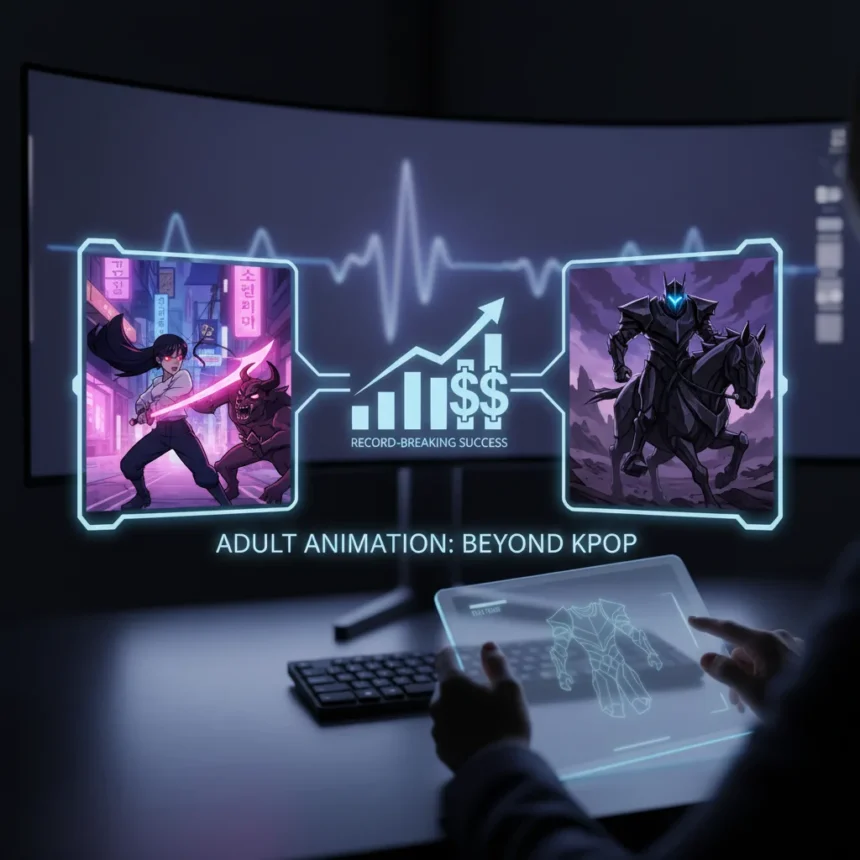
Adult animation has quietly become streaming’s most valuable commodity. KPop Demon Hunters just became Netflix’s most-streamed show ever internationally, and that success is not an accident—it is proof that audiences are hungry for stylized, risk-taking animation that refuses to chase photorealism. The question now is whether that appetite extends beyond one viral hit into a broader renaissance of ambitious adult animation projects.
Key Takeaways
- KPop Demon Hunters is Netflix’s most-streamed international show, signaling strong demand for adult animation.
- The success of stylized animation challenges the dominance of 3D realism in modern film releases.
- Genndy Tartakovsky’s abandoned Black Knight concept—a medieval action story about a knight piloting a 20-foot suit of armor—could work as an adult-focused spin-off.
- The Black Knight premise involved mechanical control through ropes, pulleys, and levers, set in the 14th century.
- Animation style alone can attract audiences beyond existing fan bases, according to industry commentary.
Why KPop Demon Hunters Cracked the Code
KPop Demon Hunters succeeded where countless other animated projects flounder: it refused to apologize for being adult-oriented and visually unconventional. The film’s ascent to Netflix‘s most-streamed international show is not just a win for one production—it is a referendum on what audiences actually want from animation. While Hollywood has spent two decades chasing 3D realism as the default aesthetic for animation, KPop Demon Hunters proved that bold, distinctive visual language can outperform technical polish.
This matters because it shatters a persistent myth in entertainment: that animation must chase photorealism to justify a theatrical or streaming release. The opposite is true. Audiences are exhausted by the uncanny valley of overly realistic 3D animation. They are drawn to projects with a point of view, a signature style, something that could not exist in live-action. KPop Demon Hunters delivered exactly that, and the numbers reflect a hunger for more.
The Case for Genndy Tartakovsky’s Black Knight as Adult Animation
Genndy Tartakovsky’s The Black Knight is a fascinating case study in abandoned potential. The concept centers on a medieval knight who controls a towering 20-foot suit of armor using an intricate system of ropes, pulleys, and levers—a premise set in the 14th century that feels simultaneously ridiculous and genuinely compelling. The original idea leaned heavily into adult-oriented action and mechanical spectacle, a far cry from the family-friendly animation Tartakovsky is better known for.



The Black Knight was pitched as a more adult animated action movie, but it never materialized as a full production. Yet the core concept remains potent. In a post-KPop Demon Hunters world, where audiences have proven their appetite for stylized, mature animation, The Black Knight’s medieval mechanical premise could find its moment. The visual complexity alone—rendering rope tension, armor weight, the physics of a knight fighting from inside a moving fortress—would demand distinctive animation that could not be replicated in live-action.
What makes this idea resonate now is not nostalgia for Tartakovsky’s earlier work. It is the recognition that animation style alone can attract an audience far beyond existing fans. The animation community has shifted. Audiences have shifted. The conditions that killed The Black Knight a decade ago no longer apply.



Adult Animation Versus the 3D Realism Trap
Modern animation is trapped in a false binary: either chase photorealism with latest 3D rendering, or accept that your project will be dismissed as niche. KPop Demon Hunters obliterated that assumption. The film succeeded not despite its stylized aesthetic but because of it. Its visual language is instantly recognizable, thematically coherent, and impossible to mistake for anything else.
The contrast with 3D realism-focused releases is stark. When every animated film aims for the same technical benchmark—smooth surfaces, realistic lighting, human proportions that hover in the uncanny valley—they all blur together. KPop Demon Hunters stands alone because it chose a different path entirely. That choice is not a limitation; it is the entire reason audiences paid attention.
This principle applies directly to The Black Knight. A project about a knight piloting a mechanical suit through 14th-century warfare would be tedious in photorealistic 3D. The weight, the absurdity, the mechanical poetry of it all demands a stylized approach that Tartakovsky’s visual sensibility could deliver. The fact that such a concept was shelved suggests the industry has been slow to learn what KPop Demon Hunters just taught it: distinctive animation beats technical realism every time.
Could The Black Knight Work as a Spin-Off?
The real question is not whether The Black Knight could work, but whether the market conditions finally align for it to exist. KPop Demon Hunters has created a moment. Streaming platforms are actively hunting for the next stylized animation hit. Adult audiences have proven they will consume animation that is not aimed at children. And Tartakovsky’s original concept, while unconventional, carries enough visual intrigue to justify a full production.



A Black Knight project would not need to be a direct sequel or spin-off in the traditional sense. It could exist as a companion piece in a broader slate of adult animation that Netflix or another platform is building. The medieval setting, the mechanical premise, and the action-heavy tone would differentiate it from KPop Demon Hunters while serving the same audience appetite for stylized, mature storytelling.
The animation style alone would be the draw. Audiences have learned to seek out animation with a distinctive visual voice. They no longer expect all animation to look the same. That shift in expectation is everything The Black Knight needs to succeed.
Is adult animation finally becoming mainstream?
KPop Demon Hunters’ record-breaking performance suggests yes. For years, adult animation existed in the margins—prestige festival entries, late-night cable slots, cult streaming hits. Now it is pulling the highest viewership numbers on the world’s largest streaming platform. That is not a niche phenomenon; that is a market signal that the industry can no longer ignore.
What would a Black Knight spin-off actually look like?
Based on the original concept, The Black Knight would be a medieval action film centered on the mechanical spectacle of a knight controlling a massive suit of armor through ropes and pulleys. The visual complexity and thematic weight of that premise suggest a project aimed at adult audiences, distinct from typical animated adventure films.
Why did The Black Knight concept never become a full project?
The brief does not specify the exact reasons The Black Knight was shelved. However, the timing suggests it preceded the shift in audience appetite for stylized adult animation that KPop Demon Hunters has now catalyzed. Market conditions, production costs, and platform interest all likely played roles in its abandonment.
The window for adult animation has opened wider than ever before. KPop Demon Hunters did not create that appetite—it simply proved it existed at a scale the industry could no longer ignore. Projects like The Black Knight, abandoned in an earlier era, deserve a second look. The audience is finally ready.
Where to Buy
KPop Demon Hunters Deluxe Screen Comic: | $18.99 at Amazon US | $37.28 at Amazon US
Edited by the All Things Geek team.
Source: Creativebloq