





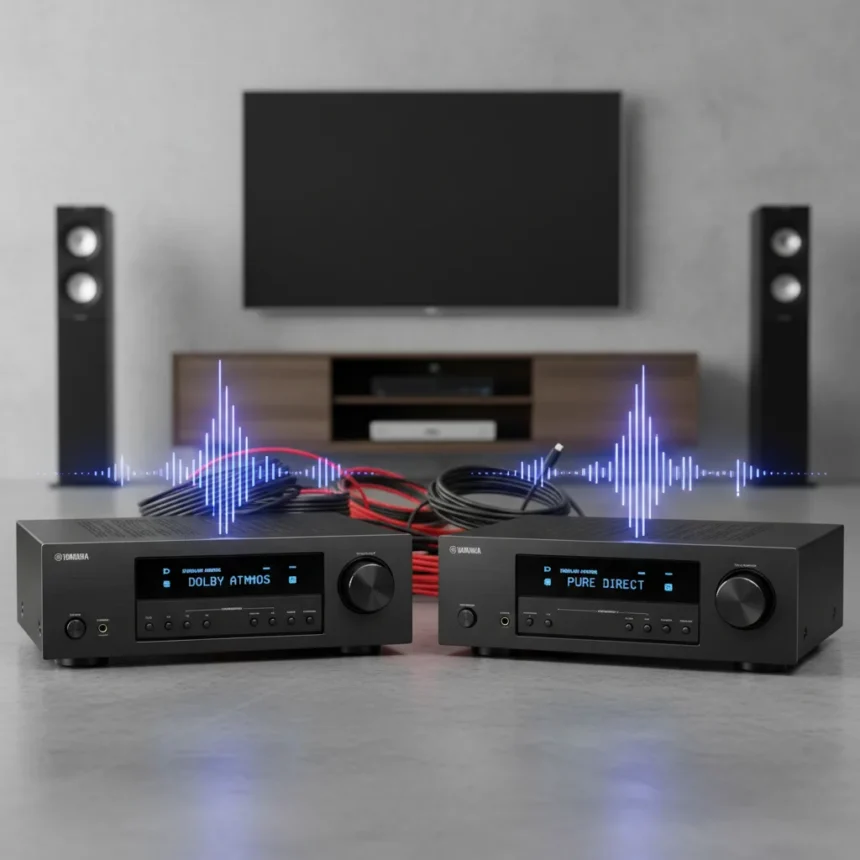
The Yamaha RX500A vs RX300A comparison matters because both receivers deliver Dolby Atmos support at entry-level pricing, yet the RX500A is positioned as the next step up in Yamaha’s budget AV receiver lineup. For home cinema buyers deciding whether the extra investment in the RX500A justifies its cost over the RX300A, understanding their core differences is essential.
Key Takeaways
- Both Yamaha RX500A and RX300A support Dolby Atmos for immersive home theater sound
- The RX300A is a 5.2-channel receiver, while the RX500A offers more channels for expanded surround capability
- The RX500A is Yamaha’s next step up from the RX300A in their budget receiver tier
- Both models look nearly identical in design and appearance
- The choice between them depends on whether you need additional channels for your speaker configuration
Channel Count: The Main Separator
The most significant difference between Yamaha RX500A vs RX300A lies in their channel configurations. The RX300A delivers 5.2-channel capability, making it suitable for standard surround setups with a center channel, left and right fronts, two surround speakers, and a subwoofer. The RX500A, by contrast, provides more channels than the RX300A, allowing you to expand your speaker array if you want to add height channels for Dolby Atmos overhead effects or additional surround speakers.
This channel advantage means the RX500A can accommodate more complex room layouts without requiring an external amplifier. If your home theater space can support additional speakers—whether that’s ceiling-mounted Atmos drivers or rear surrounds—the RX500A gives you the connectivity to use them directly from the receiver. The RX300A’s 5.2 configuration works perfectly for smaller rooms or simpler setups, but it caps your expansion potential.
Design and Appearance: Nearly Indistinguishable
Visually, the Yamaha RX500A and RX300A are nearly identical. Both receivers share the same chassis design, front-panel layout, and overall aesthetic. This means if appearance matters in your entertainment cabinet, you won’t notice a dramatic difference between the two models. The similarity extends to their physical footprints, so either will fit into standard AV equipment racks without issue.



The near-identical appearance can be deceptive, however. Don’t let the visual similarity fool you into thinking these are the same receiver with different model numbers. The internal amplification, processing power, and connectivity differ meaningfully, even if the faceplate looks the same.
Dolby Atmos Support on Both Models
Both the Yamaha RX500A and RX300A include Dolby Atmos decoding, which is significant for budget-conscious home theater builders. Dolby Atmos adds height and depth to surround mixes, creating more immersive soundscapes than traditional 5.1 or 7.1 setups. This means you’re not sacrificing immersive audio capability by choosing the cheaper RX300A—you’re only losing the flexibility to expand your speaker count.



The presence of Atmos support on both models reflects a shift in the AV receiver market, where immersive audio is no longer reserved for premium tiers. Yamaha’s budget receivers now deliver the same spatial audio format as far more expensive competitors, making either the RX500A or RX300A a viable entry point for Atmos enthusiasts on a limited budget.
Which Receiver Should You Choose?
The Yamaha RX500A makes sense if you plan to build a more ambitious surround setup or want room to grow without replacing your receiver later. The additional channels justify the extra cost for anyone committed to a multi-speaker Atmos system with height channels. If your room is smaller or you’re satisfied with a traditional 5.2 configuration, the RX300A delivers the same Dolby Atmos capability at a lower price point.
Neither receiver is a wrong choice—it’s a matter of matching your current and future speaker needs to the right model. The RX300A is the smarter buy if you’re building a modest system today. The RX500A is the wiser investment if you’re thinking ahead.
Does the Yamaha RX300A support Dolby Atmos?
Yes, the RX300A includes full Dolby Atmos decoding. You can use it with ceiling-mounted Atmos speakers or upward-firing drivers to create the height dimension that defines immersive audio. The 5.2-channel configuration handles this without requiring additional amplification.



Can you expand the Yamaha RX500A with more speakers later?
The RX500A’s higher channel count gives you more flexibility for expansion than the RX300A. You can add height channels, rear surrounds, or other speaker types without maxing out the receiver’s connectivity. The RX300A’s 5.2 configuration is more limiting if you want to add speakers beyond the standard surround array.
Are the Yamaha RX500A and RX300A identical in appearance?
The two receivers look nearly identical in design and physical layout. Visual appearance alone won’t distinguish them in an equipment rack. The real differences are internal—channel count, amplification, and processing power—rather than external styling.
The choice between Yamaha RX500A vs RX300A comes down to one question: do you need more channels than 5.2? If yes, the RX500A is the logical step up. If your setup fits within 5.2 and Dolby Atmos is your priority, the RX300A delivers the same immersive audio at a lower cost. Both receivers prove that budget AV receivers no longer mean sacrificing modern surround technology.
Edited by the All Things Geek team.
Source: What Hi-Fi?




