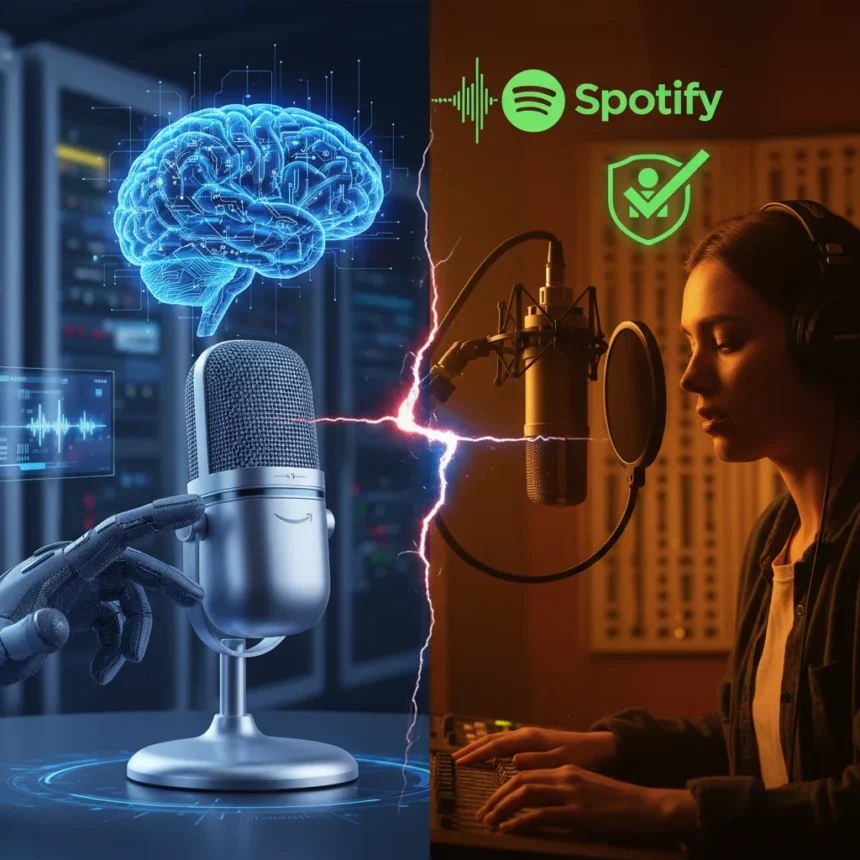
AI podcast generation is now a feature, not a concept. Amazon’s Alexa+ can create podcast episodes on demand, generating audio content about news and other topics in minutes. The timing is awkward—Spotify is simultaneously rolling out verification badges for podcasts definitely made by humans, essentially admitting that listeners need help distinguishing real shows from synthetic ones.
Key Takeaways
- Amazon’s Alexa+ can now generate AI podcasts on demand about news and other topics.
- Spotify is verifying human-created podcasts with badges to help users identify authentic shows.
- The two moves reveal a widening split in how platforms approach AI-generated audio content.
- Content provenance—knowing whether audio is human or AI-made—is becoming a critical user concern.
- The podcast industry faces a credibility challenge as AI generation tools become more accessible.
What AI podcast generation actually means
Alexa+ podcast generation works by taking a prompt or topic request and converting it into a podcast-style audio episode. The feature generates content on demand, letting users create audio summaries or discussion pieces without recording anything themselves. This sits at the intersection of text-to-speech technology and generative AI—the system doesn’t just read text aloud, it structures it as a podcast with pacing, segments, and presentation logic built in.
The feature raises an obvious question: who wants fake podcasts? The article’s skeptical framing suggests the answer is not obvious. Listeners subscribe to podcasts for personality, expertise, and authenticity. A synthetically generated news roundup lacks all three. Yet the feature exists, which means Amazon sees a use case—perhaps quick audio summaries for smart speaker users, or on-demand content generation for specific niches where personality matters less than speed.
Why Spotify’s verification move matters more than it seems
Spotify’s decision to verify human-created podcasts is not a ban on AI content. It is a classification system. By marking podcasts that definitely come from humans, Spotify acknowledges that listeners will soon need that distinction. The verification badge becomes a trust signal in an environment where AI-generated audio is becoming harder to spot.



This creates a practical problem for the podcast ecosystem. If verification becomes standard, unverified shows—whether AI-generated or simply from new creators without the badge—face credibility friction. Creators gain incentive to seek verification. Platforms gain responsibility for vetting. Listeners gain clarity, but only if they trust the verification process itself. The system works only if users believe Spotify’s verification means something real.
The broader split in platform strategy
Amazon and Spotify are pursuing opposite strategies. Amazon is democratizing podcast creation through AI generation—lowering the barrier to entry, enabling anyone to produce audio content instantly. Spotify is raising the bar for authenticity by verifying human creators and implicitly questioning the legitimacy of AI-generated shows.



Neither approach is inherently wrong, but they expose a fundamental tension in the audio industry. Platforms can either accelerate content creation through AI tools or build trust through human verification. They can do both, but the messaging becomes confused. Alexa+ says AI podcasts are convenient and useful. Spotify’s verification says human podcasts are worth distinguishing. Users caught between these signals may simply tune out—or demand platforms pick a lane.
What this means for podcast creators
Human creators benefit from Spotify’s verification in the short term. A badge signals authenticity in a crowded marketplace. But the long-term threat is real. If AI podcast generation becomes frictionless and cheap, platforms will face pressure to distribute AI content alongside human shows. Verification badges slow that pressure but do not stop it.
The real question is whether listeners will tolerate AI podcasts at all. Early adoption suggests skepticism. The article’s tone—questioning why anyone would want synthetic news podcasts—reflects genuine audience doubt. But skepticism can shift. If AI-generated podcasts become good enough, or if they occupy specific niches (daily briefings, automated summaries, niche topic deep-dives), acceptance may follow. Spotify’s verification strategy assumes listeners will always prefer human content. That assumption may not survive if AI quality improves.
Is AI podcast generation actually useful?
The feature solves a real problem for some users: quick audio content without production overhead. A business owner could generate daily news briefings. A researcher could turn articles into audio summaries. An educator could create lecture recaps. These are narrow use cases, but they exist. Whether they justify a feature depends on adoption rates and user satisfaction—neither of which are verifiable from available information.



The skepticism in the article title is warranted. Most listeners want personality, analysis, and human judgment from podcasts. AI can generate audio, but it struggles to generate the contextual wisdom, emotional resonance, and editorial voice that makes podcasts valuable. Spotify’s verification move implicitly bets that listeners will keep preferring human shows. That bet seems safe for now.
FAQ
Can Alexa+ podcasts be shared on Spotify?
The research brief does not specify whether Alexa+ generated podcasts can be uploaded to Spotify or other podcast platforms. The feature appears to be Alexa-specific, generating audio within the Amazon ecosystem, but broader distribution capabilities are not verified from available sources.
Does Spotify’s verification mean AI podcasts are banned?
No. Spotify’s verification badges identify human-created podcasts but do not prohibit AI-generated shows. The system is a classification tool, not a ban. AI podcasts can still exist on the platform; they simply will not carry the human-creator badge.
Will AI podcast generation replace human podcasters?
Not in the near term. The feature addresses specific use cases—quick summaries, on-demand briefings—where personality and expertise matter less. Traditional podcasts depend on host credibility and editorial judgment, which AI cannot yet replicate convincingly. Human creators remain the industry standard, but AI tools will continue expanding into niches where efficiency outweighs authenticity concerns.
The collision between Alexa+ podcast generation and Spotify’s human verification reveals a deeper industry reckoning. Audio platforms are splitting into two camps: those accelerating AI content creation and those defending human authenticity. Listeners will ultimately decide which direction wins. For now, skepticism is justified. But as AI tools improve and use cases proliferate, that skepticism may not hold.
Where to Buy
Edited by the All Things Geek team.
Source: TechRadar