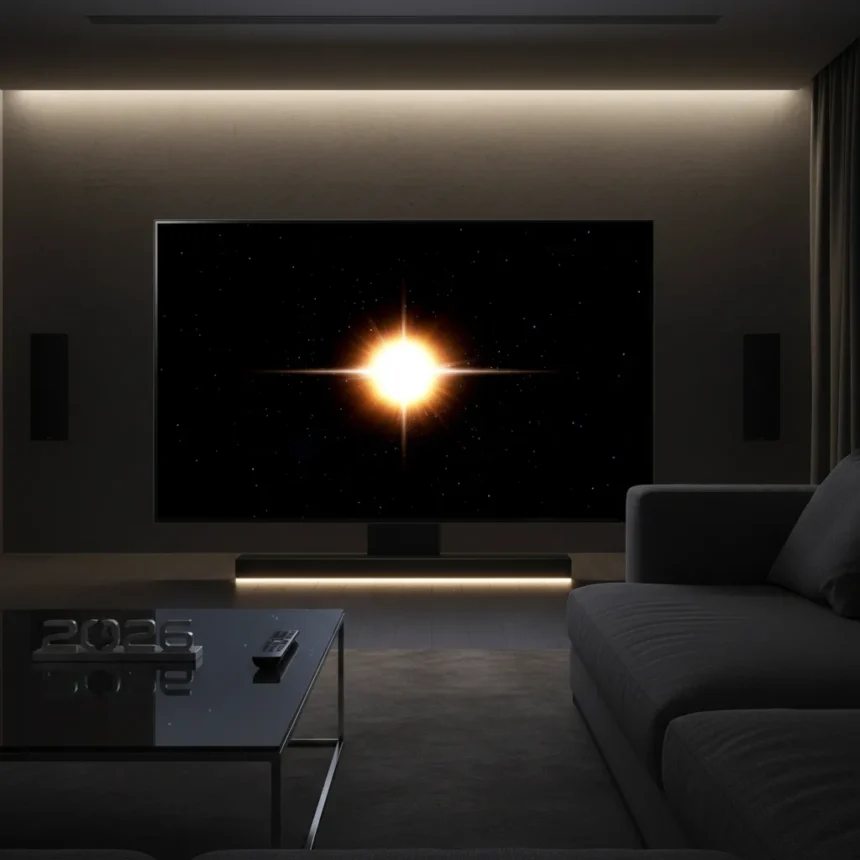
The LG OLED G6 is LG’s flagship stand-mount OLED television for 2026, engineered to deliver brightness levels that historically belonged only to Mini-LED panels while retaining the perfect black levels that define OLED technology. After years of Mini-LED sets claiming the brightness crown, LG is making a serious argument that OLED has not hit its ceiling—and the G6 is the proof.
Key Takeaways
- The LG OLED G6 matches Mini-LED brightness while keeping OLED’s perfect blacks and zero haloing
- Hyper Radiant Colour technology delivers the brightness gains over the previous G5 model
- Perfect Black polarising layer reduces glare without sacrificing contrast
- webOS 26 adds Copilot and Gemini AI integration powered by the Alpha 11 Gen 3 processor
- Available in 48- to 83-inch sizes, with a 97-inch variant using different panel technology
LG OLED G6 Brightness: The Technology Behind the Claims
The jump from last year’s G5 to the G6 hinges on one innovation: Hyper Radiant Colour. LG’s G5 already introduced a multi-layered OLED panel that outshone any previous OLED set. The G6 takes that foundation and pushes brightness even further, reaching levels that traditionally required Mini-LED’s backlit zones and their associated compromises. The critical difference is architecture. Mini-LED TVs use thousands of dimming zones behind the panel, which can cause blooming—light spilling into dark areas. OLED pixels emit their own light independently, so no halo effect appears around bright objects on dark backgrounds. The G6 keeps that self-illuminating advantage while climbing the brightness ladder that Mini-LED has owned for years.
LG demonstrated the G6 directly alongside Samsung’s S95F QD-OLED panel under bright ambient light to prove the point. The comparison showed that glare has limited impact on the G6’s black level, a significant claim in a category where brightness gains often come with visibility trade-offs. This is where Perfect Black technology enters the equation—a polarising layer designed to suppress reflections and glare without dimming the image itself.
Perfect Black and OLED’s Enduring Contrast Advantage
Perfect Black is not a marketing flourish; it addresses a real problem. Bright OLED panels in well-lit rooms can wash out blacks because reflected ambient light bounces off the screen surface. LG’s polarising layer tackles this by filtering out-of-plane light while preserving the panel’s self-illuminating contrast. The result is a TV that can be both bright and dark—a combination that has eluded OLED sets until now. LG has historically dominated black level performance, and the G6 extends that legacy by proving OLED can compete on brightness without surrendering the feature that made OLED special in the first place.



AI Features and Smart TV Integration in the LG OLED G6
The G6 is not just a display upgrade; it is a smart TV rethink. webOS 26 integrates both Microsoft Copilot and Google Gemini, making the TV function as an AI-enabled smart display rather than a passive panel. The Alpha 11 Gen 3 AI Processor 4K powers these features, handling local processing where possible and using cloud-based computation for heavier tasks. This processor is the engine enabling the AI features, turning the TV into something closer to a smart assistant with a massive screen.
Sizes, Availability, and What’s Next
The LG OLED G6 will be available in 48-, 55-, 65-, 77-, and 83-inch sizes, with a separate 97-inch model using a different panel technology. The TV is expected to go on sale later in 2026, though pricing has not been revealed. For a premium OLED set with this level of innovation, expect this to sit at the top of LG’s lineup and command a corresponding price tag.



Is the LG OLED G6 Worth the Wait?
If you have been holding out on OLED because brightness felt like a compromise, the G6 changes the equation. It proves OLED is still evolving, not stalling. The technology gap between OLED and Mini-LED has narrowed significantly, but OLED’s contrast and pixel-perfect control give it an edge that brightness alone cannot match. For cinematic picture quality—the kind that makes films and shows feel immersive—the G6 is shaping up to be a landmark set.
How does the LG OLED G6 compare to the G5?
The G6 builds on the G5’s multi-layered OLED panel with Hyper Radiant Colour for additional brightness and adds Perfect Black technology to manage glare. Both are premium sets, but the G6 represents a meaningful step forward in brightness without sacrificing OLED’s contrast advantages.
Will the LG OLED G6 be expensive?
Pricing has not been announced, but given its position as LG’s flagship stand-mount OLED TV and the advanced technologies involved, expect it to be positioned at the premium end of the market. The exact cost will be revealed closer to the 2026 launch.
What sizes will the LG OLED G6 come in?
The LG OLED G6 will be offered in 48-, 55-, 65-, 77-, and 83-inch sizes. A 97-inch variant is also planned, though it uses a different panel type than the standard models.



The LG OLED G6 signals that OLED is not resting on its contrast laurels. By marrying brightness to perfect blacks and adding AI smarts through webOS 26, LG has built a TV that challenges the assumption that you must choose between brightness and picture quality. For anyone serious about premium television, 2026 just became a very interesting year to upgrade.
Where to Buy
LG OLED evo AI G6 4K Smart TV 2026 | Samsung OLED S90H 4K TV (2026) | Sony Bravia 8 II 65-inch QD-OLED TV
Edited by the All Things Geek team.
Source: T3