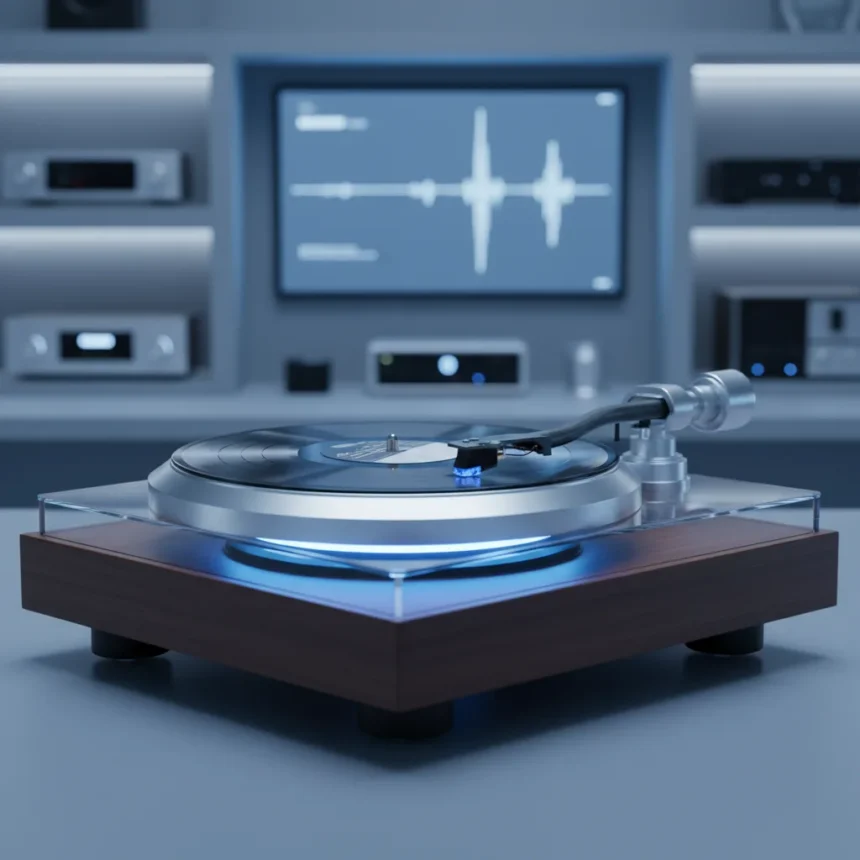
An air-floating turntable represents a radical departure from conventional vinyl playback, using a hovercraft-like suspension mechanism to isolate the platter from external vibration—a feature typically reserved for five-figure audiophile equipment. Yet this design achieves that level of engineering sophistication at a price point that defies the audio industry’s long-standing premium markup on latest technology.
Key Takeaways
- Air-floating mechanism isolates platter vibration using hovercraft-style suspension engineering
- latest audio design typically commands premium pricing, but this turntable breaks that convention
- Innovation in turntable isolation addresses a fundamental challenge in analog playback
- Price-to-performance ratio challenges assumptions about high-end audio accessibility
What Makes Air-Floating Turntable Design Revolutionary
The air-floating turntable eliminates traditional bearing systems by suspending the platter on pressurized air, a technique borrowed from industrial hovercraft design. This engineering approach removes direct mechanical contact between the spinning platter and the turntable base, theoretically reducing vibration transmission that degrades sound quality. Traditional turntables rely on precision ball bearings or oil-damped systems, which, while effective, cannot fully isolate the platter from environmental vibration and structural resonance. The air-bearing approach represents a fundamental rethinking of how turntables isolate moving components from external noise sources.
Vibration isolation has always been central to high-fidelity vinyl playback. Even microscopic vibrations from footsteps, speaker feedback, or building resonance can travel through a turntable’s structure and modulate the stylus tracking, introducing noise into the signal path. By floating the platter on air pressure rather than mechanical contact, this design theoretically achieves isolation levels previously accessible only through expensive isolation platforms or custom-built equipment. The innovation addresses a real problem in analog audio—one that audiophiles have historically solved through expensive add-ons rather than fundamental redesign.
Why Price Expectations for Air-Floating Turntable Technology Rarely Match Reality
latest audio technology has long operated under an unspoken rule: innovation equals expense. High-end turntables with advanced isolation systems, precision tonearms, and premium materials routinely exceed $5,000, with flagship models reaching $20,000 or more. Consumers have internalized the assumption that air-bearing isolation—a technology once exclusive to laboratory equipment and ultra-luxury audio—would command prices reflecting that exclusivity and engineering complexity. This air-floating turntable disrupts that expectation by delivering the isolation architecture at a fraction of the cost typically associated with comparable engineering sophistication.



The disconnect between expected and actual pricing reveals inefficiencies in how audio manufacturers price innovation. Many high-end turntable makers bundle air-bearing isolation with premium materials, hand-assembly, and limited production runs—all factors that justify higher costs. This particular design appears to prioritize the core innovation while maintaining affordability, suggesting that the engineering breakthrough itself, rather than exclusivity or brand heritage, drives the value proposition. For consumers skeptical of audio industry pricing conventions, this represents a genuine challenge to the notion that superior isolation technology must remain a luxury good.
How Air-Floating Turntable Design Compares to Conventional Isolation Methods
Traditional turntables address vibration isolation through three primary methods: precision ball bearings with low-friction design, oil-damped systems that absorb oscillation, and external isolation platforms that decouple the entire turntable from environmental vibration. Ball-bearing systems are cost-effective and widely used in mid-range equipment but cannot eliminate all structural vibration. Oil damping improves isolation but adds complexity and maintenance requirements. External platforms work well but require additional investment and space, effectively doubling the cost of a high-quality turntable setup.



The air-floating approach bypasses these mechanical compromises entirely. Rather than trying to minimize vibration transmission through precision engineering of contact points, it eliminates contact altogether. This represents a categorical difference in isolation philosophy—not incremental improvement but architectural reinvention. The trade-off is that air-bearing systems require consistent air pressure maintenance and may demand more precise manufacturing tolerances than traditional bearings. However, the fundamental advantage—true vibration isolation at the source—positions this design as a genuine alternative to both conventional turntables and expensive isolation platforms, rather than simply another incremental refinement of existing technology.
What the Hovercraft Mechanism Actually Achieves in Turntable Performance
The hovercraft-style suspension creates a thin layer of pressurized air between the platter and the turntable base, allowing the platter to float freely with minimal friction. This mechanism achieves two critical audio engineering goals: it reduces the mechanical path through which vibration travels from the environment into the stylus, and it minimizes the friction losses that can introduce subtle distortions into playback. In theory, this results in cleaner signal recovery from the vinyl groove, with less noise floor and more accurate tracking of fine details in the recording.
The practical audio benefit depends on several factors the air-floating turntable design must balance: maintaining consistent air pressure to preserve platter stability, ensuring the platter remains level and centered during rotation, and preventing air leakage that would degrade isolation over time. If engineered correctly, an air-bearing turntable can achieve isolation performance comparable to turntables costing several times more, simply because it addresses vibration at its source rather than attempting to filter it downstream. The hovercraft mechanism is not new to precision engineering—laboratory equipment and high-end industrial machinery have used air bearings for decades—but applying it to affordable consumer turntables represents a genuine innovation in how that proven technology reaches the mainstream audio market.
Is an Air-Floating Turntable Worth Buying Over Traditional Models?
The value proposition depends on your priorities within vinyl playback. If vibration isolation and noise floor matter more to you than brand prestige or aesthetic design, an air-floating turntable offers isolation architecture typically found in equipment costing significantly more. If you already own an external isolation platform or prefer a traditional turntable with proven reliability, the upgrade may not justify the switch. However, if you are building a vinyl setup from scratch and want isolation performance without the cost multiplier of luxury branding, this design challenges the assumption that you must choose between affordability and isolation quality.



One consideration: air-bearing systems are less common in consumer audio, meaning service support and replacement parts may be less readily available than for traditional turntables. If long-term reliability and easy maintenance matter to you, this is a legitimate trade-off. For early adopters and audio engineers curious about how industrial-grade isolation performs in a consumer product, the air-floating turntable represents a rare opportunity to access proven isolation technology at an accessible price.
Can an air-floating turntable maintain consistent platter speed without traditional bearings?
Air-bearing systems can maintain consistent rotational speed through precise air pressure regulation and motor design, though the mechanism differs from ball-bearing systems. The platter floats on air rather than rolling on bearings, so speed stability depends on consistent air pressure and motor torque balance. Properly engineered air-bearing turntables achieve speed stability comparable to or exceeding traditional designs, but this requires more sophisticated pressure control systems than conventional turntables employ.
Does an air-floating turntable require more maintenance than traditional turntables?
Air-bearing systems may require periodic air filter checks and pressure calibration, depending on design. Traditional turntables require occasional bearing lubrication and stylus cleaning. The maintenance profile differs rather than increases, though consumers unfamiliar with air-bearing equipment may need to learn new servicing procedures. Reliability depends on manufacturing quality and design robustness—not inherently on the air-bearing approach itself.
What happens to an air-floating turntable if air pressure drops?
If air pressure drops significantly, the platter would lose its floating isolation and settle onto a backup bearing or contact surface, degrading performance but preventing damage. Well-designed systems include failsafe mechanisms to prevent platter contact with the base, ensuring the turntable remains functional even if air pressure is lost. This is a standard engineering safeguard in air-bearing equipment.
The air-floating turntable proves that innovation in audio isolation does not require five-figure pricing. By applying proven industrial engineering to consumer turntables, this design challenges the audio industry’s assumption that isolation performance and affordability are mutually exclusive. Whether it represents the future of mainstream vinyl playback or remains a niche product depends on how well it balances isolation performance with reliability and user experience—but as a proof of concept, it demonstrates that latest audio technology can reach beyond the luxury market.
Where to Buy
6 Amazon customer reviews | £886
Edited by the All Things Geek team.
Source: T3