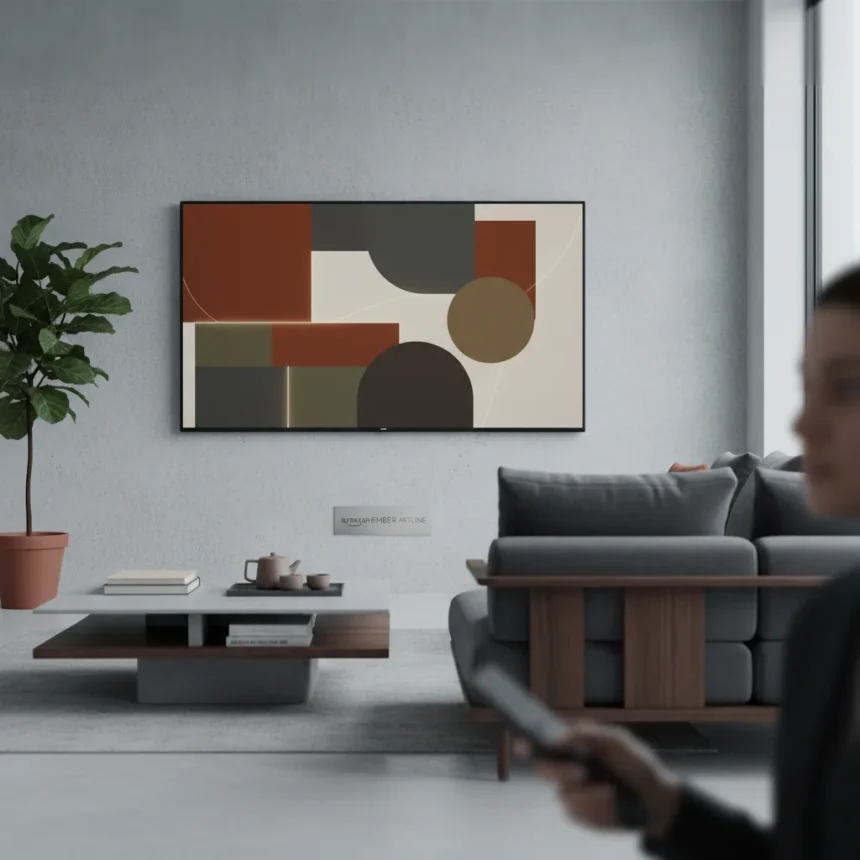
The Amazon Ember Artline TV is an “Art TV” designed to adapt digital artwork to match your room’s décor, blending entertainment and home design in a single display. After sitting directly in front of the device, the experience proved far more complicated than the marketing suggests. The promise is elegant: a television that doubles as a dynamic art gallery. The reality? Far messier.
Key Takeaways
- Amazon Ember Artline TV functions as both a television and adaptive digital art display for home décor.
- Hands-on experience with the device left the reviewer conflicted about its practical viability.
- Art TVs raise fundamental questions about whether dual-purpose displays solve a real problem or create a compromise product.
- The category competes with traditional TVs and traditional art—and may not beat either.
- Amazon’s entry into Art TVs signals market interest, but execution questions remain unanswered.
What the Amazon Ember Artline TV Actually Does
The Amazon Ember Artline TV is built around a core concept: when you’re not watching television, the screen displays curated digital artwork that adapts to your room’s lighting, color palette, and décor. It is not a passive art frame. The system actively responds to its environment, theoretically creating a seamless visual experience that feels less like a black rectangle on your wall and more like an integrated design element. The device sits at the intersection of entertainment and interior design, attempting to solve a problem that many homeowners face—the visual dead space created by a powered-off television.
This approach differs fundamentally from traditional television. A standard TV is a display device optimized for viewing content from a distance. Art TVs, by contrast, must excel at two competing tasks: delivering sharp, engaging television while also serving as a subtle, aesthetically pleasing backdrop when idle. Balancing these requirements is harder than it sounds. The Amazon Ember Artline TV attempts this balance through software and curated content libraries, but the tension between these goals becomes apparent during extended use.
The Conflicted Reality of Art TVs
Sitting in front of the Amazon Ember Artline TV reveals the core problem with the Art TV category itself. When displaying artwork, the device must maintain color accuracy and subtle detail—requirements that differ sharply from television’s brightness and contrast demands. When switching between art mode and television mode, the visual shift is jarring. The artwork display emphasizes subtlety and ambient integration. The television display prioritizes punch and clarity. A single device cannot optimize for both without compromises.



The reviewer’s conflicted reaction stems from this fundamental tension. The Amazon Ember Artline TV performs neither role perfectly. As a television, it competes against purpose-built displays optimized for motion, brightness, and fast refresh rates. As an art display, it competes against dedicated art frames and traditional wall art, which do not require power, software updates, or subscription services. The Amazon Ember Artline TV exists in an uncomfortable middle ground, asking users to accept trade-offs in both categories for the convenience of a single device.
This is not unique to Amazon’s offering. The broader Art TV category faces the same architectural challenge: any device built to serve two masters will serve both with less precision than a specialist tool. Samsung’s approach to this space, for example, uses similar adaptive display technology, but the fundamental compromise remains unchanged. You gain versatility. You lose optimization.



Is the Art TV Category Actually Viable?
The skepticism surrounding the Amazon Ember Artline TV extends beyond execution to the category itself. Art TVs assume homeowners want a powered display occupying prime wall real estate when not watching television. This assumption may not hold. Many users prefer a television that disappears into the wall when off, not one that actively displays content. Others invest in actual art—paintings, prints, photography—precisely because these mediums do not require electricity or software maintenance.
The Art TV pitch also assumes users will pay a premium for this dual functionality. The category requires either accepting a television that is not optimized for viewing, or accepting an art display that is not optimized for aesthetics. Neither is an easy sell. A consumer shopping for a television prioritizes picture quality and features. A consumer shopping for wall art prioritizes aesthetic impact and permanence. The Art TV asks both audiences to compromise, which is a difficult value proposition.
The Amazon Ember Artline TV’s arrival signals that major manufacturers believe the market exists. Whether consumers will embrace the category at scale remains an open question. The hands-on experience suggests that the gap between marketing promise and practical reality is substantial. Art TVs may remain a niche product for users with very specific needs: those who genuinely want both excellent television and ambient artwork in the same device, and who are willing to accept compromises in both areas to achieve it.
Who Should Actually Buy the Amazon Ember Artline TV?
The Amazon Ember Artline TV makes sense for a narrow audience. If you have a room where wall space is premium and you genuinely want both a television and a dynamic art display, the device offers a space-efficient solution. If you value the convenience of a single device over optimization in either role, the Amazon Ember Artline TV deserves consideration. If you are building a smart home and want tight integration with Amazon’s ecosystem, the device fits naturally into that infrastructure.



For everyone else, the math is harder. Traditional televisions offer better picture quality. Dedicated art frames offer better aesthetics and lower cost. Combining both separately gives you optimization in each category. The Amazon Ember Artline TV asks you to pay for versatility you may not need and accept compromises you do not want. The hands-on experience confirms that the device works as designed—the conflict is not about execution, but about whether the design itself solves a real problem for most users.
Can Art TVs Become Mainstream?
For Art TVs to move beyond niche status, manufacturers would need to either dramatically improve the art display quality without sacrificing television performance, or dramatically reduce the price premium. Currently, neither is happening. The technology required to deliver excellent performance in both modes simultaneously remains expensive and compromised. Amazon’s entry into the category suggests confidence, but confidence alone does not guarantee market adoption.
The broader question is whether Art TVs represent a genuine category evolution or a temporary experiment. Televisions have been optimized for decades. Wall art has existed for millennia. A device that attempts to replace both is fighting against entrenched consumer expectations and deep category expertise. The Amazon Ember Artline TV is competent at both tasks. It is exceptional at neither. That may be enough for early adopters. It is unlikely to be enough for mainstream adoption.
Does the Amazon Ember Artline TV justify the premium over a regular TV?
The justification depends entirely on your use case. If you actively want an art display that adapts to your room’s décor when the television is off, the premium may be worth it. If you see the art feature as a nice-to-have bonus, the cost difference makes a traditional television the smarter choice. Most users fall into the latter camp, which is why Art TVs remain a niche category.
How does the Amazon Ember Artline TV compare to traditional art frames?
The Amazon Ember Artline TV offers dynamic, updatable content that traditional art cannot match. However, traditional art requires no power, no software, and no subscription services. It also tends to look more intentional and permanent on a wall. For pure aesthetic impact, a well-curated piece of wall art typically outperforms a digital display, even one designed specifically for that purpose.
What makes Art TVs different from regular televisions?
Art TVs prioritize ambient display quality when the television is off, adapting artwork to your room’s environment. Regular televisions optimize for viewing performance and brightness. Art TVs make architectural and software compromises to excel at both tasks, whereas traditional televisions focus entirely on television performance. This fundamental difference explains why Art TVs occupy an awkward middle ground between televisions and art displays.
The Amazon Ember Artline TV represents an interesting experiment in merging two categories that have historically remained separate. The hands-on experience reveals why that separation exists. Televisions and art displays have fundamentally different design priorities. A device that serves both will inevitably disappoint users who prioritize either one. Amazon’s entry into Art TVs is noteworthy, but the category’s future remains uncertain. Until manufacturers solve the core compromise—optimizing for both television and art simultaneously—Art TVs will remain a solution searching for a problem most users actually have.
Where to Buy
Ember Artline | Amazon Ember Artline 55-inch:
Edited by the All Things Geek team.
Source: T3