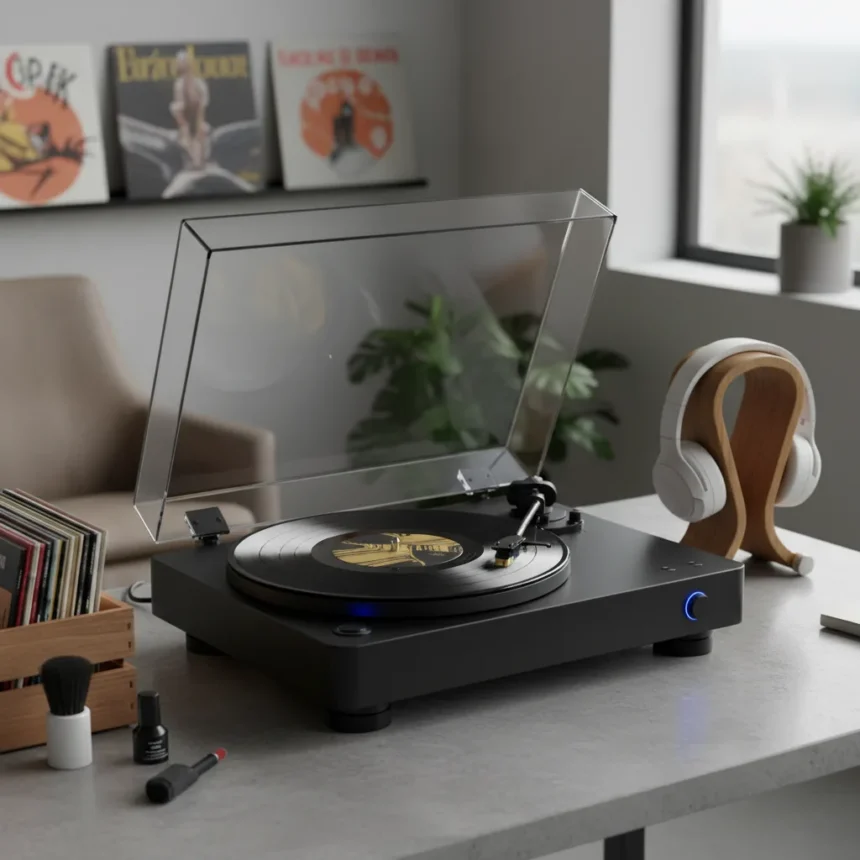
Bluetooth turntables have quietly solved one of vinyl’s biggest modern frustrations: how to play records without tethering yourself to a wired speaker system. These wireless record players let you spin your collection through Bluetooth headphones or speakers, marrying analog warmth with the freedom to move around your space. Whether you’re building your first setup or upgrading an existing one, understanding which Bluetooth turntables fit your needs—and how to keep your records in peak condition—matters more than ever.
Key Takeaways
- Bluetooth turntables eliminate the need for wired speaker connections while preserving vinyl sound quality.
- Entry-level Bluetooth models like the Audio-Technica AT-LP60XBT and Crosley Voyager offer affordable wireless listening.
- Higher-end options such as the Pro-Ject T1 Phono BT and Audio-Technica AT-LP120XBT-USB add features like USB recording and pitch control.
- Vinyl maintenance requires a cleaning brush, microfiber cloth, and record cleaning solution to protect your collection.
- A built-in phono preamp simplifies setup by eliminating the need for external amplification gear.
Why Bluetooth Turntables Matter Right Now
The vinyl revival is real, but most listeners don’t want to sacrifice modern convenience for it. Bluetooth turntables bridge that gap. Instead of running cables across a room to powered speakers or a receiver, you can pair your record player to any Bluetooth-enabled speaker or headphones instantly. The wireless connection doesn’t degrade sound quality significantly—a major advantage for anyone tired of the setup hassle that traditionally comes with analog playback. This shift has made vinyl accessible to a generation that expects wireless everything.
The appeal goes beyond novelty. A Bluetooth turntable works with your existing speaker ecosystem. Own a Sonos system? Connect wirelessly. Prefer a vintage stereo receiver? Use the RCA outputs instead. This flexibility is why models like the Crosley C100BT—a belt-driven turntable with electronic 33/45 RPM selection, stroboscope, pitch control, and an Audio-Technica AT95E cartridge—have gained traction as entry-level options. They don’t force you into one workflow.
Choosing the Right Bluetooth Turntable for Your Setup
Budget matters, but so does what features you actually need. Entry-level Bluetooth turntables like the Audio-Technica AT-LP60XBT, Sony PS-LX310BT, and Crosley Voyager keep costs down while delivering wireless playback. These models work well if you’re testing the waters or adding vinyl to a casual listening space. They typically include a built-in phono preamp, meaning you don’t need to buy additional amplification gear to get started.


If you want more control, step up to mid-range options. The Pro-Ject T1 Phono BT and Audio-Technica AT-LP120XBT-USB add features like USB recording, allowing you to digitize your records, plus adjustable features such as pitch control for DJs or collectors. The AT-LP120XBT-USB also includes a removable headshell, meaning you can swap cartridges if you want to experiment with different sound profiles. These machines reward tinkerers without demanding the five-figure investment of true high-end analog gear.
For those seeking networked listening rather than Bluetooth, the Victrola Stream Carbon represents an alternative approach. It uses Wi‑Fi connectivity and includes a built-in phono preamp and RCA outputs, letting you integrate it into smart-home systems or fall back to traditional wired speakers if needed. The choice between Bluetooth and Wi‑Fi often comes down to your existing ecosystem and whether you value the simplicity of Bluetooth pairing or the reliability of a dedicated network connection.



Essential Vinyl-Care Accessories You Actually Need
A Bluetooth turntable is only half the equation. Vinyl records are physical media that degrade with dust, fingerprints, and improper storage. The good news: maintaining them doesn’t require expensive equipment. You need three core items: a record cleaning solution, a cleaning brush or applicator, and a microfiber cloth. These basics prevent dirt from grinding into grooves and extend the life of both your records and your turntable’s stylus.
Wet cleaning is the most effective method. Apply a small amount of record cleaning solution—sometimes mixed with distilled water—to your applicator, then gently apply it to the record’s playing surface as it spins at 33 RPM. Hold the applicator steady across the width of the record for a couple of rotations, then drag it toward the outer edge to remove dirt and debris from the grooves. Flip the record and repeat on the other side, then let it dry naturally or wipe it with a fresh microfiber cloth. This process takes minutes but prevents months of degraded playback quality.
Don’t overlook the cartridge. The stylus that reads your records costs money to replace—the Audio-Technica AT95E, commonly included on entry-level turntables, runs around $49 when purchased separately. Keeping records clean directly protects this investment. A single grain of sand caught in a groove can damage a stylus faster than years of normal use. Regular cleaning is cheaper than cartridge replacement.
Bluetooth Turntables vs. Traditional Wired Setups
The traditional argument against wireless audio—that it introduces latency or sound loss—largely evaporates with modern Bluetooth codecs. Tom’s Guide’s broader record-player coverage confirms that Bluetooth playback does not diminish sound very much, making it a practical choice for most listeners. The real trade-off isn’t audio quality; it’s convenience versus control. A wired setup gives you precise impedance matching and zero latency, valuable for audiophiles who want to optimize every variable. A Bluetooth turntable gives you flexibility and ease, valuable for anyone who actually wants to listen to records without a degree in electronics.


That said, Bluetooth turntables with built-in phono preamps still require you to manage one critical detail: proper grounding. A phono preamp amplifies the tiny signal from your cartridge and corrects for the equalization curve vinyl requires. Built-in versions handle this automatically, eliminating the need to buy a separate preamp or receiver. This is why even budget Bluetooth models often include this feature—it’s the difference between a plug-and-play experience and a frustrating afternoon of troubleshooting.
Setting Up Your First Bluetooth Turntable
The setup process is straightforward. Unbox the turntable, place it on a level surface away from vibration sources like speakers or subwoofers, and plug it in. Pair it to your Bluetooth speaker or headphones using your device’s Bluetooth menu—most turntables enter pairing mode automatically on first power-up. If your model includes RCA outputs, you can also connect to a traditional receiver or powered speakers as a backup. This dual-connectivity is why Bluetooth turntables are so forgiving for beginners; you’re never locked into one listening method.
Calibration matters more than most new listeners realize. Place the tonearm on a record and check that the stylus sits properly in the groove without excessive force. Most turntables ship with a counterweight adjustment that controls tracking force—the pressure the stylus exerts on the record. Too much force damages vinyl; too little causes skipping and distortion. If your model includes a removable headshell or adjustable counterweight, spend ten minutes getting this right. It’s the single most important step for protecting your records and maximizing sound quality.
Frequently Asked Questions
Do Bluetooth turntables sound as good as wired ones?
Bluetooth turntables sound nearly identical to wired models because the Bluetooth connection carries the amplified signal, not the delicate cartridge output. The real sound quality depends on your cartridge, turntable construction, and speakers—not the connection type. Entry-level Bluetooth and entry-level wired turntables sound similar; the same applies at higher price points.
What’s the difference between a turntable with a built-in preamp and one without?
A built-in phono preamp amplifies and equalize the cartridge signal, so you can connect directly to powered speakers or receivers. Without one, you need a separate preamp or receiver with a dedicated phono input. Built-in preamps simplify setup and save money, which is why most Bluetooth turntables include them.
How often should I clean my vinyl records?
Clean records before first play and then as needed—typically every few months if you play them regularly. Visible dust or audible pops and crackles are signs your records need cleaning. Regular maintenance prevents buildup that damages both your records and stylus over time.
Bluetooth turntables have made vinyl accessible without forcing you to choose between analog warmth and modern convenience. Whether you’re spinning a single album or building a serious collection, the right turntable paired with basic maintenance habits ensures your records sound great for years to come. Start with a budget-friendly Bluetooth model, invest in cleaning supplies, and you’re ready to enjoy vinyl the way it’s meant to be heard—wirelessly.
Where to Buy
FluanceFluance Vinyl Record & Stylus Cleaning Kit$19.99shop now | menesiaMenesia Record Weight Stabilizer$9.99shop now | Hudson Hi-FiHudson Hi-Fi 100x Inner & 100x Outer Protective Sleeves$39.95shop now | GrooveWasherGroovewasher Vinyl Record Cleaning Kit$49.50shop now | 40% OFFMarleyHouse of Marley Stir It Up Turntable$149.99$249.99shop now
Edited by the All Things Geek team.
Source: Tom's Guide