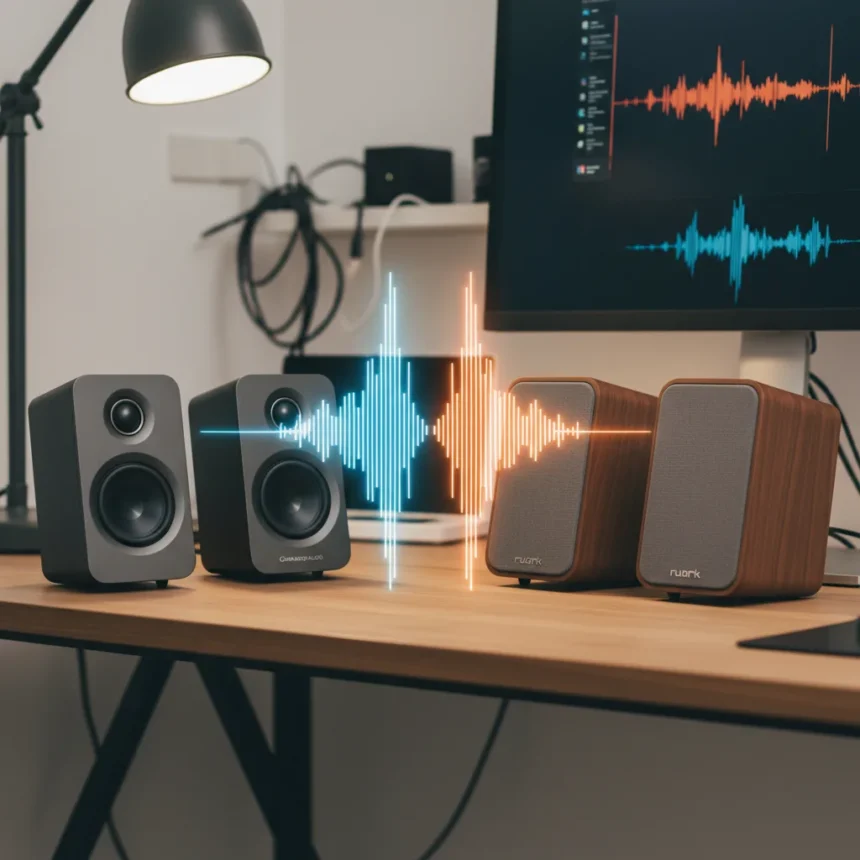
The compact desktop speakers market is heating up. Cambridge Audio’s new L/R S enters a direct price-and-performance battle with the established Ruark Audio MR1 Mk3, both landing at roughly £399 per pair. But sound quality tells a different story than the price tag suggests.
Key Takeaways
- Cambridge L/R S and Ruark MR1 Mk3 cost the same (£399) but deliver noticeably different sonic signatures
- Ruark MR1 Mk3 outperforms in rhythmic punch, dynamic range, and midrange clarity
- Cambridge L/R S lacks a phono stage and volume controls on the unit itself
- L/R S supports aptX HD Bluetooth and optical up to 24-bit/192kHz with compatible streamers
- Ruark MR1 Mk3 includes real wood veneer finish at no extra cost
Sound Quality: Where the Ruark Pulls Ahead
The Ruark MR1 Mk3 has the edge in the areas that matter most for active listening. What Hi-Fi found the Ruark delivers superior rhythmic impetus, dynamic expression, and soundstage size compared to the Cambridge L/R S. When playing demanding tracks like Massive Attack’s “Angel,” the Ruark sounds more muscular and engaging, while the Cambridge presents what reviewers describe as a “cloudy veil” over the midrange.
The Cambridge L/R S, by contrast, uses 100 watts of Class D power across four drivers—a 21mm hard-dome tweeter and 76mm mid/bass driver per speaker—with a claimed frequency response of 55Hz–24kHz. Despite this capable spec sheet, the speaker struggles to match the Ruark’s tonal refinement. The L/R S also slightly overplays low-frequency information, which can muddy detail in the crucial midrange where vocals and instruments live.
That said, the Cambridge does create a soundstage that sounds larger than its compact 226 x 134 x 180mm footprint suggests, making it capable of filling a modest desk with convincing stereo imaging. For casual listening or secondary rooms, this spatial presentation has real appeal.



Connectivity and Physical Design
The Cambridge L/R S offers more input flexibility than you might expect from a compact speaker. It includes RCA line level, optical, and USB-C inputs, plus a subwoofer output for those who want to add low-end grunt. Bluetooth codecs span aptX HD, aptX, SBC, and AAC. The optical input on the Ruark MR1 Mk3 supports high-resolution audio up to 24-bit/192kHz when paired with compatible streamers like the WiiM Pro Plus.
Here’s where the Cambridge stumbles: it has no physical volume or input controls on the unit itself, meaning you’re tethered to an app or remote for basic adjustments. The Ruark MR1 Mk3, meanwhile, includes a phono stage for turntable users—a feature the Cambridge completely lacks. If vinyl is part of your listening routine, this is a decisive advantage for the Ruark.



The Ruark also ships with real wood veneer at no extra cost, giving it a more premium aesthetic on a desk compared to the Cambridge’s more utilitarian appearance.
Should You Buy the Cambridge L/R S or Ruark MR1 Mk3?
Choose the Ruark MR1 Mk3 if sound quality is your priority and you value a phono stage or want speakers that sound polished across all genres. Its dynamic range and midrange clarity justify the small price premium over the Cambridge. Choose the Cambridge L/R S if you prioritize connectivity options, Bluetooth codec support (aptX HD is a nice touch), and are willing to accept a slightly softer, less muscular presentation in exchange for a compact footprint that still images convincingly. The L/R S also makes sense if you plan to add a subwoofer later—that dedicated output gives you flexibility the Ruark doesn’t offer.
Neither speaker is a wrong choice at this price point, but they serve different listeners. The Ruark suits discerning ears and vinyl enthusiasts. The Cambridge suits convenience-focused users and those who value flexibility over absolute sonic refinement.
How do the Cambridge L/R S and Ruark MR1 Mk3 compare in size?
The Cambridge L/R S measures 226 x 134 x 180mm per speaker. The Ruark MR1 Mk3 is described as even more compact, making it the tighter fit for truly cramped desks. Both are genuinely small by active speaker standards.



Does the Cambridge L/R S have a phono input for turntables?
No. The Cambridge L/R S lacks a phono stage entirely, so you cannot connect a turntable directly. The Ruark MR1 Mk3 includes one, making it the better choice for vinyl listeners.
Can I control the Cambridge L/R S volume without a remote?
No. The L/R S has no physical volume or input controls on the speaker itself. You must use an app or remote to adjust levels, which is inconvenient if you frequently switch between sources or just want quick access to volume.
The compact desktop speaker category rewards different priorities depending on your setup and listening habits. The Ruark MR1 Mk3 wins on pure sound quality and feature completeness, but the Cambridge L/R S remains a solid alternative if connectivity and flexibility matter more to you than absolute sonic prowess. At the same price, the Ruark edges ahead—but neither speaker will disappoint if your desk space is tight and your budget is modest.
Where to Buy
Edited by the All Things Geek team.
Source: What Hi-Fi?