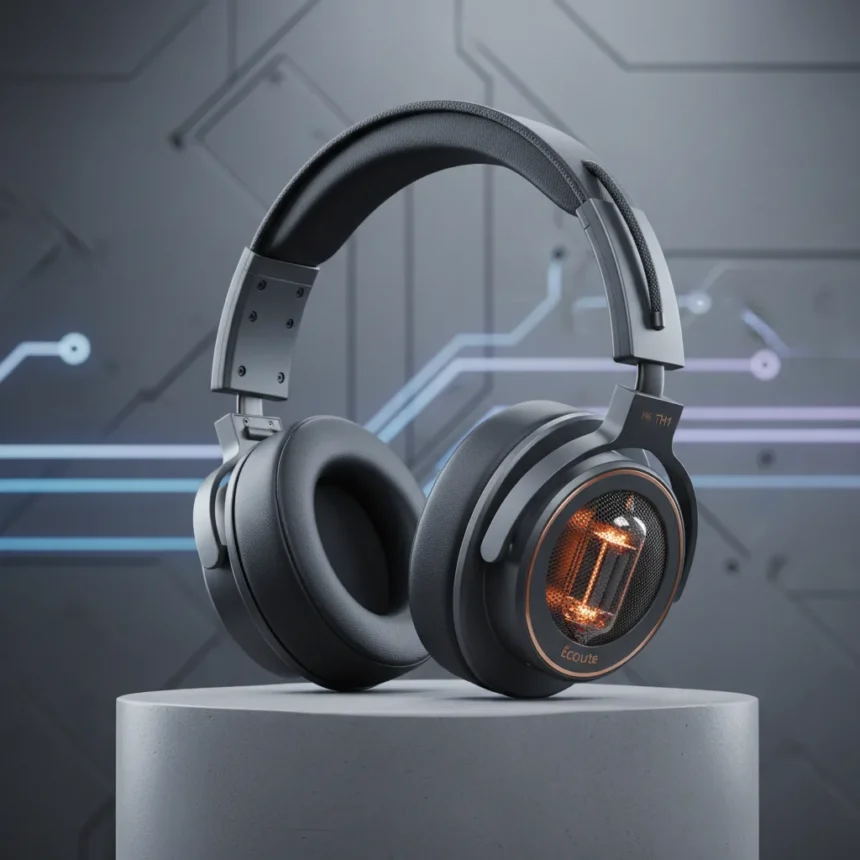
The Écoute TH1 wireless headphones are closed-back over-ear audiophile headphones with a built-in Nutube 6P1 dual-triode vacuum tube preamp and DAC, weighing 424 grams and measuring 210 x 168 x 92mm. They represent an unusual marriage of analog tube warmth and modern wireless connectivity—a design that challenges the assumption that portable audio must sacrifice sonic character for convenience.
Key Takeaways
- Built-in Nutube 6P1 vacuum tube preamp delivers analog warmth in wireless over-ear form
- 40mm titanium-coated Mylar transducers with Class A/B dual-mono amplification
- Dual connectivity: Bluetooth 5.3 with LDAC codec, USB-C DAC for 32bit/384kHz high-resolution audio, and 3.5mm analog jack
- 20-hour battery life at maximum volume; 3.5-hour charging via USB-C
- Passive isolation 15-20 dB; ANC adds approximately 5 dB additional isolation
Why Tube Preamps Matter in Wireless Headphones
Vacuum tube preamps are almost never found in wireless headphones because they demand power, generate heat, and complicate miniaturization. The Écoute TH1 solves this by using the compact Nutube 6P1, a small-signal triode that delivers the harmonic coloration and compression characteristics audiophiles associate with analog warmth. This is not a gimmick—it is a genuine design choice that shapes the frequency response and dynamic character of every signal passing through the headphones.
The preamp feeds into a high-bias Class A/B dual-mono amplification stage, meaning each ear receives its own dedicated amplifier circuit. This topology reduces crosstalk and improves stereo separation compared to single-amplifier designs. The result is a soundstage described as more refined, wider, and more holographic than the Sennheiser Momentum 4, though with noticeably less bass emphasis. The bass reaches down to 35 Hz with low distortion across volumes, delivering deep extension without bloat.
Écoute TH1 Wireless Headphones Sound Character and Frequency Response
The midrange is the signature strength of the Écoute TH1 wireless headphones. Vocals and instruments occupy a clear, detailed center stage without the hollow or overly thin character that plagues some audiophile headphones. The treble extends and remains airy, delivering a sense of openness and detail that rewards classical, jazz, and acoustic recordings. The bass is deep and clear without overpowering the midrange, a balance that shifts depending on which sonic mode you select or which preset—Écoute or Harman—you load via the companion app.



Passive isolation ranges from 15-20 dB, and active noise cancellation adds approximately 5 dB of additional isolation. Maximum volume sits around 100-105 dB, a firmware update was promised to increase this ceiling, though the headphones remain limited by design to protect hearing. For a wireless headphone with tube electronics, this is respectable—not stadium-loud, but sufficient for most listening environments.
Connectivity, Controls, and Battery Performance
The Écoute TH1 wireless headphones offer three connectivity pathways. Bluetooth 5.3 with LDAC codec support is the primary wireless option, offering 10-meter range and profiles for audio streaming, call handling, and voice commands. USB-C accepts high-resolution digital audio up to 32bit/384kHz, allowing wired connection to computers or DAPs without activating Bluetooth. A 3.5mm analog jack provides passive audio input when the battery is dead or when you want to bypass all electronics entirely.



Physical on-ear controls handle volume, track navigation, and call management. The right earcup manages play, pause, and power; the left handles volume adjustment. A built-in microphone handles basic calls with good clarity, though it lacks the broadcast-quality boom microphone you would find in gaming-focused headphones like the Maxwell. Battery life reaches 20 hours at maximum volume with a 1500mAh cell, 30 hours in standby, and 3.5-hour recharge time via USB-C.
How the Écoute TH1 Compares to Wireless Alternatives
The Sennheiser Momentum 4 is the closest competitor in terms of wireless audiophile positioning, but the TH1 trades some bass impact for a wider, more holographic soundstage and superior midrange clarity. The Momentum 4 leans warmer and bassier; the TH1 is more linear and transparent, with the vacuum tube preamp adding subtle harmonic richness rather than aggressive coloration. If you prioritize gaming or call quality, the Maxwell’s broadcast-grade microphone is a significant advantage the TH1 does not match. But for music listening, the TH1’s sonic refinement and analog pedigree create a different category entirely.
Is the vacuum tube preamp worth the engineering complexity?
Yes, if you listen critically to music and value midrange clarity and soundstage width over bass punch. The Nutube 6P1 preamp is not snake oil—it measurably shapes the frequency response and adds harmonic compression that makes vocals and instruments feel more present and three-dimensional. For casual listeners or gaming, the added complexity is unnecessary.
How long does the Écoute TH1 battery last on a single charge?
The Écoute TH1 wireless headphones deliver 20 hours of playtime at maximum volume with a 1500mAh battery. Standby time extends to 30 hours, and USB-C charging takes 3.5 hours. Real-world battery life depends on volume level and whether ANC is active.



Can you use the Écoute TH1 wired without the battery?
Yes. The 3.5mm analog jack allows passive audio input independent of battery charge, and the USB-C port accepts high-resolution digital audio up to 32bit/384kHz when connected to a computer or portable DAP. This flexibility is rare in wireless headphones and appeals to users who value redundancy and analog-first workflows.
The Écoute TH1 wireless headphones succeed because they refuse to compromise on either end of the audio spectrum. They are wireless and portable, yet they prioritize sonic character and detail over convenience features like noise cancellation or gaming microphones. For audiophiles willing to carry 424 grams of tube-powered engineering, they deliver a listening experience that justifies the unconventional design.
Edited by the All Things Geek team.
Source: What Hi-Fi?