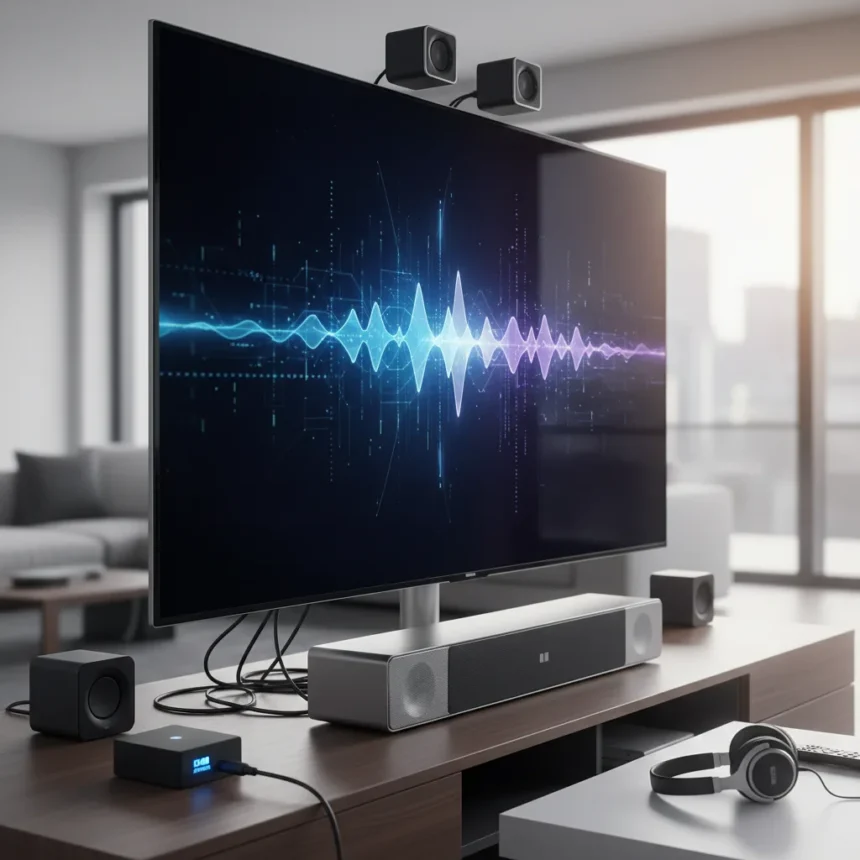
Free-to-air TV Dolby Atmos is finally arriving—and it works on the television you already own. No internet required. No subscription fee. No ATSC 3.0 tuner upgrade. Instead, broadcasters are encoding immersive audio directly into Dolby Digital Plus (DD+) bitstreams that current ATSC 1.0 tuners can receive and pass through to compatible soundbars and receivers via standard HDMI ARC ports.
Key Takeaways
- Free-to-air TV Dolby Atmos uses Dolby Digital Plus encoding on existing broadcast infrastructure without requiring ATSC 3.0 tuners.
- Height channels deliver overhead sound effects, creating immersive audio beyond traditional 5.1 or 7.1 surround setups.
- Backward compatible with legacy content; works with any TV or soundbar featuring HDMI ARC connectivity.
- No subscription or internet connection needed; free-to-air broadcasts compete directly with streaming services on audio quality.
- Rollout is already underway in supported markets with existing equipment compatible immediately.
This is a watershed moment for broadcast television. For years, free-to-air TV has felt left behind by streaming services, which offer Dolby Atmos as standard on Netflix, Prime Video, and other platforms. OTA broadcasts have been locked into 5.1 surround sound while cord-cutters with cable subscriptions got spatial audio. Free-to-air TV Dolby Atmos closes that gap without asking viewers to buy new hardware or pay monthly fees.
How Free-to-Air TV Dolby Atmos Actually Works
The technical elegance here lies in using DD+ as the delivery mechanism. Dolby Digital Plus supports Atmos extensions for spatial audio without requiring the higher bandwidth that Dolby TrueHD demands. Broadcast stations encode Atmos content into DD+ bitstreams at 48 kHz sampling rate—the same standard used by streaming services. Your TV tuner receives the signal via antenna, decodes it, and passes the Atmos metadata through your HDMI ARC port to a compatible soundbar or audio receiver, which then renders the spatial objects to physical speakers, including height channels for overhead effects.
The beauty of this approach is backward compatibility. Older televisions without Atmos support will simply decode the DD+ signal as standard 5.1 surround sound and never know the difference. Content providers don’t have to maintain separate feeds. Viewers with modern ARC-equipped TVs get immersive audio; everyone else gets reliable legacy audio. That’s a rarity in broadcast technology, where upgrades typically fracture audiences into haves and have-nots.


Why This Matters More Than It Seems
Free-to-air TV Dolby Atmos represents a direct challenge to streaming’s audio dominance. For nearly a decade, the industry narrative has positioned OTA television as a dinosaur—grainy picture quality, limited content, stuck in the past. Yet here’s broadcast television adopting the same immersive audio technology that Netflix and Amazon Prime tout as premium features, delivering it at no cost and with zero internet dependency.
That’s powerful for cord-cutters tired of subscription fatigue. You can watch free-to-air broadcasts with Atmos-capable soundbars and get the same spatial audio experience as a streaming subscriber—minus the monthly bill. For households with multiple TVs or budget constraints, that matters enormously. Dolby Atmos adds height channels and object-based audio that positions sound in three-dimensional space, creating effects like rain falling from above or helicopters moving overhead, rather than just left-to-right panning.



The contrast with ATSC 3.0 is instructive. NextGen TV promised 4K resolution and immersive audio but required entirely new broadcast infrastructure and viewer hardware. Free-to-air TV Dolby Atmos achieves the audio part using existing ATSC 1.0 systems, no new tuners necessary. It’s a pragmatic win for broadcasters who can’t afford wholesale equipment replacement and for viewers who won’t buy new hardware for a feature they can get free on their current setup.
Compatibility and Setup Requirements
To hear free-to-air TV Dolby Atmos, you need three things: a TV with a compatible tuner (virtually all modern sets), an HDMI ARC port on that TV, and a soundbar or audio receiver that supports Dolby Atmos decoding. HDMI 2.1 is preferred for maximum compatibility, but HDMI ARC—the audio-return-channel standard found on most TVs sold in the last five years—will work fine for broadcasts. You don’t need eARC, the faster variant. You don’t need new cables. You don’t need to install anything or sign up anywhere.
Backward compatibility is near-total. If your soundbar or receiver can decode Dolby Digital Plus, it can theoretically handle Atmos extensions embedded within that stream. Some older equipment may not recognize the Atmos metadata, in which case you’ll hear standard surround sound instead—no errors, no degradation, just legacy audio. This is the opposite of ATSC 3.0, which would simply fail on incompatible tuners.
The Bigger Picture: Free TV’s Competitive Resurgence
Streaming services have convinced viewers that premium audio and video quality require monthly payments. Free-to-air TV is methodically dismantling that assumption. First came improvements to picture quality and content variety. Now comes immersive audio at parity with paid platforms. The trend suggests broadcast television isn’t fading—it’s evolving to compete on terms it can actually win: cost and accessibility.


This also reveals a weakness in the streaming model. To get Atmos, you need a subscription, an internet connection, and compatible hardware. Free-to-air TV Dolby Atmos needs only the last of those three. For rural viewers with poor broadband, for budget-conscious households, and for anyone skeptical of subscription lock-in, OTA broadcasts suddenly look far more appealing.
What About Next-Gen TV (ATSC 3.0)?
ATSC 3.0 still has a role, but it’s narrower than once imagined. NextGen TV can deliver 4K resolution and immersive audio, but it requires new broadcast infrastructure and new tuners in every TV sold going forward. Free-to-air TV Dolby Atmos delivers the audio part of that promise using infrastructure that already exists. Broadcasters can roll out Atmos now, without waiting for the industry to standardize on ATSC 3.0 or for manufacturers to embed new tuners in millions of televisions.
That’s a pragmatic victory. ATSC 3.0 remains the long-term play for 4K broadcast, but free-to-air TV Dolby Atmos is the immediate win for audio—and for many viewers, that’s the upgrade that matters most.
When Can You Actually Get This?
Free-to-air TV Dolby Atmos is already rolling out in supported broadcast markets, with no specific launch date announced for all regions. If your area has a compatible broadcaster and your TV has HDMI ARC, you may already be receiving Atmos-encoded content without realizing it. Check your TV’s audio settings and your soundbar’s manual to confirm Atmos support, then scan for channels as usual.
Is my current TV compatible with free-to-air TV Dolby Atmos?
If your TV has HDMI ARC and was manufactured in the last five years, it almost certainly is. HDMI ARC is standard on modern televisions. The critical factor is whether your audio system—soundbar, receiver, or headphones—supports Dolby Atmos decoding. Check your device’s specifications or manual for Atmos certification.
Do I need a new antenna or tuner for free-to-air TV Dolby Atmos?
No. Free-to-air TV Dolby Atmos works with your existing antenna and ATSC 1.0 tuner. The Atmos metadata is embedded in the same Dolby Digital Plus signal your current TV already decodes. No hardware upgrade is required.
How does free-to-air TV Dolby Atmos compare to streaming Atmos?
The audio quality and spatial rendering are equivalent—both use DD+ Atmos at 48 kHz sampling rate. The difference is distribution: streaming requires internet and subscriptions; free-to-air requires only an antenna and compatible audio hardware. Content libraries differ, but for viewers interested in broadcast television, OTA Atmos is now competitive with streaming on audio quality alone.
Free-to-air TV Dolby Atmos is a quiet revolution. It doesn’t demand new hardware, doesn’t require subscriptions, and doesn’t need internet. It simply takes technology that already exists and deploys it on broadcast television to finally give cord-cutters the immersive audio experience that streaming subscribers have enjoyed for years. For a medium that many wrote off as obsolete, that’s a compelling reminder that free television still has life left in it.
Edited by the All Things Geek team.
Source: TechRadar