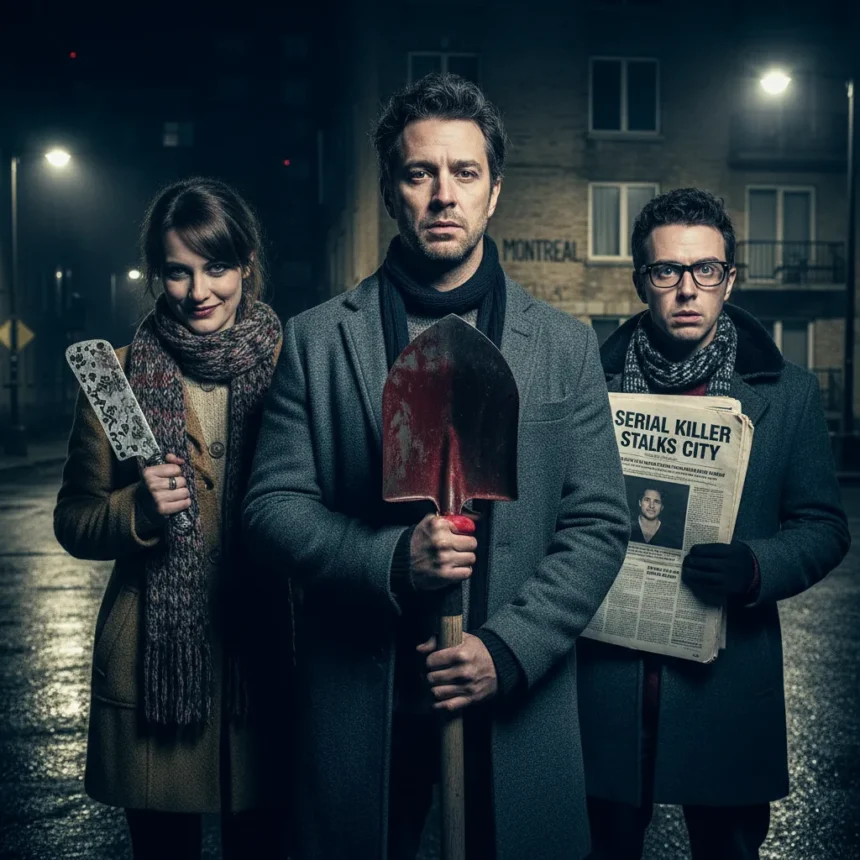
Good Neighbours is a 2011 Canadian dark comedy thriller made by Luc Allard, streaming on Prime Video, where three Montreal apartment neighbors descend into bizarre violence and mutual suspicion while a serial killer terrorizes their neighborhood. The film stars Jay Baruchel as Victor, a new resident who befriends wheelchair-bound Spencer and cat-loving Louise in a three-story brownstone in the Notre-Dame-de-Grâce district. What begins as cordial cohabitation spirals into chaos when the building’s residents prove far more dangerous than the predator hunting the city outside their walls.
Key Takeaways
- Good Neighbours blends pitch-black comedy with graphic violence, swerving between mundane and brutal without warning.
- The film features one of the most memorable murder scenes in recent cinema—brutal and hilarious simultaneously.
- Jay Baruchel and Scott Speedman anchor a story about ordinary people doing extraordinary horrible things.
- Reviews clash sharply: critics praise its twisted humor while some dismiss it as lacking conventional thriller suspense.
- Streaming on Prime Video, it remains an underseen gem for audiences seeking dark indie fare.
Why Good Neighbours Works as Dark Comedy, Not Thriller
Good Neighbours succeeds precisely because it abandons thriller conventions. The New York Times captured this perfectly: the film is not a crackerjack thriller by design—it is a dark comedy about people who do horrible things. That distinction matters. If you enter expecting jump scares, plot twists, or a detective’s methodical hunt, you will leave disappointed. If you want to watch three neighbors gradually reveal themselves as fundamentally unhinged, you have found your film. The serial killer terrorizing Montreal becomes almost secondary to the psychological unraveling happening inside the apartment building itself.
Rotten Tomatoes describes the film as swerving from bland to brutal, endearingly coy to shockingly explicit, finding pitch-black comedy among white-bread lives. This tonal whiplash is intentional. Victor arrives as a quiet, forgettable neighbor. Spencer wheels through the hallways with polite distance. Louise tends her cats with domestic obsession. Then poison appears. Cats die. Revenge plans hatch. The violence escalates not from external threat but from the neighbors themselves, each convinced the others pose the real danger. That is the dark comedy at work: ordinary people in an ordinary building becoming monsters through proximity and suspicion.
The Film’s Brutal Centerpiece
Audiences consistently highlight one scene as the film’s masterstroke: a murder sequence that manages to be both brutal and hilarious at the same time. This is not gratuitous gore played for shock value. The scene works because it emerges organically from the neighbors’ escalating paranoia and twisted logic. It is the moment where Good Neighbours fully commits to its identity—neither thriller nor comedy, but something darker that refuses to choose between them. For cat lovers especially, the film carries weight; the poisoning of Louise’s cats becomes a turning point that transforms the entire narrative from darkly comic to genuinely menacing.



Mixed Critical Reception Reveals the Film’s Divisiveness
Critics cannot agree on whether Good Neighbours is brilliant or broken. Metacritic reviewers note that even when the plot becomes too obvious and the thriller aspects fall apart, the film can wrestle a laugh out of you. That observation cuts both ways—some read it as a strength, others as a fundamental flaw. Movieguide takes a harsher stance, calling the film awful and arguing it fails as a thriller because it is not thrilling or suspenseful at all. That reviewer missed the point. Good Neighbours was never aiming for suspense. It aims for discomfort, dark humor, and the creeping realization that your neighbors are strangers wearing familiar faces.
The film’s greatest strength is its refusal to play by genre rules. It does not build tension toward a climax. It does not resolve neatly. It simply shows three people spiraling into increasingly unhinged behavior, each convinced they are the sane one. That approach alienates viewers seeking conventional narrative satisfaction. It delights viewers who appreciate unsettling, character-driven dark comedy with a body count.



Why Good Neighbours Remains Underseen
Good Neighbours arrived in 2011 to modest theatrical attention and has since lived in streaming limbo—available but not promoted, present but forgotten. Prime Video does not market it as a prestige indie gem. It sits in the algorithm without fanfare. That obscurity is partly the film’s fault. It does not fit neatly into genre categories, making it hard to market and easy to overlook. A viewer browsing Prime Video for a thriller finds it lacks conventional thrills. A viewer seeking comedy finds it too violent and dark. The film exists in the cracks between categories, which is exactly where the best underseen films live.
Compared to mainstream serial killer narratives, Good Neighbours offers something genuinely different. It does not glorify the killer or treat the investigation as a puzzle to solve. The killer remains a distant abstraction while the real horror unfolds in domestic spaces between people who share walls. That perspective shift—focusing on the neighbors rather than the crime—distinguishes it from countless other dark thrillers crowding streaming platforms.
Should You Watch Good Neighbours?
If you appreciate dark comedy with genuine stakes, unsettling character studies, and a willingness to be weird and violent without apology, Good Neighbours demands your attention. The film runs 1 hour 38 minutes, short enough for a single evening but dense enough to linger afterward. Jay Baruchel and Scott Speedman deliver understated performances that let the absurdity build gradually. The Montreal setting grounds the strangeness in a real place, making the neighbors’ descent into chaos feel more credible and disturbing.
If you need plot momentum, conventional thrills, or a satisfying resolution, skip it. If you want to be entertained by a story that respects your intelligence and does not explain its darkness, stream it tonight.



Is Good Neighbours actually a thriller?
Not in the traditional sense. It is marketed as a dark comedy thriller, but the thriller elements are secondary to the character dynamics and dark humor. The film prioritizes psychological unraveling over plot mechanics, making it fundamentally a comedy that contains violent and disturbing content rather than a thriller that occasionally cracks jokes.
Why do people call Good Neighbours a must-see for cat lovers?
A pivotal plot point involves the poisoning of Louise’s cats, which sets off a chain reaction of revenge and suspicion among the neighbors. The scene is both darkly funny and genuinely disturbing, and it becomes a turning point where the film shifts from comedic to menacing.
Where can you watch Good Neighbours?
Good Neighbours is currently streaming on Prime Video, available to subscribers. The 2011 Canadian film is easy to find once you know it exists, though it remains criminally overlooked among the platform’s vast catalog of more heavily promoted content.
Good Neighbours succeeds because it refuses to be what audiences expect. It is not a great thriller, but it is a genuinely unsettling dark comedy that trusts viewers to find humor in discomfort. If you are tired of predictable streaming fare and want something that actually surprises you, Prime Video’s most underrated gem is waiting in your queue.
Where to Buy
Stream "Good Neighbours" on Prime Video
Edited by the All Things Geek team.
Source: Tom's Guide