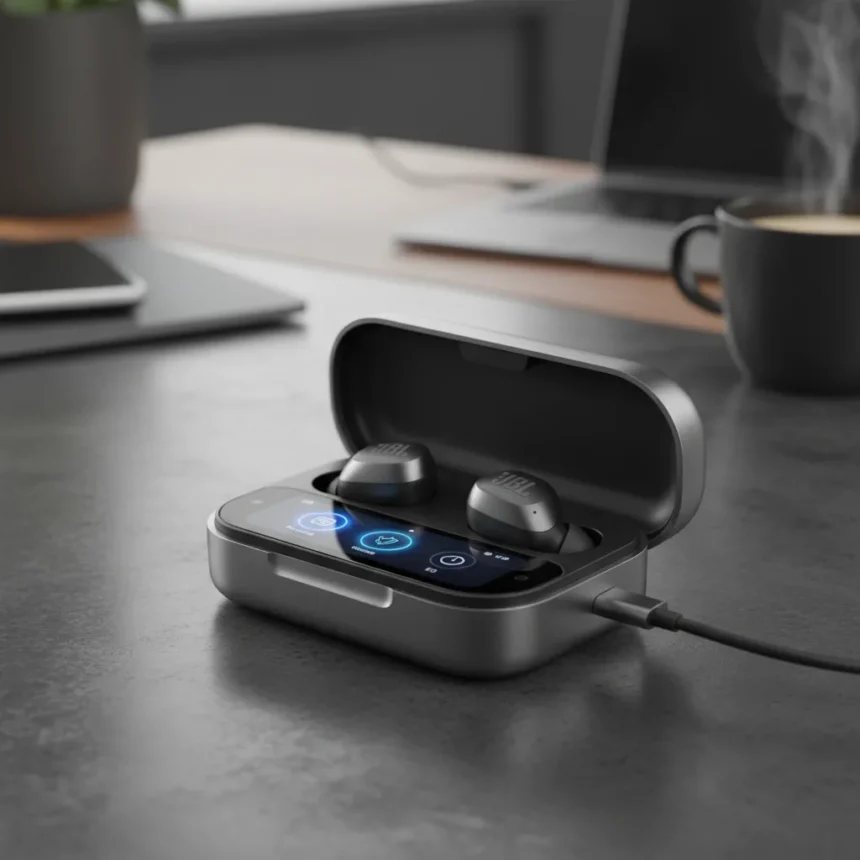
JBL Live Buds 4 are premium wireless earbuds made by JBL, featuring a groundbreaking Smart Charging Case with Smart OS 3.0 that delivers battery visibility and audio controls without pairing to a device. This standalone functionality—battery checks, EQ adjustments, active noise cancellation toggles, and track skipping—exists nowhere else on AirPods Pro 3, Sony WF-1000XM5, Bose QuietComfort Ultra Earbuds, or Samsung Galaxy Buds models. The innovation raises a blunt question: why haven’t other premium audio brands thought of this already?
Key Takeaways
- JBL Live Buds 4 include a touchscreen Smart Charging Case with standalone audio controls, unseen on competing premium earbuds
- Three models available: Live Buds 4 (no stem), Live Beam 4 (stem with silicone tip), Live Flex 4 (semi-open stem design)
- All three feature True Adaptive 2.0 noise cancelling and 10 mm or 12 mm dynamic drivers
- Smart Case allows battery status, EQ, ANC, and track control without smartphone pairing
- Direct competitor to Apple AirPods Pro 3 with a feature Apple has not yet matched
JBL Live Buds 4 Smart Charging Case Explained
The Smart Charging Case with Smart OS 3.0 is the feature that separates JBL Live Buds 4 from every other premium earbud on the market. A small touchscreen on the case itself displays battery percentage for both buds and case, eliminating the need to open an app or pair with a phone to check power status. From that same case interface, users control EQ presets, toggle True Adaptive 2.0 noise cancelling on and off, and skip tracks—all without touching a device. This is not a minor convenience; it is a fundamental rethinking of how earbuds interact with users in real-world scenarios. Apple’s AirPods Pro 3 require smartphone interaction for equivalent controls. Sony’s WF-1000XM5 and Bose’s QuietComfort Ultra Earbuds lack any case-based control interface whatsoever.
The case design itself matters. Unlike charging cases that are purely utilitarian black rectangles, JBL’s Smart Case becomes a second control hub. For commuters, gym-goers, or anyone who switches between devices frequently, this eliminates friction. You do not need to unlock your phone, open an app, and hunt for the settings you want. The controls live on the case. That simplicity is the entire point.
Three Models, One Innovation
JBL Live Buds 4 come in three distinct form factors, each with the same Smart Charging Case advantage. The Live Buds 4 are traditional in-ear buds with no stem—the most compact option, available in Black, Blue, Silver, and Sand. The Live Beam 4 adopt the stem design with silicone tips, a form factor popularized by AirPods Pro, and ship in seven color options including Green and Purple. The Live Flex 4 take a semi-open approach with no silicone tip, featuring larger 12 mm dynamic drivers compared to the 10 mm drivers in the other two models, and also available in seven colors. All three models share True Adaptive 2.0 noise cancelling, meaning the core audio experience is comparable across the lineup—the choice becomes purely about fit preference and aesthetic.



The color variety alone signals JBL’s intent to compete directly with Apple’s ecosystem-driven loyalty. Where AirPods Pro come in white only, JBL offers seven color choices across two of its three models. For users who want their earbuds to match their phone or personal style, this is a meaningful differentiation. It is a small detail, but small details compound into reasons to choose one brand over another.
Why This Feature Matters for the Entire Industry
The Smart Charging Case with Smart OS 3.0 is not just a feature—it is a statement about earbud design philosophy. Premium earbuds have become increasingly dependent on smartphone apps for basic functionality. Want to change your noise cancellation level? Open the app. Want to adjust EQ? Open the app. Want to skip a track? Either use the earbud touch controls (which are finicky and unreliable on most models) or pull out your phone. JBL has identified this friction point and solved it at the hardware level.



This approach also addresses a real-world scenario that smartphone-app-dependent earbuds ignore: what happens when your phone dies, is in another room, or you are switching between multiple devices? With JBL Live Buds 4, the case remains functional and responsive. The case becomes the primary interface, not a secondary afterthought. That is why every audio brand should be taking notes. Sony, Bose, Apple, and Samsung have all optimized for app integration; none have prioritized the case as a control surface. JBL has found a gap in the market and filled it.
How JBL Live Buds 4 Compare to AirPods Pro 3
Apple AirPods Pro 3 remain the market leader in premium earbuds, but JBL Live Buds 4 now offer something AirPods cannot: standalone case controls. AirPods Pro 3 rely entirely on Siri voice commands or iPhone app controls for adjusting settings. If you are in a noisy environment, Siri becomes unreliable. If your phone is across the room, you cannot quickly toggle ANC. JBL’s approach is more practical. Both earbuds offer active noise cancellation, but only JBL’s case gives you immediate, tactile access to those controls without a device. For users in ecosystems beyond Apple—Android users, Windows users, or anyone with multiple devices—JBL Live Buds 4 represent a more flexible option. The trade-off is that AirPods integrate more smoothly with iPhones and Apple Watches, while JBL offers broader device compatibility and superior case usability.
Frequently Asked Questions
What makes the JBL Live Buds 4 Smart Charging Case unique?
The Smart Charging Case features a touchscreen interface running Smart OS 3.0, allowing users to check battery status, adjust EQ, toggle noise cancelling, and skip tracks directly from the case without pairing to a smartphone. No other major premium earbud brand—Apple, Sony, Bose, or Samsung—offers this standalone case functionality.
Which JBL Live Buds 4 model should I choose?
The choice depends on fit preference. The Live Buds 4 are stemless and most compact; the Live Beam 4 use a traditional stem with silicone tips; the Live Flex 4 are semi-open with larger 12 mm drivers for enhanced bass. All three include the Smart Charging Case and True Adaptive 2.0 noise cancelling, so the core experience is consistent across models.



How do JBL Live Buds 4 compare to Sony WF-1000XM5?
Both offer premium noise cancelling, but JBL Live Buds 4 include the revolutionary Smart Charging Case with standalone controls, while Sony WF-1000XM5 lack any case-based interface and require app or earbud touch controls for settings adjustments. JBL prioritizes practical hardware usability; Sony prioritizes app-driven customization.
JBL Live Buds 4 represent a genuine shift in how premium earbuds should handle user control. The Smart Charging Case is not a gimmick—it is a solution to a real problem that Apple, Sony, Bose, and Samsung have all overlooked. Whether that innovation is enough to pull users away from established ecosystems remains to be seen, but JBL has raised the bar for what premium earbuds should include. Every audio brand should be asking themselves: why does not our case do this?
Edited by the All Things Geek team.
Source: Tom's Guide