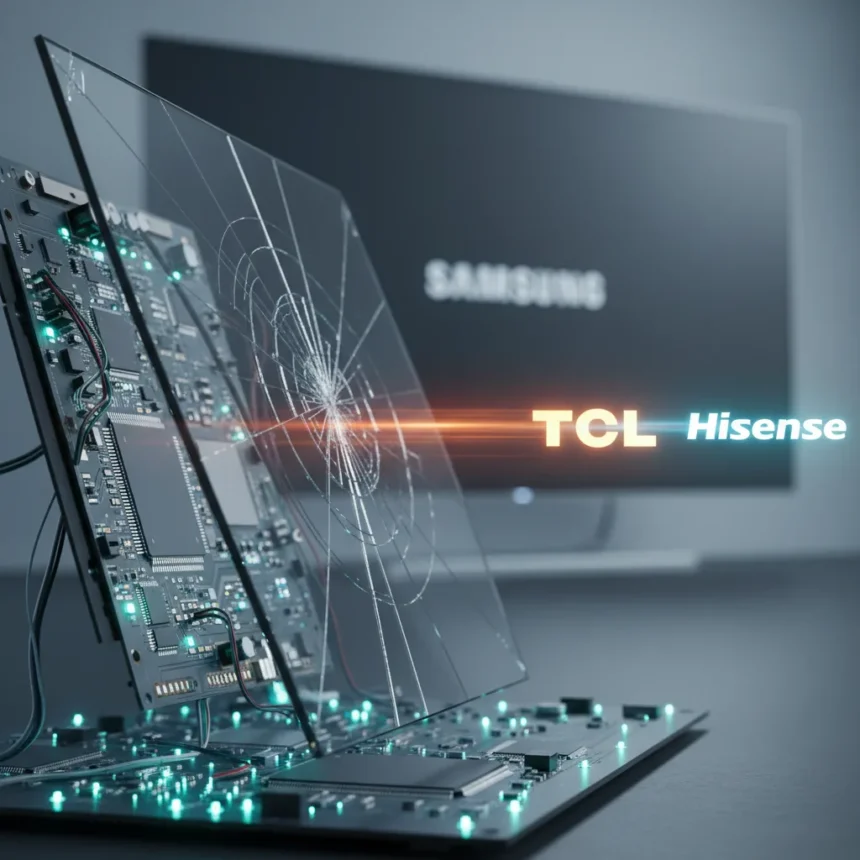
Micro-LED TV technology was supposed to be the next frontier of premium home entertainment, but Samsung’s decision to pull back from aggressive investment in the space is forcing a reckoning. The company’s TV leadership has scaled back plans to mass-produce Micro-LED sets, citing prohibitive production costs and yields too low to justify commercial viability at scale.
Key Takeaways
- Samsung’s TV division is retreating from Micro-LED production investment, signaling manufacturing challenges remain unsolved.
- Current Micro-LED TVs cost well over $100,000 and only exist in 100-inch-plus sizes, making them inaccessible to mainstream buyers.
- Micro-LED offers superior brightness (4,000-5,000+ nits), infinite contrast, no burn-in risk, and longer lifespan than OLED.
- TCL and Hisense are pursuing MicroRGB and Mini-LED as bridges toward affordable Micro-LED, potentially reaching 65-inch models under $4,000 by 2028.
- Full Micro-LED market competition remains years away despite earlier optimism about near-term availability.
Why Samsung’s Pullback Matters
Samsung’s retreat is not a minor strategic adjustment—it is a signal that Micro-LED TV technology faces fundamental production barriers that remain unresolved. The company has invested billions in the space over nearly a decade, positioning the technology as the inevitable successor to OLED. Yet the gap between laboratory demonstrations and profitable manufacturing has proven far wider than the industry initially acknowledged.
The core problem is brutally simple: making millions of microscopic inorganic LEDs and assembling them into a display at consumer scale is exponentially harder than producing OLED panels. Samsung’s decision to redirect resources toward Mini-LED and other near-term technologies suggests the company believes Micro-LED TV technology will not reach mainstream viability in the timeframe executives had promised. This is a significant credibility hit for an industry that has spent years telling consumers to wait for the next big thing.
Micro-LED TV Technology vs. OLED’s Established Dominance
To understand why Samsung’s retreat stings, consider what Micro-LED TV technology promises. The displays use inorganic gallium nitride LEDs instead of organic materials, delivering brightness levels of 4,000 to 5,000-plus nits compared to OLED’s 1,000 to 2,000 nits. Micro-LED offers infinite contrast ratios, zero burn-in risk, and a lifespan potentially exceeding 30 years—compared to OLED’s maximum 10 years and frequent degradation issues.


OLED remains the high-end standard because it delivers stunning color accuracy and deep blacks from self-emitting pixels. But OLED has real weaknesses: burn-in from static images, brightness limitations in bright rooms, and organic material degradation over time. Micro-LED TV technology would eliminate all three problems while adding brightness that makes OLED look dim by comparison.
The catch is that OLED is mature. Samsung, LG, and other manufacturers have spent 15 years perfecting production lines, driving down costs, and building supply chains. Micro-LED TV technology remains in early manufacturing stages. Current models cost over $100,000 and only exist as 100-inch-plus displays for luxury installations or commercial use. No consumer-accessible 55-inch or 65-inch Micro-LED TV exists at any price.



TCL and Hisense Keeping the Flag Flying
While Samsung retreats, TCL and Hisense are positioning themselves as the potential leaders in advancing Micro-LED TV technology. Both companies are investing in MicroRGB and Mini-LED as bridge technologies—using inorganic LEDs in a more manufacturable form factor than true Micro-LED.
Hisense’s RGB Mini-LED approach uses larger inorganic LEDs than Micro-LED but maintains the core advantages: no burn-in, superior brightness, and longer lifespan than OLED. The company is betting that incremental improvements in this direction will eventually converge with true Micro-LED as manufacturing techniques mature. TCL is pursuing similar strategies, treating Mini-LED and MicroRGB as stepping stones rather than dead ends.
The economics are more favorable at this intermediate step. RGB Mini-LED can be produced with existing or slightly modified equipment, yields are higher, and production volumes can scale to actual consumer demand. Industry projections suggest a 65-inch MicroRGB display could reach under $4,000 by 2028—still premium, but within reach of affluent buyers rather than only ultra-luxury customers. Whether that timeline holds is another question entirely, especially with Samsung’s pullback signaling confidence in the space is lower than before.
The Manufacturing Reality Check
Samsung’s decision reflects a hard truth: Micro-LED TV technology faces manufacturing challenges at every scale below 100 inches. Creating millions of microscopic LEDs and placing them with micrometer precision is a problem that has not been solved at volume. Yields—the percentage of panels that pass quality inspection—remain too low to justify the investment required to build factories.



The company is shifting focus to Mini-LED, which uses larger LED backlights and is far easier to manufacture at scale. Mini-LED is not as technically superior as Micro-LED, but it is viable today and can be sold at prices that justify production. This is the pragmatic choice of a manufacturer that needs to sell TVs now, not bet everything on a technology that might arrive in five years.
For TCL and Hisense, the calculation may be different. These companies have lower cost structures and different market expectations. They may be willing to accept lower margins and longer development timelines if they believe Micro-LED TV technology will eventually dominate. But Samsung’s retreat removes the largest, most-resourced competitor from the race, which paradoxically could help smaller competitors by reducing competitive pressure—or it could signal that the technology is simply not viable at consumer scale.
What Comes Next for Micro-LED TV Technology?
The timeline for mainstream Micro-LED TV technology has stretched repeatedly. Earlier predictions of consumer availability by 2024 or 2025 have already passed. Current industry estimates suggest full market competition in 3 to 5 years, but Samsung’s pullback casts serious doubt on whether that will materialize.
More likely is a long, slow march. TCL and Hisense will continue advancing Mini-LED and MicroRGB, gradually improving brightness, contrast, and lifespan. Micro-LED will remain confined to niche luxury segments and commercial displays for years. Eventually, manufacturing techniques will improve, costs will fall, and Micro-LED TV technology may become accessible to mainstream buyers—but not before OLED has consolidated its position and improved further.
The real question is whether OLED will still be relevant by then. LG and Samsung are not idle. OLED manufacturing is becoming more efficient, costs are falling, and new variants like QD-OLED (quantum dot OLED) are improving brightness and color. By the time Micro-LED reaches consumer prices, OLED may have solved enough of its weaknesses to remain the better value proposition for most buyers.
Is Micro-LED TV technology actually viable at consumer scale?
Current evidence suggests viability remains uncertain. Micro-LED TVs exist only as ultra-premium, ultra-large displays costing over $100,000. Manufacturing at smaller sizes with acceptable yields has not been achieved. Samsung’s retreat suggests the company does not believe consumer-scale viability is achievable in a commercially meaningful timeframe, which is a significant signal given Samsung’s resources and expertise.
When will affordable Micro-LED TVs actually arrive?
Industry projections point to 65-inch MicroRGB displays under $4,000 by 2028, but these timelines have shifted repeatedly. Samsung’s pullback makes earlier timelines less credible. Realistic availability for mainstream consumers likely remains 5 to 10 years away, if it happens at all.
Should I wait for Micro-LED TV technology instead of buying OLED now?
No. OLED TVs are mature, affordable, and deliver excellent picture quality today. Waiting for Micro-LED means missing years of superior viewing experience while manufacturing challenges persist. If you need a new TV, OLED is the right choice. Micro-LED may eventually dominate the premium segment, but OLED will remain competitive for the foreseeable future.
Samsung’s retreat from Micro-LED TV technology is a reality check for an industry that oversold timelines and underestimated manufacturing complexity. The technology is genuinely superior on paper, but superiority on paper does not matter if it cannot be produced affordably at scale. TCL and Hisense may prove Samsung wrong, but for now, the momentum has shifted. OLED remains the standard, and Micro-LED remains a promise waiting to be kept.
Edited by the All Things Geek team.
Source: TechRadar