





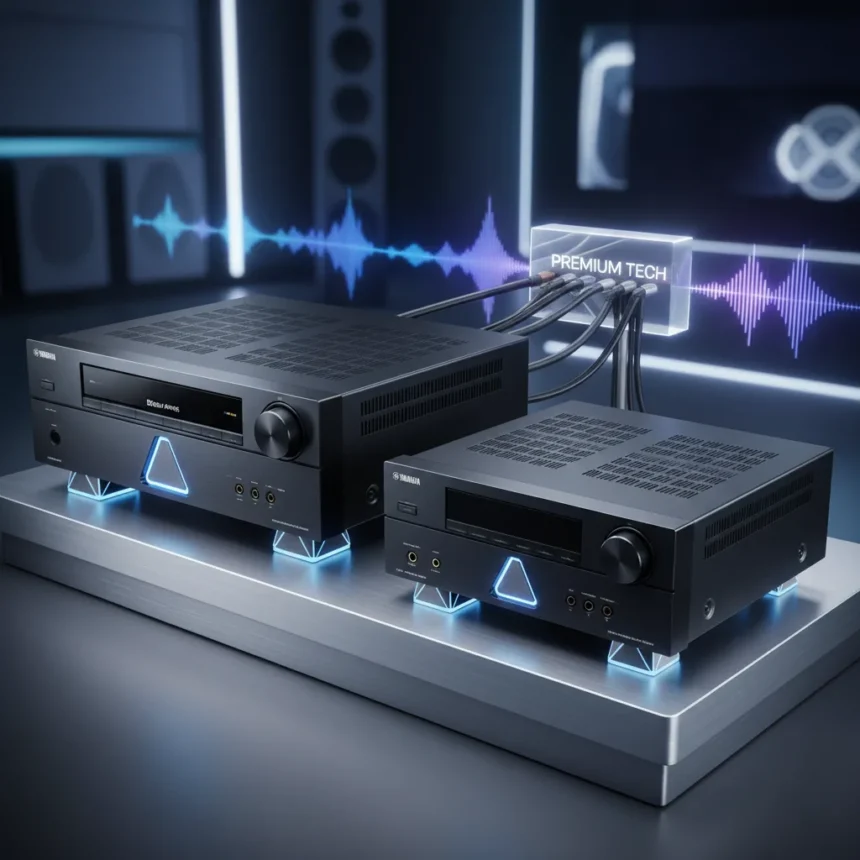
Yamaha’s two new Dolby Atmos AV receivers borrow a critical anti-resonance feature from their high-end Aventage siblings, extending premium vibration-dampening technology to mid-tier models. This move signals a shift in how Yamaha distributes advanced engineering across its receiver lineup, bringing structural refinement typically reserved for flagship gear down to more affordable Dolby Atmos systems.
Key Takeaways
- Two new Yamaha Dolby Atmos AV receivers incorporate anti-resonance technology from Aventage high-end models.
- Aventage series, launched in 2010, established Yamaha’s premium AV receiver platform with iterative improvements.
- The borrowed feature targets vibration control to improve sound clarity and fidelity.
- Aventage models support 8K@60Hz and 4K@120Hz via 7 HDMI 2.1 inputs and advanced surround processing.
- Mid-tier receivers gain access to engineering refinements historically exclusive to flagship pricing tiers.
What the Borrowed Anti-Resonance Feature Actually Does
The anti-resonance technology inherited from Aventage models addresses a fundamental problem in audio reproduction: unwanted vibration in the receiver’s chassis degrades sound quality by introducing coloration and muddiness into the signal path. By dampening structural resonance, the feature allows cleaner audio reproduction across dialogue, music, and surround effects. This is not a new concept in high-end audio—premium amplifiers have long prioritized rigid chassis design—but extending it to mid-tier Dolby Atmos receivers makes the benefit accessible to more home theater builders.
Aventage receivers have incorporated this refinement as part of their broader engineering philosophy, which also includes support for advanced spatial audio formats like Dolby Atmos Height Virtualization and integration with MusicCast multiroom streaming. The new mid-tier models do not inherit the entire Aventage feature set, but the anti-resonance technology represents a meaningful technical carryover that directly impacts listening experience.
How Yamaha’s Aventage Legacy Shaped This Decision
Yamaha introduced the Aventage series in 2010 as its flagship AV receiver platform, positioning the line as the company’s answer to premium home theater amplification. Since then, Aventage models have accumulated features like Surround: AI technology, which analyzes content five times per second to distinguish dialogue, ambience, and action elements, then automatically selects from over 24 DSP programs to optimize surround processing. The 2021 Aventage lineup—including the RX-A8A, RX-A6A, and RX-A4A—introduced support for 8K@60Hz and 4K@120Hz video via seven HDMI 2.1 inputs, plus integration with Amazon Alexa and AirPlay 2.



By borrowing the anti-resonance technology for the new mid-tier Dolby Atmos receivers, Yamaha is democratizing one of Aventage’s core engineering principles. The move reflects confidence that this particular refinement delivers measurable value without requiring the full premium price tag of a flagship Aventage model.
Why This Matters for Dolby Atmos Home Theater Buyers
Mid-tier Dolby Atmos AV receivers occupy a critical price-to-performance sweet spot for home theater enthusiasts. They deliver spatial audio support without the premium cost of flagship models, but they often sacrifice some of the engineering refinement found in high-end gear. By incorporating the anti-resonance feature, Yamaha narrows that gap. The borrowed technology improves the receiver’s ability to reproduce clean, detailed surround effects and dialogue clarity—exactly what Dolby Atmos content demands.



Compared to competitors like the Sony STR-DN1050, which balances muscle and subtlety through aptX Bluetooth and DSD support but lacks Dolby Atmos entirely, the new Yamaha receivers offer a more modern spatial audio foundation. The Onkyo TX-NR636 addresses this gap with firmware-enabled Dolby Atmos support at a similar price point, but without the Aventage-derived structural refinements now appearing in Yamaha’s new models.
What Aventage Owners Already Know About This Technology
Aventage enthusiasts recognize the anti-resonance approach as part of a broader philosophy that prioritizes signal purity through mechanical excellence. The Aventage platform combines this structural discipline with a Qualcomm 64-bit chipset designed to improve sound quality, Dolby Atmos height channel support, and deep integration with streaming services via Spotify Connect and Amazon Music. These receivers also support DTS:X and Auro-3D surround formats on higher-tier models, creating an ecosystem where vibration control works in concert with advanced surround processing.
The fact that Yamaha is now extending this core engineering principle to mid-tier Dolby Atmos receivers suggests the company sees anti-resonance as a foundational technology worth distributing across its lineup, rather than reserving it as a premium-only differentiator.
Frequently Asked Questions
What is the anti-resonance feature in Yamaha receivers?
The anti-resonance technology dampens unwanted vibration in the receiver’s chassis, reducing coloration and distortion in the audio signal. This structural refinement improves clarity across dialogue, music, and surround effects by allowing cleaner signal reproduction.



Do the new Yamaha Dolby Atmos AV receivers include all Aventage features?
No. The new mid-tier receivers inherit the anti-resonance feature but do not include the full suite of Aventage capabilities like Surround: AI, 8K video support, or Auro-3D processing. They focus on delivering Dolby Atmos support with improved structural engineering.
How do these receivers compare to Sony or Onkyo alternatives?
The new Yamaha receivers offer modern Dolby Atmos support with premium anti-resonance engineering, positioning them ahead of older Sony models that lack Dolby Atmos entirely. Onkyo receivers like the TX-NR636 provide Dolby Atmos at similar price points, but without the Aventage-derived structural refinements now standard in Yamaha’s mid-tier Dolby Atmos lineup.
Yamaha’s decision to distribute anti-resonance technology across its mid-tier Dolby Atmos AV receivers reflects a maturing strategy: take the engineering refinements that made Aventage flagships sound clean and detailed, then make them available to buyers who want spatial audio without the premium price. It is a smart move that acknowledges where real value lives in receiver design—not in feature count, but in how faithfully a receiver reproduces what is already encoded in the content.
Edited by the All Things Geek team.
Source: What Hi-Fi?




