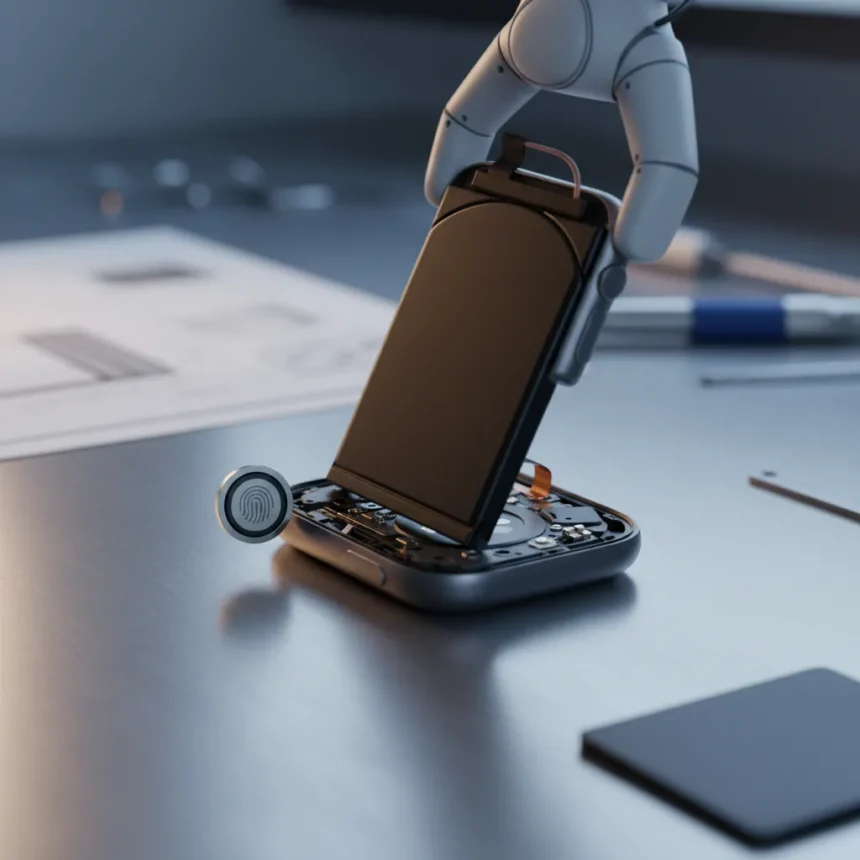
Apple Watch Touch ID has been cancelled. According to leaker Instant Digital on Weibo, Apple has abandoned its long-rumored plans to add fingerprint biometric authentication to its smartwatch, choosing instead to allocate internal space and engineering resources toward larger batteries and advanced health sensors. This decision, while disappointing to some, reveals practical priorities that may actually serve users better than on-device fingerprint scanning ever would.
Key Takeaways
- Apple Watch Touch ID has been shelved due to manufacturing complexity and battery constraints.
- Current unlock methods include PIN entry while worn or iPhone-paired biometrics.
- Apple prioritizes battery optimization and health sensors over on-device fingerprint authentication.
- Patents exist for Touch ID on Watch, but prototypes remain internal-only.
- Series 12 with new T8320 chip expected to focus on iterative improvements, not major features.
Why Apple Watch Touch ID Made Sense on Paper
The appeal of Apple Watch Touch ID was straightforward: faster Apple Pay transactions, app logins without reaching for your iPhone, and enhanced security for health data stored on-device. Apple even patented the technology, envisioning a side-button fingerprint sensor similar to the iPad Air design. Code leaks from August 2025 hinted at internal testing under Apple’s “Mesa” codename, suggesting serious engineering work was underway. For years, this felt inevitable—a natural feature evolution for a device that already handled payments and authentication.
Yet patents and prototypes rarely tell the full story. The gap between what engineers can prototype and what fits into a shipping product is often measured in millimeters and milliwatt-hours. Apple Watch internals are notoriously dense. Teardowns consistently show components packed with minimal slack, meaning adding a fingerprint sensor would require either shrinking the battery, cutting other components, or redesigning the entire enclosure—each option carrying real trade-offs.
Apple Watch Touch ID vs. Practical Battery Reality
Here’s where the leaker’s claim gains credibility: Apple Watch users consistently cite battery life as the single biggest frustration with the platform. Unlike Garmin wearables, which routinely deliver 10-14 days per charge, Apple Watch models struggle to reach two full days of typical use. A user who recently switched from Garmin to Apple Watch would immediately notice the difference—and likely resent it. Adding a fingerprint sensor without compromising battery capacity is, by the leaker’s account, an engineering impossibility within current form factors.


Instant Digital’s statement that Apple prefers “optimizing battery life and incorporating more sophisticated health sensors instead” reflects a hierarchy of user needs. Most Apple Watch owners unlock their device dozens of times daily through wrist detection and PIN entry while wearing it, or they simply pull out their iPhone—a device they carry anyway. The friction of waiting for biometric authentication is minimal compared to the constant frustration of a watch that dies by evening.
What This Means for Apple Watch Series 12 and Beyond
The upcoming Series 12, rumored to use a new T8320 chip, is expected to be an iterative update rather than a generational leap. Without Apple Watch Touch ID in the roadmap, the focus shifts to incremental gains: slightly improved battery endurance, new health sensors, and software refinements. The Ultra 4 (2026) may see experimental Touch ID prototypes in early builds, but production viability remains questionable.



This isn’t a failure of ambition—it’s a recognition that not every feature belongs on every device. Fingerprint sensors work brilliantly on phones and tablets where there’s ample space and power budget. On a wrist-worn device with severe spatial constraints, the cost-benefit calculation shifts dramatically. Apple’s decision to deprioritize Touch ID suggests the company is learning to say no to features that sound appealing but deliver marginal real-world benefit at the expense of fundamentals like battery life.
Does Apple Watch Need On-Device Biometrics?
The current authentication model—PIN while worn, iPhone biometrics while away—actually solves the security problem without adding complexity to the Watch itself. Apple Pay transactions already require wrist detection plus a double-tap gesture, creating a two-factor verification that fingerprints wouldn’t meaningfully improve. Health data stored on-device remains encrypted regardless of unlock method. From a security standpoint, on-device Touch ID is a convenience feature, not a necessity.
Competitors with fingerprint sensors on wearables have rarely made that feature a marquee selling point, suggesting market demand is lukewarm. The real differentiator remains ecosystem integration: Apple Watch’s tight coupling with iPhone, AirPods, and Mac makes it valuable regardless of whether it has Touch ID. Battery life, conversely, is a daily frustration that every owner experiences.
Is Apple Watch getting Touch ID in 2026?
No. According to the leaker, Apple has no plans to add Touch ID to Apple Watch due to engineering challenges, manufacturing costs, and battery capacity constraints. Internal prototypes may exist, but production models are not in development.



Why did Apple abandon Apple Watch Touch ID?
Space and power limitations in the Watch’s enclosure make adding a fingerprint sensor incompatible with larger batteries—Apple’s stated priority. The leaker claims Apple chose to optimize battery life and health sensors instead.
What are the current ways to unlock Apple Watch?
You can enter a PIN while wearing the Watch, or use Touch ID and Face ID on your paired iPhone. The Watch automatically locks when removed from your wrist. These methods provide sufficient security without adding complexity to the device itself.
Apple’s decision to shelve Apple Watch Touch ID reveals mature product thinking: not every feature that technically could fit belongs on a device that’s already struggling to justify its battery drain. The real upgrade users want is one that lasts longer between charges, and that’s where Apple’s engineering focus belongs. For anyone considering an Apple Watch, expect iterative improvements in endurance and health monitoring—not the biometric leaps that made headlines a year ago.
Where to Buy
Apple Watch Ultra 3 | Apple Watch 11 | Apple Watch SE 3
Edited by the All Things Geek team.
Source: TechRadar