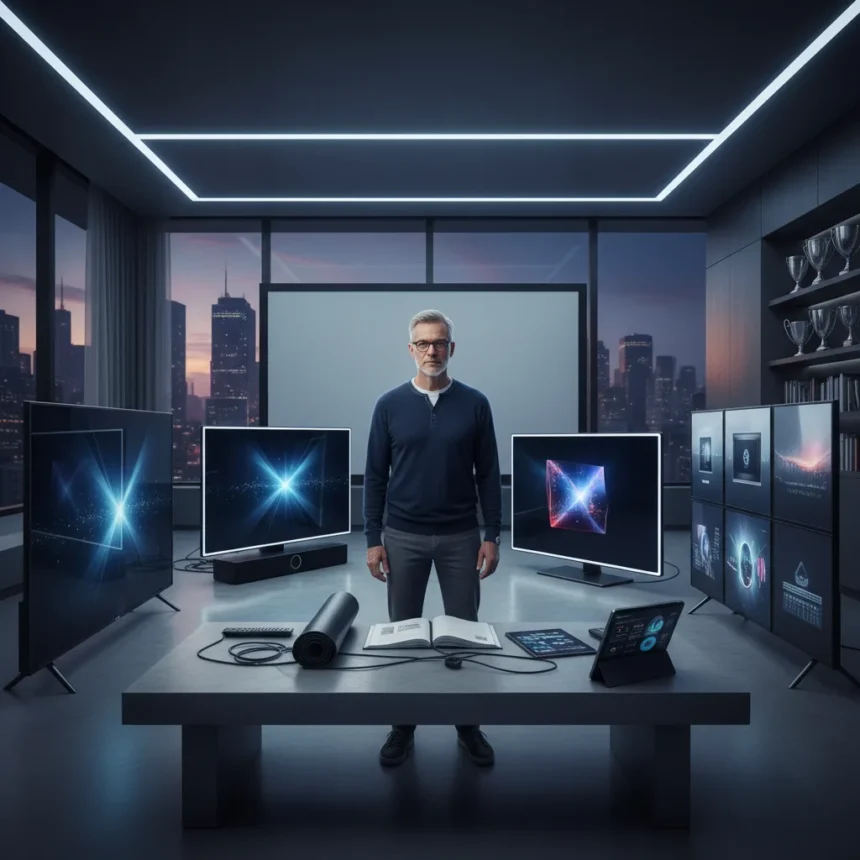
After a decade of testing televisions, identifying which models will matter in 2026 requires more than reading spec sheets—it demands pattern recognition built from hundreds of hours with screens of every type. The most anticipated TVs 2026 represent a convergence of technological maturity, competitive pressure, and genuine innovation in display technology.
Key Takeaways
- LG G6 OLED expected to advance organic display performance in 2026
- Samsung S95H OLED represents Samsung’s flagship OLED ambition
- LG C6 OLED targets mainstream buyers seeking premium picture quality
- TCL X11L brings mini-LED technology to mid-market competition
- Hisense RGB Mini-LED 116UXS demonstrates large-format innovation
The Five Models Reshaping 2026 Television
After years of incremental improvements and marketing hyperbole, 2026 is shaping up differently. The five most anticipated TVs 2026 span three distinct technology camps: pure OLED, Samsung’s quantum-dot OLED approach, and advanced mini-LED implementations. Each represents a different answer to the same question: how do you deliver exceptional picture quality at a price consumers will actually pay?
LG’s G6 OLED and C6 OLED occupy the premium and mainstream OLED segments respectively. Samsung’s S95H OLED signals the company’s continued commitment to organic display technology despite historical skepticism. TCL and Hisense, meanwhile, are pushing mini-LED to territory previously reserved for OLED—larger screens, higher brightness, more aggressive pricing.
Why These Five Matter More Than Others
The television market in 2026 faces a fundamental tension: OLED technology has proven its picture quality superiority, but mini-LED has closed the gap on brightness and longevity concerns. These five models represent the industry’s best attempt at resolving that tension. LG’s dual OLED strategy (G6 for enthusiasts, C6 for budget-conscious buyers) acknowledges that premium picture quality now comes in two price brackets.

Samsung’s S95H OLED entry signals a manufacturer willing to compete head-to-head in OLED rather than retreat to LCD or mini-LED. That matters because competition drives innovation. TCL and Hisense are not afterthoughts here—the X11L and 116UXS represent legitimate technological advancement in mini-LED, not just cost-cutting.
The OLED Dominance Question
OLED displays have dominated high-end television for years, but 2026 tests whether that dominance extends downmarket. The LG C6 OLED is crucial to watch because it will either prove that premium picture quality can reach mainstream prices or reveal that OLED’s cost structure still limits its addressable market. Samsung’s S95H OLED adds another variable: can a company with limited OLED manufacturing experience compete with LG’s established production and supply chain?



The G6 OLED, positioned above the C6, will define the absolute ceiling of what OLED technology can deliver in 2026. If the improvements are incremental, the market may consolidate around fewer flagship models. If they are meaningful, the G6 justifies a premium tier that separates true enthusiasts from mainstream buyers.
Mini-LED’s Counter-Argument
TCL’s X11L and Hisense’s RGB Mini-LED 116UXS are the wild cards. Both represent manufacturers betting that mini-LED’s advantages—brightness, longevity, thermal efficiency, and cost—outweigh OLED’s picture quality edge in real-world viewing. A 116-inch Hisense set is a statement: mini-LED can scale to sizes where OLED remains technically challenging or economically infeasible.
The 2026 television market will ultimately be decided by whether consumers prioritize absolute picture quality (OLED’s strength) or value-for-size (mini-LED’s advantage). These five models are the test cases for that market split.
What Sets These Apart from Previous Years
Television innovation has slowed considerably over the past five years. Marginal improvements in brightness, contrast, and color accuracy are real but incremental. The five most anticipated TVs 2026 break that pattern because they represent genuine architectural choices—not just tuned parameters from the previous generation. LG’s willingness to segment its OLED lineup, Samsung’s entry into OLED manufacturing, and TCL/Hisense’s scaled mini-LED implementations are strategic decisions, not marketing adjustments.



This is the first year in several where the competitive landscape actually looks different heading into a new generation. That matters for consumers because it means real choice, not just cosmetic variation.
Which TV Should You Actually Watch For?
If you prioritize absolute picture quality and budget permits, the LG G6 OLED will be worth the premium. If you want OLED performance at a lower price, the C6 OLED is the model that determines whether premium display technology has truly reached mainstream accessibility. If you own a large living room and value brightness and longevity over pure black levels, the Hisense 116UXS is the outlier worth monitoring.
Samsung’s S95H OLED is the competitive wildcard. Its success or failure will determine whether OLED remains an LG-dominated category or opens to genuine multi-manufacturer competition.
Are these the only TVs worth considering in 2026?
No. These five represent the most anticipated models because they signal where the market is headed, but 2026 will include strong performers from Sony, Panasonic, and others. However, these five define the technology trends and competitive dynamics that will shape the entire market.
Will mini-LED finally overtake OLED in 2026?
Unlikely. OLED’s picture quality advantage is real, and the LG C6 OLED’s pricing will determine whether OLED remains the premium standard. Mini-LED will capture the large-screen and value segments, but OLED will remain the aspirational technology.
How do I choose between the LG G6 and C6 OLED?
The G6 is for enthusiasts willing to pay a premium for the latest technology. The C6 is for buyers who want genuine OLED performance without the flagship price tag. If you watch a lot of content and care about picture quality, either is defensible; your budget should decide.
The most anticipated TVs 2026 represent a market in transition. OLED is proving it can scale downmarket, mini-LED is proving it can scale upmarket, and manufacturers are finally competing on genuine technological differences rather than marketing variation. That competition is good news for anyone shopping for a television in the coming year.
Edited by the All Things Geek team.
Source: Tom's Guide