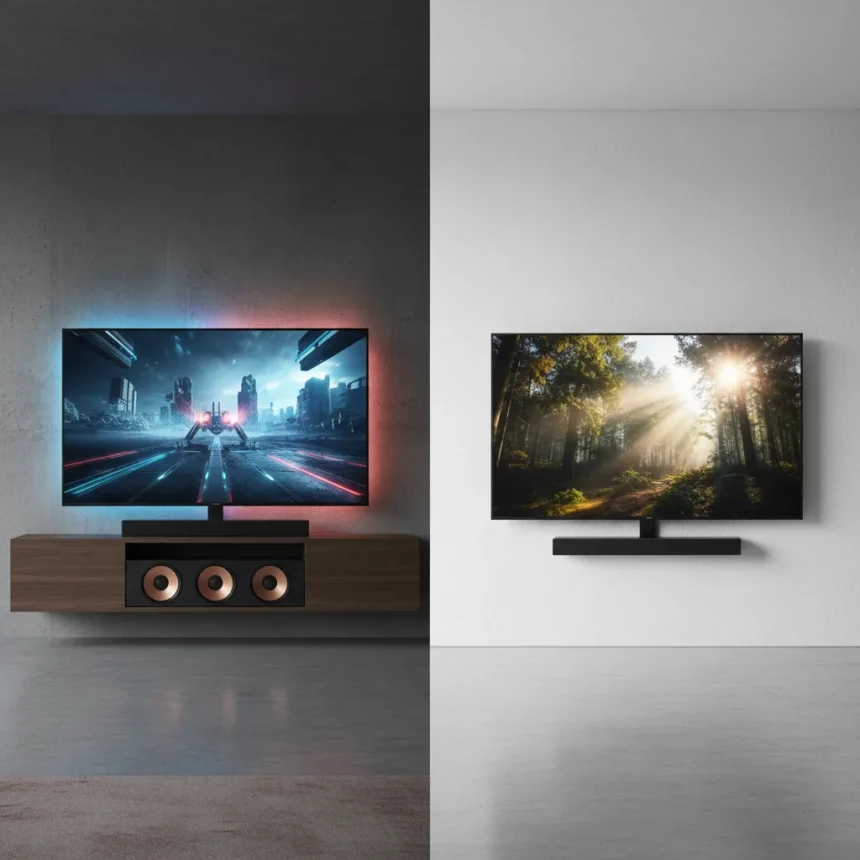
The Philips OLED910 vs LG G5 showdown pits two of 2025’s most capable OLED televisions against each other, both built on the same latest Primary RGB Tandem OLED panel technology from LG Display. Yet despite sharing identical panel architecture, these flagships diverge dramatically in real-world performance, sound quality, and gaming responsiveness—making the choice between them far more nuanced than specs alone suggest.
Key Takeaways
- Both TVs use the same Primary RGB Tandem OLED panel, but the LG G5 achieves superior HDR brightness and gaming performance.
- Philips OLED910 delivers exceptional sound via Bowers & Wilkins speakers and includes Ambilight ambient lighting; LG G5 omits both.
- LG G5 supports four HDMI 2.1 ports and 165Hz gaming with lower input lag; Philips lacks gaming-focused features.
- Philips excels at upscaling and motion interpolation; LG handles HDR tone mapping and color accuracy more naturally.
- LG G5 suits bright rooms and gaming setups; Philips performs better in dark viewing environments.
Philips OLED910 vs LG G5: the core difference
Here’s the critical reality: Philips OLED910 and LG G5 both deliver perfect OLED blacks and phenomenal black detail representation, but they diverge on brightness and processing. The LG G5 edges the Philips in HDR brightness across high-APL (average picture level) scenes—think the loading program sequence in The Matrix or the sun and fire guitars in Mad Max Fury Road. The LG’s Alpha11 AI Gen 2 Processor outperforms the Philips’ 9th Gen P5 AI chip in tone mapping, color accuracy, and reflection handling, making the LG the objectively brighter, more detailed performer in HDR content.
The Philips OLED910, equipped with its P5 single-chip processor, fights back with superior upscaling and motion interpolation—a genuine advantage if you watch a lot of broadcast or streamed content that isn’t native 4K. The Philips also includes four-sided Ambilight bias lighting, a feature LG G5 completely omits. For sound, the Philips’ Bowers & Wilkins 3.1 soundbar speakers deliver noticeably richer audio than LG’s more modest internal speakers.
HDR brightness and image quality: LG’s clearer advantage
When it comes to HDR performance, the LG G5 simply handles brighter, more contrasty images. Testing by RTINGS shows the LG G5 scoring 8.9 out of 10 in HDR brightness versus the Philips at 4.6, a gap that becomes immediately visible in high-intensity HDR scenes. The LG’s image processing also handles color more accurately and sharpness more convincingly, though this comes with a trade-off: the LG’s upscaling can highlight grain in lower-resolution content. For anyone watching 4K streaming services or gaming in HDR, the LG’s superior brightness and tone mapping make it the more immediately impressive performer.



The Philips, by contrast, suits dark viewing environments where its slightly softer processing and excellent gradation handling shine—but it does show more posterization issues in torture tests, a weakness that becomes apparent in extreme scenes. If your TV room is naturally dim or you watch primarily in the evening, the Philips’ performance gap narrows considerably.
Gaming and input responsiveness: LG dominates
For gamers, the LG G5 is the clear winner. It offers four HDMI 2.1 ports, 165Hz support, black frame insertion (BFI), variable refresh rate (VRR), and lower input lag than the Philips—advantages that matter in competitive gaming and fast-action console play. The Philips OLED910 lacks these gaming-specific features, making it a poor choice for PlayStation 5 or Xbox Series X owners who demand responsiveness.



The LG’s gaming-focused architecture also means faster response times and better motion handling in fast-paced content, though both TVs handle motion interpolation competently. If you split your viewing between films and gaming, the LG G5 simply offers more versatility.
Sound, Ambilight, and HDR format support
Here’s where Philips OLED910 reclaims ground. The Bowers & Wilkins 3.1 speaker system delivers substantially better dialogue clarity and bass response than the LG G5’s internal speakers—a real advantage if you’re not planning to add an external soundbar. The Ambilight feature, exclusive to Philips, extends the on-screen colors to the wall behind your TV, creating an immersive ambient lighting effect that some viewers find genuinely transformative and others consider gimmicky.
On format support, the Philips OLED910 includes HDR10+ capability, while the LG G5 supports only HDR10 and HLG. Both handle Dolby Vision, but HDR10+ gives Philips a slight edge for future-proofed content—though HDR10+ adoption remains limited compared to HDR10. The LG’s UK-centric smart TV system includes terrestrial catch-up services, a practical advantage for UK viewers but irrelevant elsewhere.
Which TV should you actually buy?
Choose the LG G5 if you prioritize HDR brightness, gaming responsiveness, and image accuracy. It’s the objectively superior performer in most measurable metrics and the only sensible choice if you game on modern consoles. The LG suits bright rooms, handles all content types capably, and delivers the most impressive HDR scenes.



Choose the Philips OLED910 if you value sound quality, Ambilight ambiance, and upscaling performance—and if your viewing room is naturally dark. The Philips is better suited to film-focused viewing in controlled lighting conditions and pairs well with viewers who don’t game competitively. Its Bowers & Wilkins audio system is genuinely superior to the LG’s, a meaningful advantage if you watch without an external soundbar.
How much brighter is the LG G5 than the Philips OLED910?
The LG G5 scores significantly higher in HDR brightness testing—8.9 out of 10 versus the Philips’ 4.6 on RTINGS’ scale. This gap becomes visually apparent in high-APL scenes like bright explosions, sunlit outdoor sequences, and high-intensity HDR content, where the LG delivers noticeably more punch and contrast.
Does the Philips OLED910 have better speakers than the LG G5?
Yes. The Philips OLED910’s Bowers & Wilkins 3.1 soundbar speakers deliver substantially better audio quality than the LG G5’s internal speakers, with clearer dialogue and deeper bass. If you plan to use the TV’s built-in audio without an external soundbar, the Philips is the clear winner.
Which TV is better for gaming: LG G5 or Philips OLED910?
The LG G5 is significantly better for gaming. It offers four HDMI 2.1 ports, 165Hz support, BFI, VRR, and lower input lag—features the Philips lacks entirely. For PlayStation 5, Xbox Series X, or PC gaming, the LG is the only sensible choice.
Both the Philips OLED910 and LG G5 represent the pinnacle of 2025 OLED television technology, but they serve different audiences. The LG G5 is the all-rounder: brighter, faster, more versatile. The Philips OLED910 is the specialist: superior sound, ambient lighting, and upscaling for film-focused viewers in dark rooms. Your choice depends entirely on what you value most—raw image performance and gaming speed, or audio quality and atmospheric ambiance.
Edited by the All Things Geek team.
Source: What Hi-Fi?