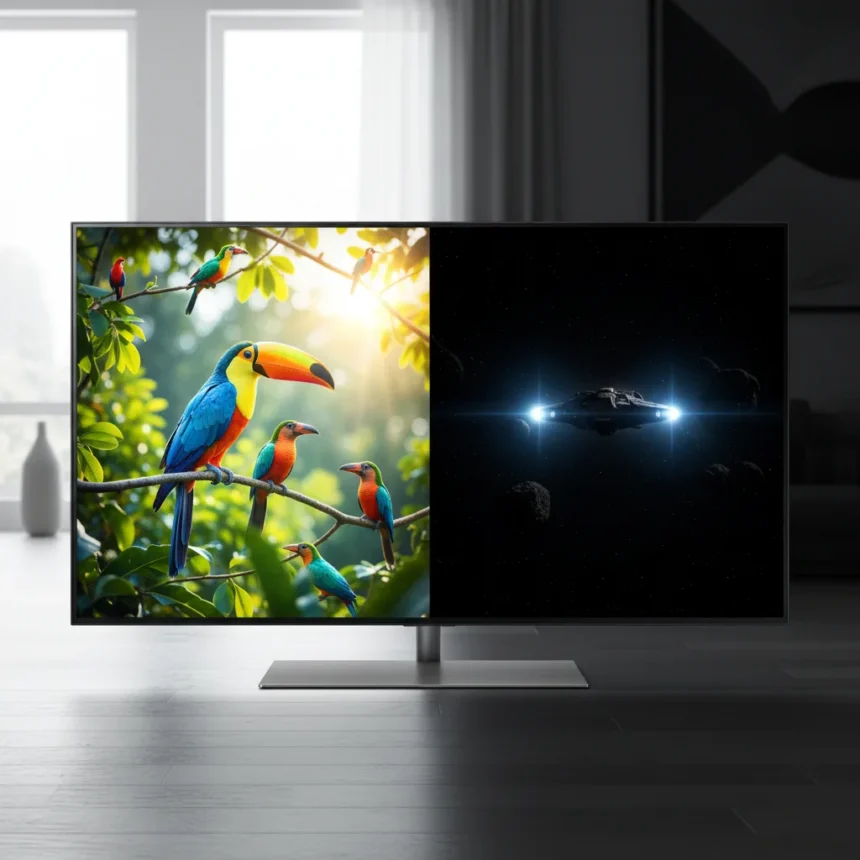
The Samsung Q7F QLED is a 2025 4K UHD TV with quantum dot technology for wide color gamut and saturated HDR highlights, available in 50-inch and 65-inch sizes starting at $499.99. It’s a TV that knows exactly what it is: a solid entry-level QLED that crushes basic budget models but lacks the precision light control that justifies premium pricing. If you watch in a bright living room and care more about vibrant colors than perfect blacks, this is worth considering. If you’re hunting for deep contrast in a dark home theater, keep shopping.
Key Takeaways
- Samsung Q7F QLED offers vivid colors and excellent brightness for glare-resistant viewing in bright rooms.
- Entry-level backlight system lacks full array local dimming, resulting in weak black levels and poor contrast in dark scenes.
- 2025 refresh adds SamsungVision AI with Q4 processor for 4K upscaling and generative AI wallpapers.
- Input lag matches premium models for 60Hz SDR gaming; motion handling excels for sports and action content.
- Priced significantly below step-up Samsung QLED models that offer superior local dimming and AI features.
Picture Quality: Bright and Colorful, But Not Dark Room Ready
The Samsung Q7F QLED shines where it matters for daytime viewing. Colors are vibrant and saturated, blacks appear reasonably deep in well-lit spaces, and the clarity across action sequences feels genuinely cinematic. The TV’s reflection handling is excellent—a critical advantage if your living room gets afternoon sun. Brightness output is high enough that glare becomes a non-issue, something cheaper models struggle with. For sports, gaming at 60Hz SDR, and fast-paced content, the motion handling is crisp without the blur that plagues entry-level panels.
But flip off the lights and the limitations become obvious. Without full array local dimming, the Samsung Q7F QLED cannot precisely control light output across different screen areas. This means bright objects on dark backgrounds—a spaceship against black space, text on a dark menu—bloom slightly. The TV’s VA panel also loses contrast and color accuracy when viewed off-angle, a trade-off inherent to its design. These aren’t flaws for casual viewing, but they’re real compromises compared to step-up Samsung models that include full array local dimming and deeper black levels.
The dual LED backlight (blue and white lights) on the 2025 refresh improves color accuracy and dynamic gamut compared to older QLED designs, but it does not solve the fundamental limitation: without per-zone dimming control, shadow detail remains sacrificed. If your primary viewing happens after sunset, the Samsung Q7F QLED will disappoint.



Smart Features and AI: Modest Upgrades That Mostly Work
The 2025 Samsung Q7F QLED runs Tizen OS with the new SamsungVision AI engine powered by the Q4 processor. The AI button lets you interact with on-screen content—casting information about actors or plot details—while generative AI wallpapers add visual flair when the TV is off. These features are genuinely useful without feeling gimmicky, unlike AI implementations that exist purely for marketing. Setup is straightforward, and the interface remains intuitive even if you’ve never owned a Samsung TV before.
Game mode presets deliver the low input lag that competitive players expect, matching performance of TVs costing twice as much. Q-Symphony integration syncs the TV’s audio with compatible Samsung soundbars, a nice touch if you’re building an ecosystem. Ambient light adjustment automatically tunes brightness and color to match your room’s lighting conditions, reducing eye strain during long viewing sessions. Voice assistant integration works, though it’s not as seamless as built-in Alexa or Google Assistant on some competitors.



The one weakness: volume output concerns have been reported by some customers, and remote control annoyances occasionally surface in user feedback. These are minor friction points rather than dealbreakers, but worth noting if you’re sensitive to audio quality or prefer a more responsive remote.
Samsung Q7F QLED vs. Competitors: Beating Budget, Losing to Premium
The Samsung Q7F QLED decisively outperforms basic budget TVs and Samsung’s own Crystal UHD lineup. You get QLED quantum dot technology, superior reflection handling, brighter HDR, and a wider color gamut—features that genuinely matter for everyday viewing. It also beats older Samsung models like the NU8000 across brightness, color, and motion handling.
Where it falters is against higher-tier Samsung QLEDs in its own price range. Those step-up models include full array local dimming, which delivers noticeably deeper blacks and more precise contrast control. They also pack more advanced AI features like AI picture mode, which upscales lower-resolution content more intelligently. For $200–300 more, you’re getting meaningful improvements, not just marketing. The question is whether those improvements justify the cost for your specific room and viewing habits.
Should You Buy the Samsung Q7F QLED?
Buy the Samsung Q7F QLED if your living room gets natural light, you watch mostly daytime content, and you prioritize vibrant colors and motion clarity. It’s a no-brainer for bright rooms where contrast limitations matter far less than brightness and glare resistance. The 2025 AI refresh makes it a smarter purchase than the 2018 model, and the $499.99 price point for the 65-inch is genuinely competitive.



Skip it if you’re a dark room cinephile who watches moody dramas and horror films late at night. The lack of local dimming will frustrate you. Skip it too if you have the budget to stretch toward a step-up Samsung QLED—the full array dimming is worth the extra cost for contrast-sensitive viewers. The Samsung Q7F QLED is honest about what it is: a bright-room specialist that trades shadow detail for vibrant color and price. Own that trade-off, and you’ll be satisfied.
Does the Samsung Q7F QLED have local dimming?
No. The Samsung Q7F QLED uses an entry-level backlight system without full array local dimming. It cannot independently control light output across different screen zones, limiting its ability to produce deep blacks and precise contrast. This is the TV’s single biggest limitation and the primary reason it underperforms step-up Samsung models.
How does the Samsung Q7F QLED handle gaming?
Excellently for 60Hz SDR gaming. Input lag matches premium models, and motion handling is crisp enough for fast-paced action and sports. Game mode presets optimize settings automatically. However, if you’re a 120Hz gaming enthusiast with newer consoles, you’ll want to verify refresh rate specifications before purchasing.
What’s new in the 2025 Samsung Q7F QLED?
The 2025 refresh adds SamsungVision AI with a Q4 processor for 4K upscaling, generative AI wallpapers, and improved content interaction through an AI button. The dual LED backlight (blue and white) enhances color accuracy and dynamic gamut compared to older QLED designs. These upgrades make the entry-level QLED more viable for bright rooms and gaming at budget prices, though they don’t address the local dimming limitation.
The Samsung Q7F QLED is a calculated compromise. It excels in the specific scenario it was designed for—bright rooms where vibrant color and motion clarity matter more than shadow detail—and it does so at a price that undercuts premium alternatives. But it’s not a universal TV, and pretending otherwise would be dishonest. Know your room, know your content, and you’ll know whether this QLED is the right fit.
Where to Buy
Edited by the All Things Geek team.
Source: Tom's Guide