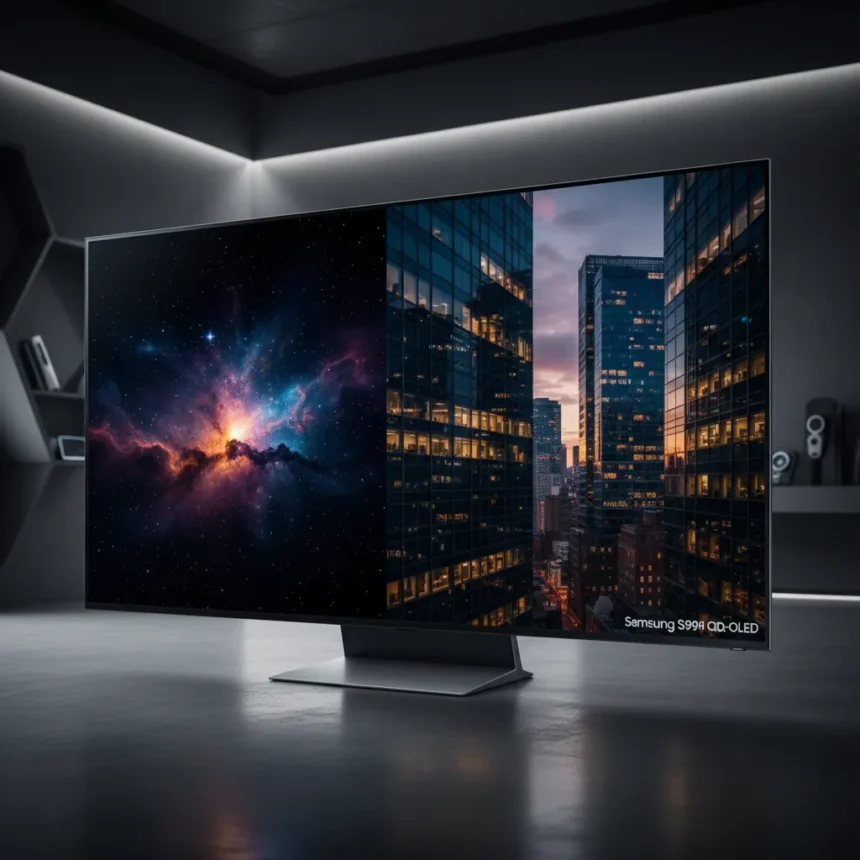
The Samsung S99H QD-OLED TV achieves what seemed impossible for years: OLED brightness that matches Mini-LED performance without sacrificing the panel technology’s legendary contrast and color accuracy. Unveiled at CES 2026, this flagship model delivers up to 35% more brightness than Samsung’s 2025 S95F, setting a new standard for high-end television that competitors will struggle to match.
Key Takeaways
- Samsung S99H QD-OLED TV is up to 35% brighter than the 2025 S95F predecessor
- Available in 55-inch, 65-inch, 77-inch, and 83-inch sizes with 4K resolution and 165Hz refresh rate
- QD-OLED panels deliver “slight extra sparkle” over standard OLED models like the cheaper S90H
- Features NQ4 AI Gen3 processor, 4x HDMI 2.1 ports, and HDR10+ support (no Dolby Vision)
- Justifies premium pricing over S90H through measurably superior brightness and color volume
Samsung S99H QD-OLED TV Brightness Breakthrough
The core achievement of the Samsung S99H QD-OLED TV is solving a decade-old problem: OLED panels have always sacrificed brightness for perfect blacks and infinite contrast. Samsung’s QD-OLED technology adds a quantum dot layer that boosts light output dramatically. The 35% brightness increase over the S95F is substantial enough to match Mini-LED TVs, which traditionally held the brightness advantage. This means the S99H delivers both the brightness needed for bright rooms and the contrast that makes OLED special.
Initial testing confirms colors appear “bright, voluminous and accurate” in Filmmaker Mode, the gold standard for picture quality. The extra brightness doesn’t wash out color; instead, it gives highlights and bright scenes more presence without crushing shadow detail. For content creators and cinephiles, this is a meaningful leap.
Samsung S99H vs. Cheaper OLED Alternatives
Samsung’s 2026 OLED lineup splits into two tiers, and the choice between them reveals how much brightness actually matters. The Samsung S99H QD-OLED TV sits above the S90H, which uses classic OLED panels without the quantum dot layer. Both offer excellent picture quality—reviewers note the S90H “looks impressive even alongside its pricier counterpart”—but the S99H’s added brightness creates a visible difference in side-by-side viewing.



The S90H is the smarter choice for darker rooms where brightness matters less and budget matters more. But for bright living spaces or anyone wanting maximum picture impact, the Samsung S99H QD-OLED TV justifies its premium through measurably superior brightness and that “slight extra sparkle”. It’s not a night-and-day difference, but it’s real.
The trade-off: Samsung dropped QD-OLED panels across the entire S90 range for 2026, meaning even the cheaper S90H uses standard OLED instead. This suggests Samsung is reserving QD-OLED exclusivity for the flagship, a strategy that protects the S99H’s positioning but limits QD-OLED availability.



Gaming and Technical Specifications
The Samsung S99H QD-OLED TV includes 4x HDMI 2.1 ports rated for 4K at 165Hz refresh rate, making it a capable gaming display. The NQ4 AI Gen3 processor handles upscaling and frame interpolation, though Samsung omits Dolby Vision support in favor of HDR10+. This is a deliberate choice—HDR10+ is brighter-capable than Dolby Vision—but it means compatibility with some streaming content may require fallback to standard HDR10.
The 3,840 x 2,160p resolution is standard 4K, and Tizen OS handles smart TV functions. There’s no ATSC 3.0 support, which is increasingly irrelevant as streaming dominates, but worth noting for traditional broadcast viewers.
Is the Samsung S99H QD-OLED TV Worth the Premium?
The Samsung S99H QD-OLED TV launches into a market where flagship OLED TVs already cost more than most people expect to spend. The brightness advantage over the S90H is real and visible, especially in well-lit rooms. If you’re buying a TV that will sit in a bright living room and you want maximum picture impact, the S99H delivers measurable value. If your room is darker or your budget is tight, the S90H offers 90% of the experience for significantly less.
The real competition isn’t the S90H—it’s the question of whether brightness matters enough to justify flagship pricing. For most viewers, it doesn’t. For those who care about peak picture quality and have the budget, the Samsung S99H QD-OLED TV sets a new bar that 2026’s other models will struggle to clear.



Does the Samsung S99H QD-OLED TV support Dolby Vision?
No. The Samsung S99H QD-OLED TV supports HDR10, HDR10+, HDR10+ Advanced, and HLG, but not Dolby Vision. Samsung prioritizes HDR10+ because it’s brighter-capable, aligning with the S99H’s brightness-focused design philosophy.
What sizes are available for the Samsung S99H QD-OLED TV?
The Samsung S99H QD-OLED TV comes in four sizes: 55-inch, 65-inch, 77-inch, and 83-inch. The S90H cheaper alternative adds smaller 42-inch and 48-inch options if you need a compact OLED.
How much brighter is the Samsung S99H QD-OLED TV than the S95F?
The Samsung S99H QD-OLED TV is up to 35% brighter than the 2025 S95F predecessor. This brightness increase is the headline upgrade and the primary reason it justifies its premium positioning over the S90H.
The Samsung S99H QD-OLED TV represents a genuine inflection point for OLED technology. Brightness has been the one legitimate weakness OLED could not fully overcome—until now. Whether that breakthrough justifies flagship pricing depends on your room, your budget, and how much you value peak picture quality. For a new publication covering global tech, the story is clear: Samsung solved a problem that’s been unsolved for a decade, and the 2026 TV market will respond to that.
Where to Buy
Check Amazon | Samsung S95F | LG OLED evo AI G6 55-inch TV 2026
Edited by the All Things Geek team.
Source: T3