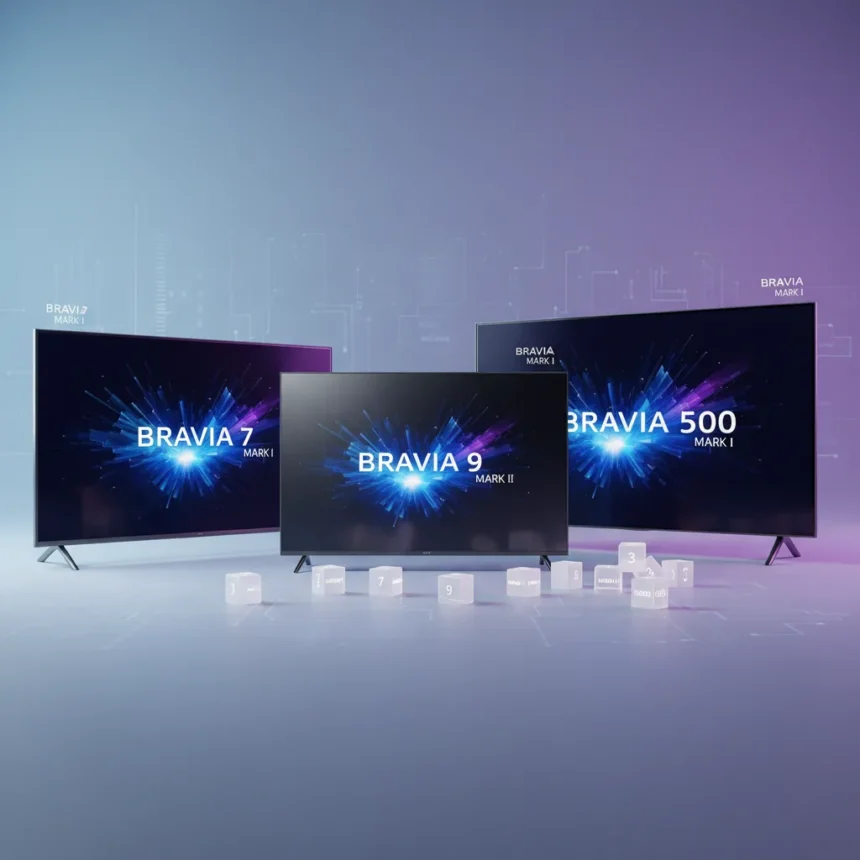
Sony’s 2026 TV lineup refers to the full range of BRAVIA sets Sony is officially selling this year, spanning entry-level LCD panels up to premium True RGB Mini LED flagships. The range runs from 43 inches to 98 inches across multiple tiers, and it marks Sony’s clearest structural split in years — while simultaneously introducing a naming convention that will confuse anyone standing in a showroom trying to choose between a BRAVIA 7 and a BRAVIA 7 Mark II.
Key Takeaways
- Sony’s 2026 BRAVIA range spans 43 inches to 98 inches across five main tiers.
- The lineup includes BRAVIA 2 II, BRAVIA 3 II, BRAVIA 5, BRAVIA 7, BRAVIA 8 II OLED, and BRAVIA 9 Mark II models.
- BRAVIA 7 Mark II and BRAVIA 9 Mark II both use Sony’s True RGB Mini LED backlight technology.
- The BRAVIA 8 II OLED is available only in 55-inch and 65-inch sizes — there is no 77-inch option this year.
- Sony has no active 8K models in its 2026 lineup; the older Z9K may still appear in some stores as leftover stock.
What Is the Sony 2026 TV Lineup, Exactly?
The Sony 2026 TV lineup is structured across five numbered BRAVIA tiers, with the lower numbers handling entry-level duties and the higher numbers covering premium and flagship territory. The key models are the BRAVIA 2 II, BRAVIA 3 II, BRAVIA 5, BRAVIA 7, BRAVIA 8 II OLED, BRAVIA 9, and BRAVIA 9 Mark II. All of them run Google TV as the operating platform.
The structural logic is sound: higher number equals more premium panel technology and processing. What undermines it is the coexistence of Mark I and Mark II variants within the same numbered tier, which means the BRAVIA 7 and the BRAVIA 7 Mark II are both active products with meaningfully different specs. That’s not a minor footnote — it’s the kind of thing that sends buyers home with the wrong television.
Sony’s 2026 BRAVIA Lineup From Entry Level to Flagship
At the entry end, the BRAVIA 2 II and BRAVIA 3 II handle the budget and mid-range slots respectively. These are the models most buyers in competitive retail markets will encounter first, and they represent Sony’s attempt to stay relevant in a segment where Hisense and TCL have been aggressively pricing their own LCD sets.



The BRAVIA 5 sits in the middle of the range without a Mark II designation this year, while the BRAVIA 7 Mark II steps up to Sony’s True RGB Mini LED backlight technology — a meaningful jump in picture quality terms. At the top, the BRAVIA 9 Mark II is Sony’s flagship LCD, also using True RGB, and it starts at 75 inches. If you want Sony’s best picture in a smaller frame, the BRAVIA 9 Mark II simply isn’t an option.
The BRAVIA 8 II occupies the OLED slot, available in 55-inch and 65-inch only. The absence of a 77-inch BRAVIA 8 II is a notable gap — 77-inch OLED is one of the most popular size choices among premium TV buyers, and Sony is leaving that ground open for LG and Samsung to claim without a fight this year.



Does Sony’s 2026 TV Lineup Compete With Hisense and TCL on RGB Mini LED?
The True RGB Mini LED technology in the BRAVIA 7 Mark II and BRAVIA 9 Mark II is Sony’s direct answer to the broader 2026 premium-TV trend. Hisense, TCL, and Samsung are all pushing their own RGB LED and micro-RGB approaches at the top of the market this year. Sony’s True RGB implementation is positioned as a premium differentiator, but it’s no longer a unique capability — the entire industry is converging on this backlight architecture for flagship sets.
Where Sony has historically separated itself from Hisense and TCL is in processing and picture calibration rather than raw panel specs. That advantage remains, but it’s harder to communicate on a spec sheet when a Hisense RGB LED TV is sitting next to a BRAVIA 9 Mark II at a fraction of the price. Sony’s brand and software ecosystem — particularly Google TV’s integration depth — are doing real work here.
Why Is Sony’s Naming So Confusing in 2026?
Sony’s 2026 TV naming is confusing because the lineup mixes numeric branding with Mark I and Mark II suffixes simultaneously, creating situations where two products share a tier number but differ significantly in technology. A shopper comparing a BRAVIA 7 to a BRAVIA 7 Mark II faces a non-obvious choice with no clear visual cue at retail to explain the gap.
This isn’t a trivial UX complaint. TV buying decisions often happen in-store, in under an hour, without deep research. When Samsung uses a clear year-based model suffix or LG uses OLED evo branding to signal tier jumps, the product story is easier to tell. Sony’s hybrid system serves its internal product roadmap logic but doesn’t serve the person standing in front of a wall of screens trying to figure out what they’re actually buying.



Is there an 8K Sony TV available in 2026?
Sony has no active 8K models in its official 2026 lineup. Some retailers may still carry the older 75-inch Z9K 8K TV as leftover stock from 2022, but it is not part of Sony’s current range. If 8K is a priority, Sony is not the brand to look at this year.
What sizes does the BRAVIA 9 Mark II come in?
The BRAVIA 9 Mark II starts at 75 inches and goes up from there. It’s a flagship-only proposition — there’s no smaller BRAVIA 9 Mark II for buyers who want Sony’s best picture in a mid-size format. Buyers wanting True RGB Mini LED in a smaller screen should look at the BRAVIA 7 Mark II instead.
Does Sony still make OLED TVs in 2026?
Yes. The BRAVIA 8 II is Sony’s 2026 OLED offering, available in 55-inch and 65-inch sizes. There is no 77-inch BRAVIA 8 II this year, which is a meaningful limitation given how popular that size is in the premium OLED segment.
Sony’s 2026 TV lineup is genuinely better organised than it has been in recent years — the numbered BRAVIA tiers give buyers a real hierarchy to work with. But the Mark I and Mark II coexistence is a self-inflicted problem that will cost Sony sales at retail, not because the products are bad, but because the naming makes the choice unnecessarily hard. Sort the naming, and this is a strong lineup. Leave it as is, and Sony is handing confused buyers a reason to walk toward a Hisense or Samsung instead.
Edited by the All Things Geek team.
Source: TechRadar