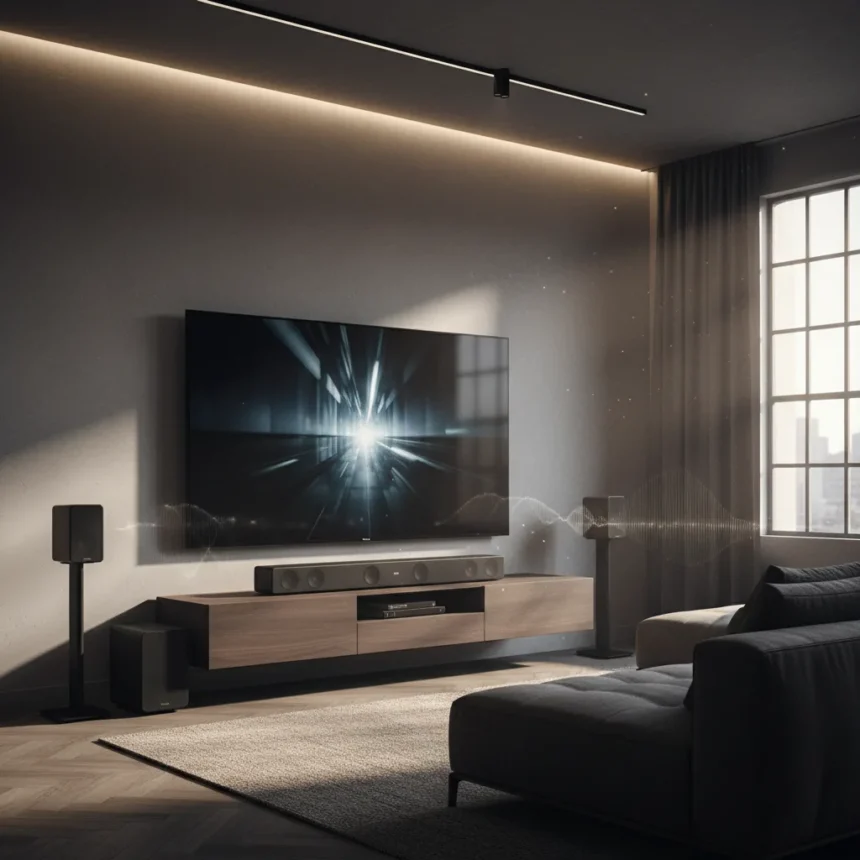
The Sony Bravia Theatre Bar 6 is a midrange soundbar with a wireless subwoofer that supports Dolby Atmos, priced around $650 and configured as a 3.1.2-channel system. It promises room-filling sound and height effects without the cost of a full surround setup. But does it deliver immersion or just volume?
Key Takeaways
- 3.1.2 configuration with up-firing drivers and 350 watts of output power delivers scale and bass impact
- Lacks HDMI In port, Wi-Fi connectivity, and rear speakers, limiting true surround and Atmos refinement
- Stereo soundstage is narrow and relies on virtualization rather than discrete surround drivers
- Very good for dialogue-heavy TV content with balanced frequency response, but aggressive bass can overwhelm midrange
- Compact 95 cm wide design fits smaller living rooms while delivering unexpected scale
Scale Without Sophistication
The Sony Bravia Theatre Bar 6 prioritizes weight and presence over delicacy. Its 350-watt output and aggressive bass tuning fill a moderately sized living room with authoritative sound. The two up-firing drivers place effects directly above you during Atmos content, creating a genuine sense of height. For viewers accustomed to thin, tinny soundbars, the sheer sonic mass feels impressive.
But that mass comes with a cost. What Hi-Fi? notes the bass is very loud and can drown out the midrange and treble at times. This tuning choice prioritizes spectacle over balance. A dialogue-heavy drama becomes a bass showcase. Atmos height effects, while present, lack the subtlety of systems with discrete height channels. RTINGS confirms that the lack of elevation impacts the immersive qualities of Atmos content during movies. The Bar 6 gives you the feeling of height, not the precision.
Virtualization Cannot Replace Rear Speakers
The Sony Bravia Theatre Bar 6 cuts costs by omitting rear speakers and Wi-Fi connectivity, relying instead on virtualization to simulate surround sound. This architectural compromise reveals itself immediately in 5.1 content. The stereo soundstage does not extend particularly wide, and the 5.1 implementation suffers from a lack of discrete surround drivers. You get the illusion of surround, not the reality.



Galaxus notes that ceiling sound reflection doesn’t work equally well in every room, and without rear speakers such as Sony’s Theatre Rear 8, there is no real surround sound. If you upgrade later with rear speakers, you will have invested in a system that was never designed for true 5.1 surround. The Bar 6 locks you into a virtualization-dependent ecosystem.
Dialogue Clarity and TV Integration
Where the Sony Bravia Theatre Bar 6 genuinely excels is dialogue reproduction. RTINGS describes it as very good for TV shows or dialogue-heavy content, with stereo frequency response tuning that is very balanced. The bar includes features like Sony Clear Voice and Voice Zoom 3.0 integration with newer BRAVIA TVs, designed specifically to lift voices above ambient sound. For streaming shows and news, this is a genuine strength.



Control is straightforward via HDMI eARC connection to your TV, with operation through either the TV remote or the BRAVIA Connect app. Music streaming arrives via Bluetooth 5.3. The omission of HDMI In and Wi-Fi means you cannot use this bar as a hub for multiple devices—it is designed as a TV-first system. That focus keeps the price down but limits flexibility.
Compact Design, Uncompromising Sound
At 95 cm wide and 11 cm deep, the Sony Bravia Theatre Bar 6 fits smaller entertainment setups without dominating the room visually. Galaxus describes it as more expansive than expected for its price, delivering clear, intelligible dialogue from a footprint that suggests a more modest system. This is the bar’s strongest practical advantage: it punches above its physical weight.
The comparison to Sonos Beam Gen 2 is instructive. The Beam lacks up-firing drivers entirely and does not support Atmos height effects. The Bar 6 offers more scale and genuine Atmos capability. But the Sonos ecosystem is more refined, with better balance and no aggressive bass coloration. You are choosing between Sony’s bombast and Sonos’s restraint.
Should You Buy the Sony Bravia Theatre Bar 6?
If you want Dolby Atmos and room-filling sound at midrange pricing, the Sony Bravia Theatre Bar 6 delivers. If you value dialogue clarity for TV and have a smaller living room, it is a solid choice. But if you care about surround accuracy, tonal balance, or upgrading your system later with rear speakers, the virtualization-dependent architecture and aggressive tuning will disappoint. This bar succeeds by being bold and unapologetic about its compromises—it is not trying to be a reference system. It is trying to be a fun, loud, visually compact solution for viewers who prioritize impact over subtlety. For that specific audience, it works.



Does the Sony Bravia Theatre Bar 6 support wireless surround speakers?
The Bar 6 does not include wireless surround speakers and relies on virtualization to simulate surround sound. You could potentially add Sony’s Theatre Rear 8 speakers, but the system was not architected for discrete surround from the start, so integration would be an afterthought rather than a core design feature.
What is the frequency response of the Sony Bravia Theatre Bar 6?
The bar covers a frequency response from 20 Hz to 20 kHz, spanning the full audible spectrum. However, the tuning emphasizes bass aggressively, which can overwhelm the midrange and treble in some content.
Can you use the Sony Bravia Theatre Bar 6 with non-Sony TVs?
Yes, the bar connects via HDMI eARC to any TV with that port and can be controlled through the BRAVIA Connect app. You lose features like Voice Zoom 3.0, which require newer Sony BRAVIA TVs, but basic operation works with any compatible television.
The Sony Bravia Theatre Bar 6 is a soundbar that knows what it is: a loud, bass-forward system designed for impact rather than refinement. It delivers Atmos height effects and dialogue clarity at a price that undercuts premium rivals. But its reliance on virtualization, aggressive tuning, and omission of rear speaker integration mean it is best suited to viewers who value scale over sophistication. For the right room and the right content, it is compelling. For everyone else, the compromises may prove frustrating.
Where to Buy
Edited by the All Things Geek team.
Source: Tom's Guide