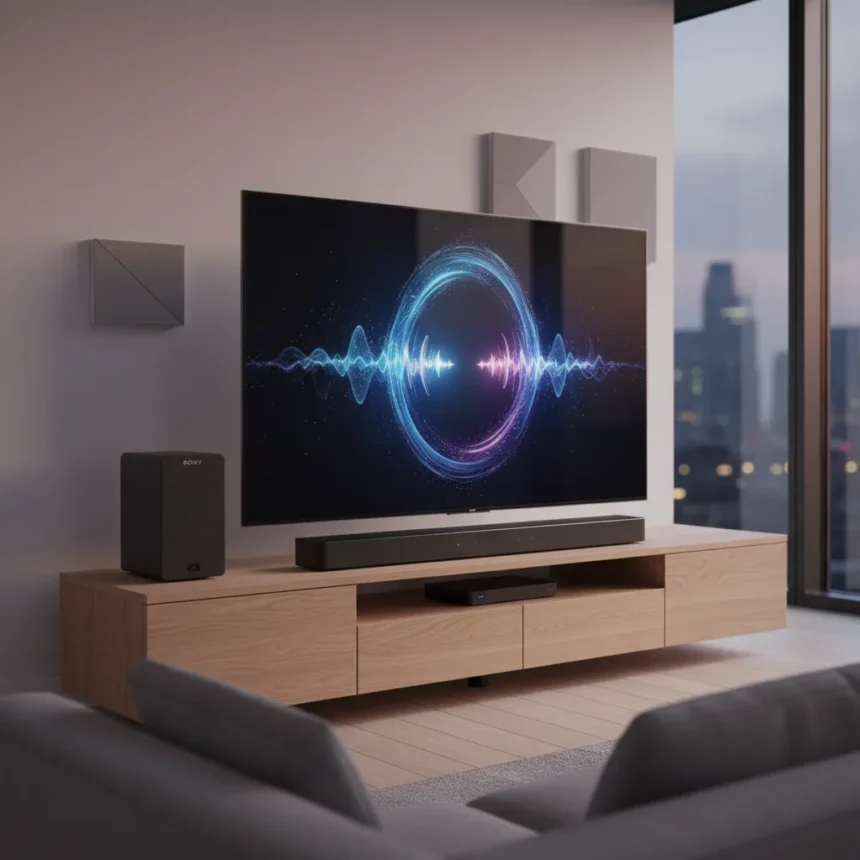
The Sony Bravia Theatre Bar 7 is a 9-speaker soundbar system designed by Sony, featuring dedicated up-firing and side-firing drivers for spatial surround sound, priced at around $870 USD, and available through Sony’s electronics site, Best Buy, and Audio Advice. Most compact soundbars force you to choose: cinematic Atmos or a living room that doesn’t look like a theater. The Bravia Theatre Bar 7 + S refuses that compromise, cramming a 5.1.2-channel experience into a single bar without requiring rear speakers or a separate subwoofer for basic surround sound.
Key Takeaways
- 9 speaker units create 5.1.2-channel surround from a single compact bar without rear speakers needed
- Supports Dolby Atmos, DTS:X, and IMAX Enhanced for premium cinematic soundtracks
- 360 Spatial Sound Mapping uses room calibration via Bravia Connect app to generate phantom surround speakers
- Dual HDMI 2.1 ports enable 4K/120Hz passthrough plus eARC, unlike Sonos Beam Gen 2
- Expandable with wireless subwoofers and rear speakers for full home theater without replacing the bar
What Makes the Sony Bravia Theatre Bar 7 Stand Out
The Sony Bravia Theatre Bar 7 distinguishes itself through architecture rather than size. Nine speaker units—including up-firing drivers for ceiling-bounce Atmos effects and side-firing speakers for wall-reflected soundstage widening—create a convincing surround field from a single bar. This matters. Most compact soundbars sacrifice spatial height or width. Sony’s approach trades nothing away.
The bar supports Dolby Atmos, DTS:X, and IMAX Enhanced, giving you access to IMAX soundtracks on Disney Plus and Sony Pictures Core. That’s a feature most soundbars in this price range skip entirely. Sound Field Optimization calibrates the audio for your specific room and seating position, ensuring the surround effect works regardless of whether you sit dead center or off to the side.
360 Spatial Sound Mapping is the real innovation. Using the Bravia Connect app, the system measures your room and creates phantom speakers around the space—essentially audio illusions that make the soundbar sound wider and taller than it physically is. It works. Not perfectly, but well enough that you stop thinking about where the sound is coming from and start thinking about what you’re watching.



The Sony Bravia Theatre Bar 7 vs. Sonos Competition
The Sony Bravia Theatre Bar 7 outguns the Sonos Beam Gen 2 in raw capability. Beam 2 has one eARC port; Sony has two HDMI 2.1 ports, one for eARC and one for 4K/120Hz passthrough, making it better for gaming and multi-device setups. Sony’s 9 speakers dwarf Beam 2’s architecture, and Sony supports dual wireless subwoofers out of the box—Beam 2 does not. For movies and gaming, Sony wins. For music, Beam 2 remains more refined, but that’s a narrower use case.
Against the Sonos Arc Ultra, Sony’s advantage is price and flexibility. Arc Ultra is a capable 5.0.2 all-in-one with up and side-firing drivers and room calibration, but it lacks IMAX Enhanced certification and costs more. The Sony Bravia Theatre Bar 7 adds IMAX Enhanced and dual HDMI 2.1 at a lower price point, though Arc Ultra has a slight edge in music playback optimization.



Expansion and Room Integration
The Sony Bravia Theatre Bar 7 is built to grow. Add wireless subwoofers like the Sub 7 for deeper bass, or add rear speakers for full surround when you’re ready. You can expand to 11 total speakers with accessories, transforming the bar into a genuine home theater system without replacing the main unit. That modularity is rare at this price tier.
If you own a Bravia TV, integration runs deeper. Voice Zoom 3 uses AI to enhance dialogue, a feature that makes streaming dialogue-heavy shows dramatically clearer. Non-Sony TVs work fine, but you lose that TV-specific optimization.
What Costs Extra and What Doesn’t
The $870 price is for the bar alone. The “+ S” designation likely refers to pairing the bar with a subwoofer like the Sub 7, which adds significant cost beyond the standalone bar price. If you want the full cinematic experience—bar plus sub plus rear speakers—expect to spend considerably more. That’s not a flaw; it’s how modular systems work. But don’t assume $870 buys you the complete package shown in marketing photos.
Frequently Asked Questions
Does the Sony Bravia Theatre Bar 7 need a subwoofer?
No. The bar creates convincing surround and bass from its 9 speakers alone. Adding a wireless subwoofer like the Sub 7 deepens bass response and adds impact for action films, but it’s optional, not required.



Can you use the Sony Bravia Theatre Bar 7 with non-Sony TVs?
Yes. The bar works with any TV via HDMI eARC or optical. You lose Bravia TV-specific features like Voice Zoom 3 dialogue enhancement, but core surround sound and Atmos support function normally.
How does 360 Spatial Sound Mapping actually work?
The Bravia Connect app measures your room dimensions and listening position, then the bar creates phantom speakers around the space using phase-shifted audio from its up and side-firing drivers. It’s not true surround, but it’s convincing enough that most viewers stop thinking about speaker placement.
The Sony Bravia Theatre Bar 7 + S solves a real problem: how to get cinematic surround sound without tearing apart your living room. It won’t replace a proper 5.1.4 home theater setup, but for apartments, smaller rooms, or anyone who refuses to hide wires and speakers, it’s the most capable compact soundbar Sony has built. The modular approach means you can start with the bar and add pieces as your budget and space allow—a smarter strategy than forcing buyers to commit to a full system upfront.
Where to Buy
Edited by the All Things Geek team.
Source: What Hi-Fi?