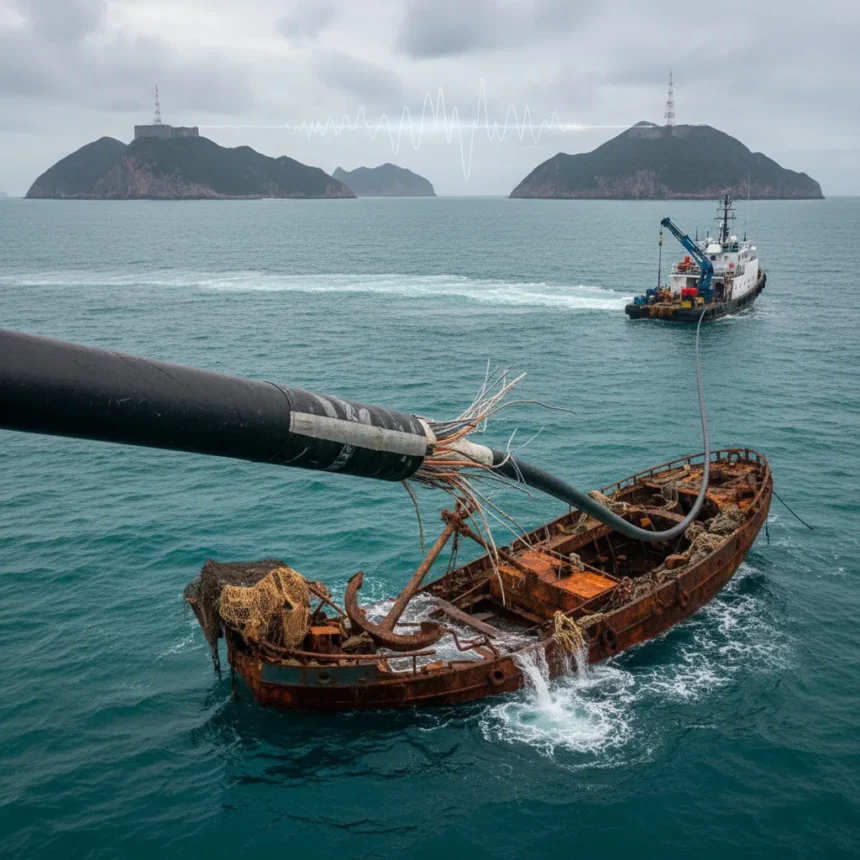
A Taiwan undersea cable connecting two strategically important military islands in the northern Taiwan Strait was partially severed early Monday, forcing authorities to activate backup microwave communications to maintain connectivity. The Taiwan-Matsu Subsea Cable 3, which links the Dongyin and Beigan islands near the Chinese coast, suffered damage during salvage operations on a grounded fishing vessel, triggering a Coast Guard investigation and raising fresh concerns about infrastructure vulnerability in one of the world’s most contested waterways.
Key Takeaways
- Taiwan-Matsu Subsea Cable 3 partially broken during salvage operations on grounded fishing vessel
- Taiwan Coast Guard halted salvage, detained 11 crewmembers, and questioned captain for investigation
- Backup microwave communications activated to maintain service while cable repair is contracted
- Matsu Islands host heavy Taiwanese military presence in strategically sensitive northern Taiwan Strait
- Incident follows 2025 conviction of Chinese freighter captain for deliberately severing different Taiwan cable
How the Taiwan Undersea Cable Was Damaged
The damage to Taiwan undersea cable infrastructure occurred when a Chinese salvage barge, operating as part of recovery efforts for a grounded fishing vessel, likely shifted due to bad weather or salvage operations and struck the subsea link. Taiwan’s digital affairs agency had appointed salvors to remove the fishing boat, and operations began early Monday with cable locations mapped to avoid such incidents. The partial break in the Taiwan-Matsu Subsea Cable 3 was reported to the Coast Guard by the subsea cable operator, triggering an immediate halt to all salvage work.
Taiwan’s Coast Guard detained 11 crewmembers from the salvage operation and took the captain ashore for questioning. The case was forwarded to the local prosecutor’s office as Taiwanese officials formally accused the Chinese salvage barge of causing the damage. One segment of the cable remained intact, allowing telecom service to continue through that portion while backup systems were activated.
Backup Systems Keep Matsu Islands Connected
Rather than lose connectivity to the Matsu Islands, Taiwan activated backup microwave communications to maintain service during the repair process. This redundancy prevented a total outage in a region that hosts significant Taiwanese military infrastructure. The digital affairs agency contracted a cable ship operator to undertake a complete repair of the severed section, though a timeline for restoration was not disclosed.


The reliance on backup systems underscores the vulnerability of undersea cable networks in contested zones. Unlike terrestrial infrastructure, submarine cables operate in international waters and are difficult to protect. Taiwan’s decision to maintain multiple communication paths reflects hard lessons learned from previous incidents and the strategic importance of maintaining uninterrupted connectivity to outlying islands.
Rising Sabotage Concerns After Recent Conviction
This incident arrives just months after Taiwan convicted a Chinese freighter captain of deliberately severing a different undersea cable. In 2025, the captain of the Hong Tai 58 was sentenced for dropping anchor in a marked cable zone and deliberately zigzagging to damage the Tai-Peng 3 cable. That case established a precedent: cable damage in Taiwan’s waters is not always accidental, and Chinese-flagged vessels have been implicated in deliberate sabotage.



The Matsu Islands incident reignites those concerns. While Taiwan officials have not yet conclusively proven intentional sabotage in this case, the timing and involvement of a Chinese salvage operation raise questions about whether the damage was truly accidental or part of a pattern of infrastructure attacks. The strategic location of the Matsu Islands—heavily militarized and near the Chinese coast—makes them a logical target for disruption. In a separate recent incident, a Chinese-crewed ship was detained near the Penghu Islands for cable damage, suggesting a broader pattern of concern.
Why Matsu Islands Matter Strategically
The Dongyin and Beigan islands that the damaged cable connects are not ordinary civilian outposts. Both host heavy Taiwanese military presence in the northern Taiwan Strait, making them critical nodes in Taiwan’s defense infrastructure. Disrupting communications to these islands could degrade Taiwan’s ability to coordinate military responses in a crisis. This is why cable damage in this region triggers immediate investigation and why Taiwan treats each incident as a potential national security threat.
The comparison to terrestrial infrastructure fails here: you cannot quickly reroute a submarine cable or deploy a backup line in days. Microwave communications, while functional, lack the bandwidth and resilience of fiber-optic cables. Taiwan’s reliance on backup systems for military-critical islands is a temporary measure, not a long-term solution.
What Happens Next?
Taiwan’s prosecutor’s office now holds the case, and the detained crewmembers remain in custody pending investigation. The cable ship operator contracted by the digital affairs agency will assess the damage and plan repairs. Depending on the severity of the break and weather conditions, restoration could take weeks. In the meantime, the Matsu Islands remain dependent on microwave links, a vulnerability that Taiwan cannot afford to tolerate indefinitely.



The broader question is whether Taiwan will strengthen enforcement of cable protection zones and increase penalties for violations. The 2025 Hong Tai 58 conviction set a precedent, but deterrence requires consistent prosecution and visible consequences for future violations.
Is this Taiwan undersea cable incident intentional sabotage?
Taiwanese officials have not conclusively proven deliberate sabotage in this case, only that a Chinese salvage barge was involved during the damage. However, the pattern of recent incidents—the Hong Tai 58 conviction, the Penghu Islands cable damage, and now this—suggests either increasing recklessness or deliberate targeting. Taiwan’s prosecutor will determine whether evidence supports criminal charges beyond negligence.
How long will repairs to the Taiwan undersea cable take?
The research brief does not specify a timeline for repairs. Cable ship operators typically require favorable weather and several weeks to locate, assess, and replace damaged sections. Taiwan’s digital affairs agency has contracted the work, but restoration depends on operational availability and sea conditions in the Taiwan Strait.
What is the difference between microwave and cable communications?
Microwave communications transmit signals through the air via relay stations and have lower bandwidth and latency than fiber-optic cables, which transmit data through glass filaments. Cables are more reliable for high-volume data transfer and military applications, while microwave serves as a backup when cables are damaged or unavailable.
Taiwan’s activation of backup microwave communications kept the Matsu Islands connected, but this temporary fix exposes a critical vulnerability: the nation’s military-strategic islands depend on undersea cables that sit in contested waters where Chinese vessels operate with minimal oversight. Until the Taiwan-Matsu Subsea Cable 3 is fully repaired and Taiwan strengthens cable protection enforcement, the risk of future outages—whether accidental or deliberate—remains unacceptably high.
Edited by the All Things Geek team.
Source: Tom's Hardware