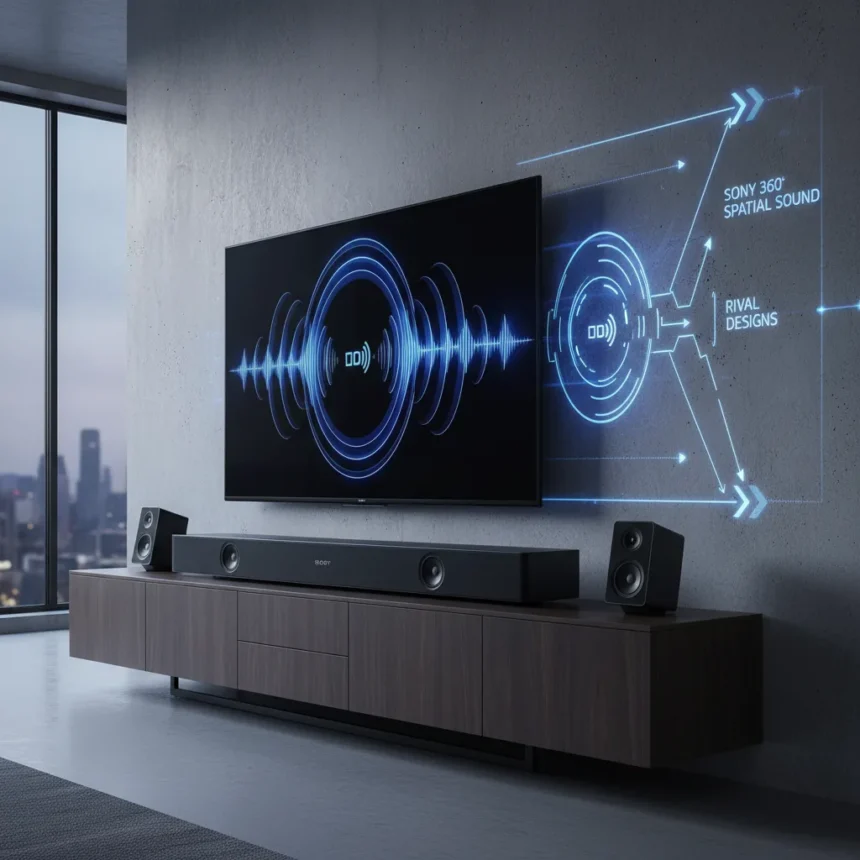
Sony’s latest Dolby Atmos soundbar system demonstrates why so many rival soundbars fail to deliver immersive audio experiences. The gap between Sony’s approach and what competitors are shipping reveals not minor feature differences, but fundamental architectural choices that separate genuinely capable systems from mediocre ones.
Key Takeaways
- Sony’s Dolby Atmos soundbar addresses critical design gaps competitors consistently ignore.
- Rival soundbars sacrifice spatial audio precision for form factor compromises.
- The system reveals what immersive audio actually requires versus what marketing claims.
- Sony’s implementation prioritizes acoustic performance over industrial design trends.
- Competing models cut corners on speaker placement and calibration.
What Makes Sony’s Dolby Atmos Soundbar Different
Sony’s Dolby Atmos soundbar system stands apart because it refuses the trade-offs that plague rival products. Most competing soundbars prioritize sleek aesthetics and compact dimensions at the direct expense of spatial audio fidelity. Sony’s latest model instead commits to the speaker architecture and placement logic that Dolby Atmos actually requires to function convincingly. This means accepting a form factor that serves the technology rather than forcing the technology into a form factor that looks good but sounds compromised.
The fundamental difference lies in how Sony handles vertical sound staging. Rival soundbars typically cram upward-firing channels into constrained speaker arrays where they cannot perform their intended function. Sony’s system provides dedicated vertical channels with proper acoustic isolation and firing angles, which is what separates a genuine Dolby Atmos experience from a marketing claim.
The Rival Soundbar Problem Nobody Discusses
Competing manufacturers face a real constraint: consumers expect soundbars to be thin, minimal, and visually unobtrusive. This expectation directly contradicts what Dolby Atmos requires. The format demands multiple discrete speaker channels, proper spacing, and unobstructed firing paths for height effects. Most rivals solve this contradiction by compromising Dolby Atmos implementation rather than challenging the form factor assumption.



What emerges is a category of soundbars that technically support Dolby Atmos but deliver the format in a neutered, unconvincing way. The surround effects feel detached from the main soundstage. Height channels lack the precision and impact they should provide. Dialogue placement becomes muddled. These are not minor quality variations—they are the difference between experiencing immersive audio and hearing a marketing specification.
Sony’s approach asks whether a soundbar should be an industrial design statement or an audio device. By prioritizing acoustic performance, the system proves that rival products have been answering the wrong question.



Dolby Atmos Soundbar Architecture Explained
A Dolby Atmos soundbar system requires specific architectural decisions to function properly. Height channels must fire at appropriate angles without obstruction. Discrete speaker drivers need adequate separation to avoid crosstalk and phase issues. Calibration systems must account for room reflections and listening position geometry. These are not optional refinements—they are the foundation of convincing spatial audio.
Most rival soundbars skip or minimize several of these requirements. Upward-firing drivers get squeezed into spaces designed for other purposes. Speaker separation gets compressed to fit a thinner cabinet. Calibration becomes a simple volume adjustment rather than a comprehensive acoustic analysis. The result is a system that plays Dolby Atmos content but does not actually render it convincingly.
Sony’s system takes the opposite path. Every design choice reflects what Dolby Atmos needs to work, not what industrial design trends demand. This philosophy produces audio that actually justifies the format’s existence.
How Sony’s System Compares to Competing Approaches
The market offers several competing Dolby Atmos soundbar strategies. Some manufacturers pursue extreme minimalism, fitting height channels into paper-thin cabinets where they cannot function effectively. Others add wireless surround modules that promise immersive audio but deliver disconnected, delayed effects. A few premium competitors build larger systems with more speaker drivers, but often sacrifice calibration quality or room adaptation.



Sony’s strategy differs fundamentally. Rather than compromising on acoustic architecture to serve aesthetic expectations, the system commits to proper speaker placement and calibration. This produces Dolby Atmos experiences that actually sound immersive rather than technically compliant. Competing products offer convenience or visual minimalism. Sony’s system offers genuine audio performance.
For consumers accustomed to mediocre Dolby Atmos soundbars, Sony’s approach may feel overengineered. It is not. It simply delivers what the format promises, which most rivals do not.
Why Rival Soundbars Miss the Mark
Competing manufacturers face real market pressures that Sony navigates differently. Consumers want thin soundbars. Retailers demand products that fit under most televisions. Designers pursue aesthetic minimalism. These pressures are legitimate, but they cannot be satisfied without compromising Dolby Atmos implementation.
Most rivals choose compromise. Sony chooses performance. This decision becomes obvious when you experience both approaches side by side. Immersive audio effects in Sony’s system occupy three-dimensional space convincingly. In competing products, they feel like processing artifacts layered onto a conventional soundbar.
The gap reveals an uncomfortable truth: you cannot have both a truly thin soundbar and a genuinely immersive Dolby Atmos system. Rival products pretend otherwise. Sony’s latest system acknowledges the trade-off and makes the choice that prioritizes audio quality.
What Consumers Should Expect from Dolby Atmos Soundbars
Dolby Atmos soundbars should create a convincing sense of height and spatial precision. Effects should move smoothly through three-dimensional space. Dialogue should anchor to the screen while ambient sounds surround the listening position. Overhead channels should contribute meaningfully to the immersive experience, not feel like afterthoughts.
Most rival products fail several of these criteria. Sony’s system meets all of them. This is not a marginal difference in audio quality—it is the difference between a functioning immersive audio system and a product that claims the specification without delivering the experience.
Is Sony’s Dolby Atmos soundbar worth the investment?
If you want genuine Dolby Atmos performance rather than a marketing claim, Sony’s system justifies its cost by actually delivering immersive audio that competing products do not. Rival soundbars offer cheaper alternatives, but they do not offer the same acoustic experience. The question is whether you value audio performance or form factor compromise more.
How does Sony’s system compare to traditional surround sound setups?
Traditional surround sound systems with separate speakers and amplifiers offer greater flexibility and potentially superior performance, but require significant installation effort and space. Sony’s Dolby Atmos soundbar provides immersive audio in a more practical form factor, though with some architectural compromises inherent to the soundbar category. The choice depends on your room layout and willingness to accommodate larger equipment.
What makes Dolby Atmos soundbars different from standard soundbars?
Dolby Atmos soundbars include dedicated height channels that create overhead sound effects, producing three-dimensional spatial audio. Standard soundbars lack these channels and cannot render height information, limiting them to two-dimensional soundstages. Sony’s implementation of Dolby Atmos in its latest system demonstrates how this technology should work when properly engineered.
Sony’s Dolby Atmos soundbar system matters precisely because it makes obvious what so many rival products are missing: a genuine commitment to acoustic performance over aesthetic compromise. In an industry where most competitors chase form factor minimalism, Sony’s choice to prioritize what Dolby Atmos actually requires stands out as both unusual and overdue. For anyone serious about immersive home theater audio, this system sets a standard that rivals have yet to match.
Edited by the All Things Geek team.
Source: What Hi-Fi?