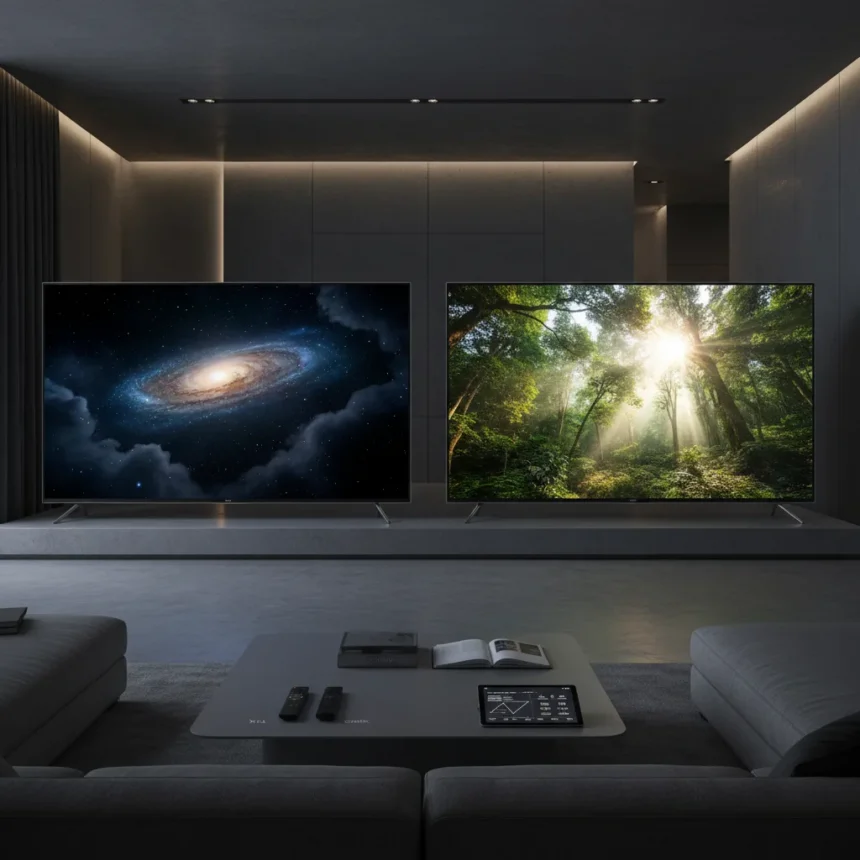
The TCL X11L vs TCL QM9K debate cuts to the heart of how to build a flagship Mini-LED television. The X11L is TCL’s 2026 SQD flagship with 20,736 local dimming zones and 10,000 nits peak brightness, while the QM9K is the 2025 flagship using QD-Mini LED technology with up to 6,000 dimming zones and 6,500 nits peak brightness. Both are premium TVs, but they take fundamentally different engineering approaches—and that matters enormously for your viewing experience.
Key Takeaways
- X11L delivers 20,736 dimming zones vs QM9K’s 6,000, creating dramatically finer contrast control
- X11L peaks at 10,000 nits brightness; QM9K measured at 4,207 nits in Standard mode by Tom’s Guide
- Both support Dolby Vision IQ, HDR10+, and IMAX Enhanced with four HDMI 2.1 ports
- X11L features TSR AiPQ processor for gaming; QM9K includes Gemini voice assistant
- X11L wins on picture benchmarks; QM9K excels at usability and glare control
Dimming Zones: Where the Real Difference Lives
The TCL X11L vs TCL QM9K comparison starts with dimming architecture, and this is where the gap becomes obvious. The X11L packs 20,736 local dimming zones using SQD-Mini LED technology paired with a WHVA 2.0 Ultra Panel, while the QM9K maxes out at 6,000 zones with its QD-Mini LED and CrystGlow WHVA panel. That’s a 3.5x difference in granularity. More zones mean finer control over which parts of the screen brighten or dim independently, which translates to less blooming around bright objects on dark backgrounds and tighter shadow detail.
The practical result? The X11L can render a starfield without halos around individual stars. The QM9K will still do this reasonably well, but you’ll notice the difference in side-by-side viewing. For content with lots of high-contrast elements—sports, sci-fi films, gaming—the X11L’s dimming precision creates a noticeably cleaner image.
Brightness and HDR: X11L Dominates on Paper
Peak brightness is where the TCL X11L vs TCL QM9K gap becomes a chasm. The X11L claims 10,000 nits peak brightness, while the QM9K officially rates at 6,500 nits. However, Tom’s Guide’s lab measurement tells a more nuanced story: the QM9K actually hit 4,207 nits in a 10% window using Standard picture mode. That’s a real-world measurement, not a marketing spec, and it matters because it shows how these TVs perform in actual viewing conditions rather than under artificial test conditions.


The X11L’s brightness advantage is genuine and substantial. For HDR content—especially in bright rooms or when viewing bright HDR highlights—the X11L will pop harder and feel more immersive. Both TVs support the same HDR formats: Dolby Vision IQ, HDR10+, and IMAX Enhanced. But the X11L’s extra brightness headroom gives it more room to breathe in HDR content, particularly for peak-brightness scenes in action films or gaming.
Features and AI: Different Priorities
The TCL X11L vs TCL QM9K also reveals different design philosophies beyond hardware. The X11L includes TCL’s TSR AiPQ processor, which handles AI-powered gaming optimizations and upscaling. If you’re a serious gamer, this processor’s gaming-specific tuning could matter. The QM9K takes a different route, featuring Gemini voice commands for hands-free control. Both TVs include four HDMI 2.1 ports with eARC, Wi-Fi 6, and Bluetooth 5.4, so connectivity is equivalent.



The voice assistant in the QM9K is genuinely useful for casual users who want to control the TV without a remote, but it’s not a picture-quality feature. The X11L’s gaming processor is more specialized—it won’t help you if you don’t game, but it’s a meaningful advantage if you do. This is where personal use case matters more than raw specs.
Picture Quality: Where X11L Pulls Ahead
According to benchmarked testing, the TCL X11L vs TCL QM9K shows the X11L consistently scoring higher in picture benchmarks. The combination of more dimming zones and greater peak brightness gives the X11L a measurable advantage in contrast, color volume, and overall image clarity. The QM9K is no slouch—it’s still a flagship Mini-LED TV with excellent performance—but the X11L’s engineering refinements put it ahead.
The QM9K does have one genuine strength: glare control and usability. If your room is very bright or if you prioritize ease of use and voice control, the QM9K wins on those practical fronts. It’s a reminder that picture quality isn’t the only measure of a TV’s value.
Which Should You Buy?
The TCL X11L vs TCL QM9K choice depends on what you value. Choose the X11L if you want the best possible picture quality, you game frequently, and you’re willing to pay for a 2026 flagship with latest dimming precision. Choose the QM9K if you prefer a TV that’s easier to use, you value voice control, and you want a proven 2025 flagship that still delivers excellent performance without the premium price tag of the newest model.



Does the X11L’s brightness really matter in normal rooms?
Yes, but with caveats. Peak brightness matters most for HDR highlights and bright rooms. In a darker room with moderate brightness settings, both TVs will look excellent. The X11L’s advantage is most noticeable in bright environments or when watching HDR content with frequent bright scenes.
Is the QM9K’s 6,000 dimming zones enough?
For most viewers, yes. The QM9K’s dimming performance is still premium-tier and will handle virtually all content well. The X11L’s extra zones create a measurable improvement, but it’s a refinement rather than a revolutionary difference.
What’s the difference between SQD-Mini LED and QD-Mini LED?
Both are Mini-LED technologies using quantum dots, but SQD (used in the X11L) and QD-Mini LED (used in the QM9K) represent different implementations of the same core concept. The X11L’s SQD approach, paired with more dimming zones, delivers superior contrast and color performance in this comparison.
The TCL X11L vs TCL QM9K isn’t a case of one TV being objectively superior across all metrics. The X11L wins on picture quality and gaming features; the QM9K wins on usability and value. If you’re buying a premium Mini-LED TV in 2025 or 2026, either choice is defensible—but know what you’re trading off. The X11L is the technical champion; the QM9K is the practical one.
Where to Buy
$9,999.99 at Amazon | $1,499.99 at Amazon | 75-inch TCL X11L for $6,999 at Amazon
Edited by the All Things Geek team.
Source: Tom's Guide