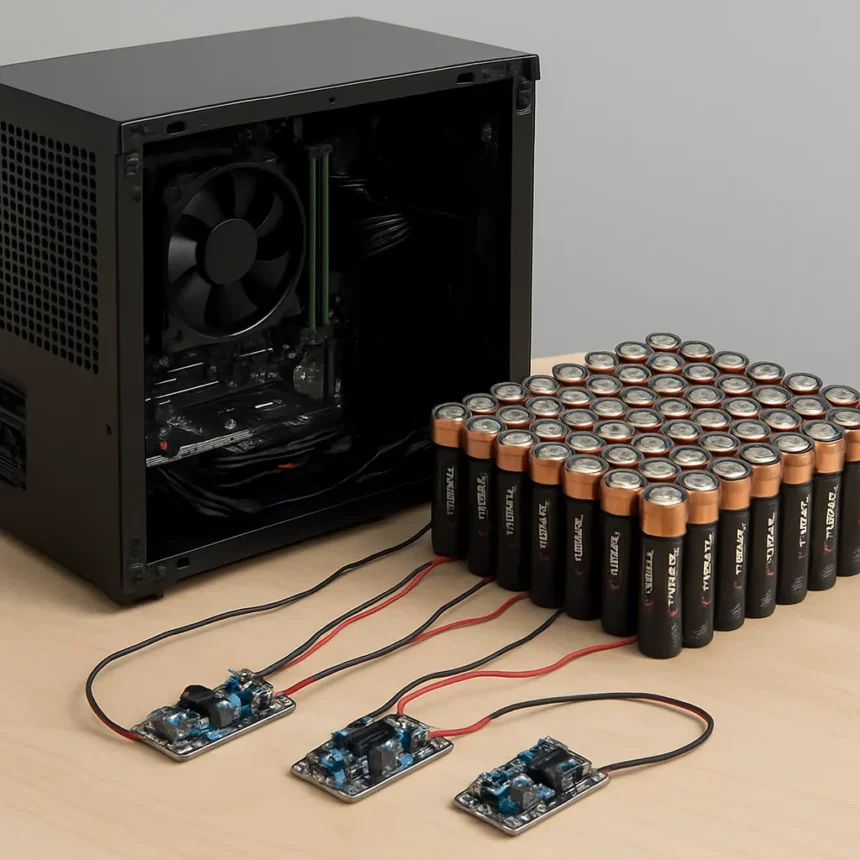
An AA battery powered PC that can run Cinebench and Minecraft for over half an hour sounds like the premise of a bad joke, but YouTube creator ScuffedBits has made it real. ScuffedBits is a DIY electronics experimenter known for pushing consumer hardware into absurd scenarios. In a follow-up to their original 56-cell experiment, they rebuilt the setup from the ground up, achieving 33 minutes and 19 seconds of runtime on 64 AA cells — more than six times longer than their previous attempt.
Why the First AA Battery Powered PC Attempt Failed
The original build used 56 alkaline AA cells in an 8-series, 7-parallel configuration, and it was a mess of compromises. Runtime topped out at under five minutes — the best result being a game of Minesweeper completed in 4 minutes and 35 seconds. The setup relied on thin Cat-5e network cable for wiring, which was never designed for the current demands of a desktop PC. Two 6,800µF 40V capacitors were added to absorb voltage spikes, and the machine could not even boot directly from the battery pack — it had to be started on an external PSU and then switched over mid-run. It worked, barely, but it demonstrated exactly what needed fixing.
A key insight from that first experiment was battery chemistry. ScuffedBits measured the short-circuit current of carbon AA cells at 2.6 amps, compared to 3.7 amps for alkaline cells. Alkaline batteries are both higher capacity and capable of delivering more current — carbon cells simply cannot keep up with the instantaneous demands of a booting PC. That data directly shaped the rebuilt design.
How ScuffedBits Rebuilt the AA Battery Powered PC
The rebuild introduced a fundamentally different electrical architecture. Instead of one large parallel bank of identical cells, ScuffedBits used three separate strings of approximately eight cells each — one carbon, one alkaline, and one NiMH — wired in series to produce roughly 25 volts DC per string when fully charged. Each string then fed into its own cheap buck regulator module, stepping the voltage down to a stable 12V DC for the ATX power connector. Running three regulators in parallel was the key stability improvement: it distributed the current load and prevented the voltage sag that killed the previous build.


The PC itself ran on an Intel Core i3 530 processor connected via a DC-DC ATX adapter that accepts 12V DC input. The monitor was powered separately by eight NiMH AA cells, and the wireless mouse and keyboard were already battery-operated — so the entire system ran without a single mains power connection. Critically, this version booted directly from the battery pack, something the first build could never achieve.
What the AA Battery Powered PC Actually Ran
Once booted into Windows, ScuffedBits put the system through a real workload sequence rather than just idling. The session included a quick game, a Cinebench benchmark run that hit a peak of 64 watts of power consumption, and a Minecraft session that involved both troubleshooting and actual gameplay. The system ran for 33 minutes and 19 seconds before voltage dropped below the cutoff threshold of approximately 10 volts.



When the system finally shut down, the battery strings told an interesting story about chemistry. The carbon cells were the most depleted, the alkaline cells were partially used, and the NiMH cells were still sitting at a healthy 1.2 volts per cell. That gap suggests NiMH cells are significantly better suited to sustained PC loads than carbon cells, and raises an obvious question about what an all-NiMH configuration could achieve. Rough estimates put a theoretical maximum of around 175Wh for an 8-series, 7-parallel arrangement, but real-world discharge rates and buck converter efficiency — estimated at around 60% — would constrain actual runtime well below that ceiling.
Is the AA Battery PC Experiment Worth Replicating?
Anyone tempted to replicate this should treat it as an electrical engineering challenge, not a casual weekend project. AA cells are not designed for the sustained high-current demands of a desktop PC, and abrupt shutdowns from voltage sag are a real risk to both data and hardware. The wiring choices matter enormously — thin cabling like Cat-5e introduces resistance that compounds voltage drop under load, and the original build suffered for it. Proper current-rated wiring and regulated voltage conversion are non-negotiable if you want stable operation.
Compared to the first experiment, the rebuild is a genuine improvement in methodology. Where the original was a proof-of-concept held together with compromises, this version demonstrates that mixed battery chemistry with per-string regulation can deliver meaningful runtime. The comparison between the two builds is itself instructive: same basic concept, but the second attempt runs more than six times longer by solving the right engineering problems rather than just adding more cells.
Could this become a real battery PC speedrun category?
The idea has been floated online, but there is no evidence of an organised competition or community around it yet. What ScuffedBits has demonstrated is a repeatable methodology — fixed hardware, defined battery count, measurable runtime — that could serve as a baseline if the concept caught on.



What battery type works best for powering a PC?
Based on ScuffedBits’ experiment, NiMH cells held up best under sustained load, maintaining 1.2 volts per cell after the carbon and alkaline strings were significantly depleted. Alkaline cells outperform carbon in both capacity and peak current output, making them a better choice than carbon for high-demand applications. NiMH cells appear to be the strongest option for extended runtime.
How many AA batteries does it take to run a desktop PC?
ScuffedBits achieved over 33 minutes of runtime with 64 AA cells arranged in three parallel strings of roughly eight cells each, stepped down to 12V via buck regulators. The previous attempt with 56 alkaline cells managed under five minutes, demonstrating that battery count alone is not the deciding factor — voltage regulation and battery chemistry matter just as much.
The AA battery powered PC experiment is ultimately a masterclass in iterative problem-solving. ScuffedBits identified the failure points of the first build — weak chemistry, unstable regulation, forced boot workarounds — and addressed each one systematically. The result is a machine that runs real benchmarks and games on hardware you can buy at any corner shop. It is impractical, expensive per kilowatt-hour, and entirely worth watching.
Edited by the All Things Geek team.
Source: Tom's Hardware