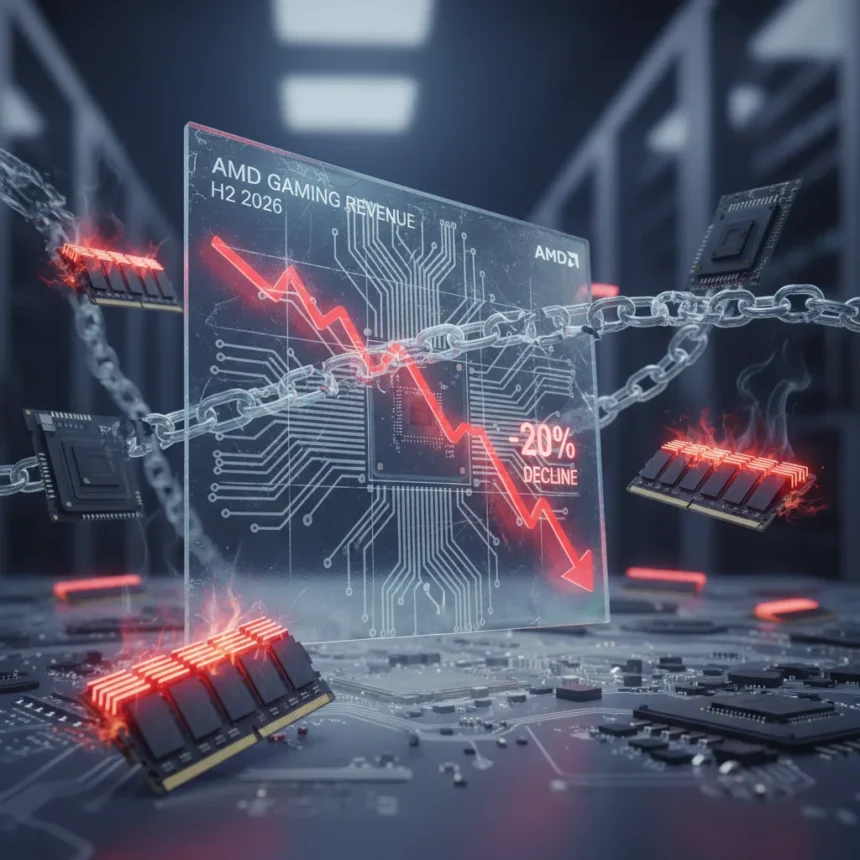
AMD gaming revenue faces a 20% decline in the second half of 2026 compared to the first half, CEO Lisa Su warned, as higher memory and component costs squeeze margins across the gaming segment. The forecast marks a sharp reversal from record performance in 2025, when AMD’s Client and Gaming segment generated $14.6 billion in revenue, up 51% year-over-year. Now, inflation in memory pricing and ongoing supply constraints are forcing AMD to model the second half as sub-seasonal to the first half.
Key Takeaways
- AMD gaming revenue expected to fall more than 20% in H2 2026 due to memory and component cost inflation.
- Record 2025 Client and Gaming revenue of $14.6 billion will not be sustained as memory crunch deepens.
- High Bandwidth Memory costs projected to rise 60% in 2026, adding pressure across the entire supply chain.
- PC total addressable market expected to decline slightly in 2026 due to inflationary pressures, particularly memory.
- Industry-wide memory constraints persist, with key customers receiving only 50-66% of required memory allocation.
Why Memory Costs Are Strangling AMD’s Gaming Outlook
The core issue is straightforward: High Bandwidth Memory (HBM) costs are expected to surge 60% in 2026, creating margin pressure that AMD cannot absorb without passing costs to consumers or accepting lower profitability. This is not a temporary hiccup. The memory shortage stems from the artificial intelligence boom, which has diverted high-end memory supply away from gaming and consumer segments. Micron’s CEO confirmed that key customers across the supply chain are receiving only 50% to two-thirds of their memory requirements, forcing manufacturers like AMD to make hard choices about which products to prioritize.
AMD gaming revenue decline reflects a brutal market dynamic: demand for gaming GPUs and CPUs remains healthy, but the cost of building them has become unsustainable. Rather than sell at a loss, AMD is modeling lower volumes for the second half of the year. The PC total addressable market itself is expected to shrink slightly in 2026 due to these same inflationary pressures, meaning AMD faces headwinds on both the supply and demand sides simultaneously.
How AMD’s Guidance Compares to Market Expectations
Wall Street was not prepared for this candor. AMD shares plummeted 17% following the earnings announcement on February 5, 2026, as the revised guidance signaled the end of the artificial intelligence-driven hype phase. Investors had grown accustomed to Nvidia-style exponential quarterly growth, and AMD’s admission of seasonal weakness in gaming revenue was read as a sign of execution challenges and slowing momentum.


The broader context matters: AMD’s Q1 2026 revenue guidance of approximately $9.8 billion represents a 5% sequential decline, slightly above analyst estimates of $9.67 billion. On the surface, meeting guidance should be neutral, but the guidance itself revealed that the company is no longer riding the AI tailwind. Gaming revenue decline is the visible proof of that shift. Unlike Nvidia, which has managed to grow gaming alongside its data center dominance, AMD is being forced to choose—and gaming is losing.
What This Means for PC Gaming in 2026
For consumers and PC builders, AMD gaming revenue decline signals potential supply constraints and possibly higher prices for Radeon graphics cards and Ryzen gaming processors in the second half of 2026. If AMD is modeling sub-seasonal gaming revenue, it means fewer new products, slower inventory replenishment, and potentially extended lead times at retailers. The company is unlikely to launch aggressive new SKUs or price cuts when memory costs are eating into margins.



The industry-wide memory crunch also affects AMD’s competitors, but differently. Nvidia has stronger pricing power and a more diversified portfolio that skews toward data center, where customers will pay premium prices for memory-intensive solutions. AMD, with a larger exposure to the consumer and gaming segments, bears more pain from memory inflation. This structural disadvantage may persist through 2026 unless memory supply rebalances—something that typically takes quarters or years to resolve.
Will AMD Gaming Revenue Recover in 2027?
AMD has not provided detailed 2027 guidance, but the company is betting on new platform launches to restore growth. The Helios platform, featuring MI455X GPUs and Zen 6 Venice CPUs, is positioned as a high-volume driver for Q3 2026 and beyond. However, these timelines are speculative, and execution risk is real. If memory costs remain elevated or supply constraints persist, even new products may not generate the revenue uplift AMD needs.
The memory crunch is also expected to ease gradually, not overnight. HBM supply is expanding, but the ramp is slow. By late 2026 or 2027, memory pricing should stabilize, giving AMD room to expand gaming revenue again. Until then, expect caution from the company and volatility in its stock price as investors recalibrate expectations for a post-AI-hype semiconductor market.
What does AMD gaming revenue decline mean for PC gamers?
For gamers, it likely means fewer new AMD graphics cards and processors hitting shelves in the second half of 2026, potentially longer wait times for popular models, and less aggressive pricing competition. AMD will prioritize profitability over market share during this period, which is rational but frustrating for consumers hoping for more options and lower prices.



How much will HBM costs rise in 2026?
High Bandwidth Memory costs are projected to increase 60% in 2026, according to industry forecasts cited in AMD’s earnings guidance. This cost inflation is the primary driver of AMD gaming revenue decline and margin pressure across the semiconductor supply chain.
Is AMD still competitive with Nvidia in gaming?
AMD remains competitive on price and performance in gaming, but the company’s ability to execute on gaming products is now constrained by memory supply and cost pressures that Nvidia, with its stronger data center revenue base, can absorb more easily. AMD gaming revenue decline reflects structural disadvantage in a memory-constrained market, not a collapse in product competitiveness.
AMD gaming revenue decline is the canary in the coal mine for the entire PC gaming industry. Memory inflation is real, supply chains are strained, and the easy growth phase of the artificial intelligence boom is over. For AMD, navigating 2026 means accepting lower gaming revenue in the near term while positioning for recovery in 2027. For consumers, it means fewer choices, longer waits, and higher prices—at least until memory supply normalizes and competition returns.
Edited by the All Things Geek team.
Source: Tom's Hardware