





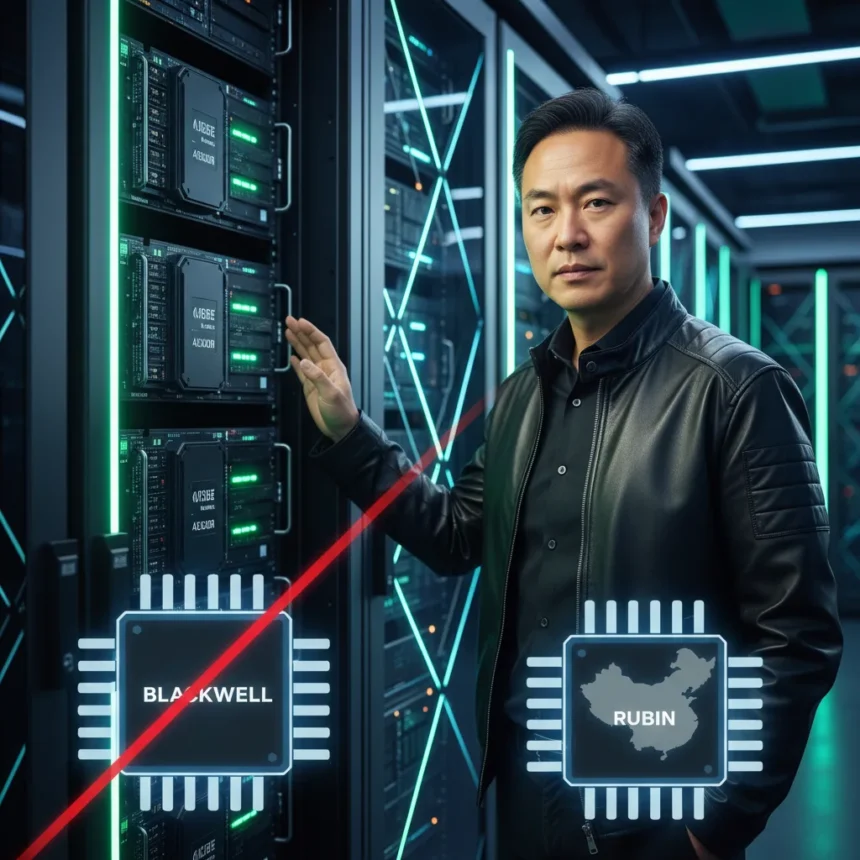
Nvidia CEO Jensen Huang has staked a clear position on US AI hardware leadership, arguing that America should maintain exclusive access to the company’s most advanced processors before considering exports elsewhere. In recent statements, Huang declared that the US should have ‘the first, the most, and the best’ when it comes to AI hardware, a stance that directly addresses geopolitical tensions over semiconductor technology and export controls.
Key Takeaways
- Huang says the US must have first access to Blackwell and Rubin chips before other markets.
- He proposes waiting until American companies fully deploy Vera Rubin before exporting Blackwell to China.
- The statement reflects Nvidia’s navigation of US export restrictions on advanced AI semiconductors.
- Huang’s position aligns with broader US efforts to maintain technological advantage over China.
- The strategy prioritizes domestic market saturation over global market expansion.
Huang’s Vision for US AI Hardware Dominance
Jensen Huang’s remarks on US AI hardware leadership represent a deliberate pivot toward nationalist technology strategy. Rather than treating Nvidia’s most advanced chips as global commodities, Huang is arguing for a tiered distribution model that privileges American companies and markets. This approach directly contradicts the semiconductor industry’s historical practice of selling to the highest bidder regardless of geography.
The CEO’s framing—’the first, the most, and the best’—carries both practical and symbolic weight. It signals to US policymakers that Nvidia is willing to voluntarily constrain its own market access in service of national technology leadership. This voluntary compliance may prove strategically valuable as the company faces increasing scrutiny over its role in China’s AI development and the effectiveness of existing export controls.
The Blackwell and Vera Rubin Timeline
Huang outlined a specific sequencing strategy for chip deployment that hinges on the Vera Rubin processor. According to his stated position, Nvidia should seek US government approval to export Blackwell chips to China only after Vera Rubin chips are widely deployed across American companies. He articulated this as: ‘When all of the American companies have ramped up in Vera Rubin, we should start to think about making sure that Blackwell is able to go compete in the market’.


This timeline effectively creates a waiting period during which American AI infrastructure—powered by Vera Rubin—would gain operational advantage before Chinese competitors gain access to Blackwell. The strategy assumes that first-mover advantage in deploying next-generation chips translates to lasting competitive superiority in AI development and deployment. Whether this assumption holds depends on how quickly American companies can convert hardware advantage into algorithmic and model improvements.
What This Means for the Global AI Race
Huang’s position on US AI hardware leadership reflects the reality that semiconductor advantage has become inseparable from geopolitical competition. By voluntarily endorsing a US-first distribution model, Huang is acknowledging that Nvidia’s market interests and US national security interests are now aligned—at least in the near term.



The practical effect is a multi-year delay in Chinese companies’ access to Nvidia’s most advanced chips. This gap could prove decisive if American AI labs use the time to build larger, more capable models. However, the strategy carries risks: Chinese competitors may accelerate development of domestic alternatives, or other chip manufacturers may fill the export gap that Nvidia creates by self-imposing restrictions.
Does Huang’s Strategy Actually Work?
The core assumption underlying Huang’s proposal—that hardware access determines AI leadership—is sound but incomplete. Blackwell and Vera Rubin chips will certainly matter for training large language models and deploying AI systems at scale. But software, data, and talent matter equally. China’s AI labs have demonstrated the ability to produce competitive models despite hardware constraints, suggesting that a chip embargo alone cannot guarantee lasting American dominance in AI.
Additionally, Huang’s voluntary approach may prove temporary. If US companies gain substantial advantage from early Vera Rubin access, political pressure to maintain the export ban on Blackwell could intensify, potentially forcing Huang’s hand regardless of his current stated position. Conversely, if the advantage proves marginal, market pressure to export Blackwell and capture Chinese demand may eventually override the nationalist framing.
FAQ
What did Jensen Huang say about China and Blackwell chips?
Huang stated that China should not receive Blackwell or Rubin AI GPUs until American companies have fully deployed Vera Rubin chips and ramped up production. He framed this as ensuring the US maintains ‘the first, the most, and the best’ AI hardware advantage.



Why is Vera Rubin the key to Huang’s export strategy?
Vera Rubin serves as the trigger point in Huang’s proposed timeline. Only after American companies have widely deployed Vera Rubin should the US consider allowing Blackwell exports to China, according to Huang’s stated position. This creates a window where US companies gain exclusive access to next-generation chips.
Does Nvidia have the authority to decide chip exports?
Nvidia must ultimately comply with US government export controls, which currently restrict advanced AI chips to China. Huang’s statements represent Nvidia’s position on how those controls should be enforced, but final authority rests with US regulators and policymakers, not Nvidia itself.
Jensen Huang’s vision for US AI hardware leadership reflects a fundamental shift in how semiconductor companies approach geopolitics. By voluntarily endorsing a US-first strategy, Huang is betting that American technological advantage—sustained through exclusive access to latest chips—will prove decisive in the global AI race. Whether that bet pays off depends not just on hardware, but on how quickly American AI labs convert that advantage into superior models and capabilities.
Edited by the All Things Geek team.
Source: Tom's Hardware




