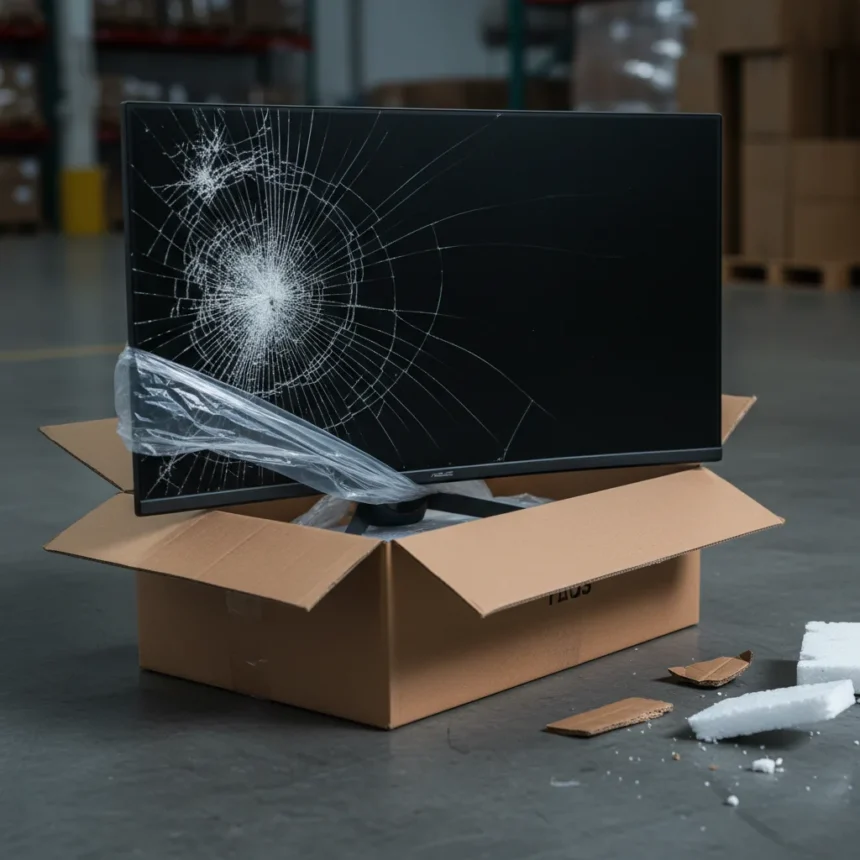
The Asus OLED gaming monitors that just started shipping are arriving in pieces—literally. The ROG Swift OLED PG32UCDM Gen 3, a 32-inch 4K 240Hz QD-OLED gaming monitor priced at $1,299, is being delivered with cracked panels to multiple buyers, and the culprit is painfully obvious: eggshell cardboard packaging with zero panel protection.
Key Takeaways
- Asus OLED gaming monitors shipping with cracked or damaged panels due to inadequate packaging
- ROG Swift OLED PG32UCDM Gen 3 features new BlackShield film improving black levels by up to 40%
- BlackShield technology offers 2.5x more scratch resistance than previous designs
- Expected March 2026 launch undermined by early shipment damage reports
- RMA requests surge as cost-cutting packaging fails to protect high-end displays in transit
What’s Wrong With Asus OLED Gaming Monitors Packaging
Buyers expecting a premium unboxing experience for a $1,299 monitor are instead receiving damaged goods. The Asus OLED gaming monitors are arriving with cracked panels because Asus stripped down packaging to bare-bones cardboard, eliminating protective foam and cushioning that should insulate a fragile OLED display during shipping. One YouTube reviewer described the packaging as flimsy, and users across forums report the same story: monitor arrives, panel is cracked, RMA process begins.
This is not a minor quality control blip. Multiple early adopters have documented the damage, and the pattern points directly to a deliberate cost-cutting measure. For a monitor at this price point, cutting packaging protection is a decision that prioritizes margins over customer experience. The irony is sharp: Asus is unveiling latest BlackShield film technology designed to improve durability and scratch resistance, yet the monitor cannot survive its own journey to buyers.
BlackShield Film Claims vs. Real-World Durability
Asus OLED gaming monitors are supposed to address a major weakness of QD-OLED panels: poor performance in bright ambient light and vulnerability to scratches. The new BlackShield film is Asus’s answer, promising to improve black levels by up to 40% in brighter rooms and delivering 2.5x more scratch resistance than previous generations. On paper, these are meaningful upgrades.


But here is the disconnect: YouTube reviewers and users have already complained extensively about how easily these monitors scratch in normal handling. Asus claims the Gen 3 BlackShield is a significant shift for contrast, yet early shipments are arriving with cracked panels before buyers even get a chance to test the scratch resistance claims. The damage is happening in transit, not through user error. This undermines the entire value proposition of paying $1,299 for a monitor marketed on durability improvements.
The BlackShield film also includes DisplayPort 2.1 support and an upgrade from DisplayHDR True Black 400 to 500 for higher brightness and contrast. These are legitimate technical improvements. But they mean nothing if the monitor arrives in pieces.



Why Packaging Matters More Than Specs
Asus OLED gaming monitors are high-value, fragile electronics. A QD-OLED panel cannot be repaired—if it cracks, the entire monitor is a loss. Shipping a $1,299 display in thin cardboard is not cost-effective; it is reckless. The cost of packaging materials is negligible compared to the cost of processing RMA requests, reshipping replacement units, and managing customer frustration.
What makes this worse is timing. The ROG Swift OLED PG32UCDM Gen 3 was unveiled around late December 2025, ahead of CES 2026, with a March 2026 launch window. Early shipments are already going out, and damage reports are surfacing before the official launch. This creates a credibility problem: potential buyers see the damage reports and question whether Asus actually stands behind its own product.
Compared to previous-generation OLED monitors and competing WOLED panels, the Gen 3 is supposed to be a step forward in real-world usability. WOLED panels have traditionally handled ambient light better, and the new BlackShield film was designed to close that gap. But a monitor that arrives cracked is worse than any previous generation, no matter what the specs say.
What Buyers Should Know Before Ordering
If you are considering the Asus OLED gaming monitors, understand that early units are arriving damaged due to packaging failure. The March 2026 launch is still weeks away, but pre-orders and early shipments are already in the field with documented issues. Asus has not publicly addressed the packaging problem or announced a fix for launch units.



The BlackShield film improvements are real and worth wanting—40% better black levels in bright rooms and significantly improved scratch resistance address genuine pain points for QD-OLED buyers. But if the monitor does not arrive intact, those improvements are irrelevant. Before placing an order, check recent reviews and user reports for your specific retailer. If you do receive a damaged unit, Asus is processing RMA requests, though the replacement process adds weeks of downtime.
Is the Asus OLED gaming monitors Gen 3 worth buying?
The specs are strong, and the BlackShield improvements are meaningful. But not if it arrives cracked. Wait for launch day reports from March 2026 to confirm whether Asus has fixed the packaging. If they have, the Gen 3 is a solid upgrade over previous QD-OLED designs. If packaging remains unchanged, the damage risk outweighs the benefits.
What is BlackShield film on the Asus OLED gaming monitors?
BlackShield is a new protective film layer that improves black levels by up to 40% in bright ambient lighting, offers 2.5x more scratch resistance than previous designs, and includes an anti-reflection coating for better clarity. It is Asus’s solution to making QD-OLED panels more durable and usable in real-world lighting conditions.
How does the Gen 3 compare to previous Asus OLED monitors?
The Gen 3 improves black levels, scratch resistance, and adds DisplayPort 2.1 support and DisplayHDR True Black 500 (up from 400). However, these upgrades are only valuable if the monitor survives shipping intact, which current packaging fails to ensure.
The Asus OLED gaming monitors represent a real step forward in QD-OLED technology, but Asus has made a critical error in packaging. Buyers are paying premium prices for premium performance, and they deserve premium protection during delivery. Until Asus fixes the cardboard-box problem, the Gen 3 is a gamble—one where the house always wins and the customer always loses if their unit arrives damaged.
Edited by the All Things Geek team.
Source: Tom's Hardware