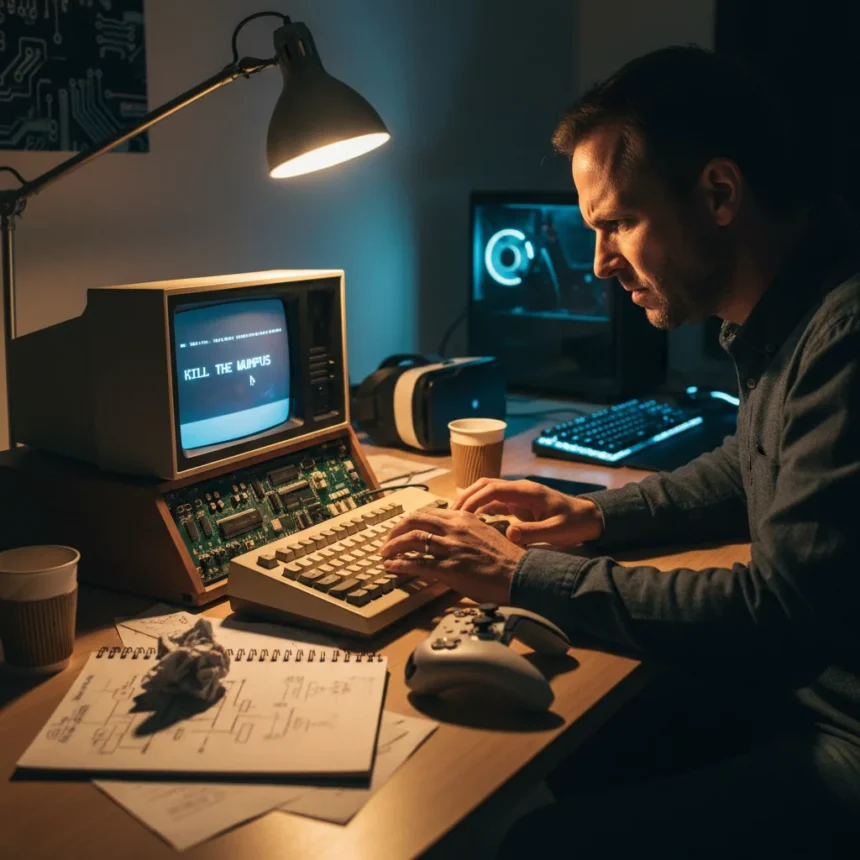
Apple-1 games from 1976 are not just difficult—they are a different species of challenge altogether. Fifty years after Apple released its first computer, revisiting the best titles available for that machine reveals how far gaming has come, and how much patience we have collectively lost.
Key Takeaways
- Apple-1 games require manual code entry via hexadecimal or cassette tape loading, taking 20-60 minutes per game before play begins.
- The original Apple-1 shipped with just 4KB of RAM and a 1MHz processor, forcing games into extreme simplicity.
- No saves, no tutorials, no hand-holding—trial-and-error was the only way forward for players in 1976.
- Modern emulators like Apple-1js offer free browser-based access to original games without hardware investment.
- Playing through a session of classic Apple-1 titles leaves players mentally exhausted in ways contemporary games rarely do.
What Made Apple-1 Games So Punishing
Apple-1 games were brutal by design, not accident. The machine itself was the constraint—4KB of RAM, a 1MHz processor, and a 280×192 resolution display meant that developers had nowhere to hide. Every byte mattered. Every instruction had to count. The result was games stripped down to pure logic and pattern recognition, with no graphical flourishes to distract or entertain.
Star Trek, one of the finest titles available for the system, exemplifies this philosophy. The game is entirely text-based. You command a starship, manage resources, and battle Klingons using single-letter commands: C for course, P for photons. There is no animation, no visual feedback beyond text output, and no mercy for poor decisions. The optimal path through each encounter is not obvious. Players had to think several moves ahead, calculate probabilities in their head, and live with the consequences of every miscalculation.
Hamurabi, another standout, reduces resource management to its absolute essence. You balance food, land, and rat infestations over ten turns, entering only numbers as input. No hints. No undo button. Fail to feed your population, and they starve. Neglect your land, and it becomes barren. The game offers no tutorial because there was no such concept in 1976. You learned by failing, repeatedly, until patterns emerged from the chaos.


The Loading Ordeal That Preceded Gameplay
Before you could even begin playing, you faced a gauntlet. Original Apple-1 games came in two forms: code you typed manually or cassette tapes you loaded. Manual entry meant sitting down with a printout of hexadecimal instructions and typing thousands of bytes into the machine, one line at a time, verifying checksums to catch errors. A single typo could corrupt the entire program. Cassette loading was faster but unreliable—the tape had to be threaded precisely, the playback speed had to be exact, and background noise could corrupt data mid-load.
This was not a five-minute setup. Loading a game often consumed 20 to 60 minutes before a single move could be made. By the time you were ready to play, you were already invested. Quitting was not an option. The psychological commitment was total.



Why Modern Gaming Feels Like Cheating Now
After spending hours with Apple-1 games, booting up any contemporary title feels like stepping into a support group. Modern games hold your hand. They offer tutorials, checkpoints, autosaves, difficulty sliders, and pause menus. They reward exploration with markers on your map. They celebrate your failures with gentle encouragement. None of this existed in 1976.
Hunt the Wumpus, a logic puzzle where you navigate a cave system and avoid hazards using Bayesian probability, would be unthinkable as a modern release. There is no UI. You receive only text descriptions of your surroundings. You must build a mental map. You must reason about probabilities. You must accept that you might waste an hour on a single run, learning nothing but the bitter lesson that you made a wrong turn three moves ago.
Super Breakout, a paddle-ball game ported to the Apple-1, demands pixel-perfect timing on a 40-column text grid. There is no visual smoothing, no predictive aiming assist, no second chances. You either hit the ball or you do not. Miss, and you lose a life. Lose three lives, and the game ends. There is no rewind, no retry from checkpoint, no difficulty adjustment.
How to Actually Play Apple-1 Games Today
The good news: you do not need a $200,000 original Apple-1 to experience these games. Free browser-based emulators like Apple-1js let you load and play original titles without hardware. The bad news: the experience is still grueling. The emulator faithfully reproduces the original machine’s limitations—every slowdown, every constraint, every moment of frustration is authentic.



Replica boards are available from hobbyists for $200 to $500, but they serve collectors more than players. The real value lies in digital archives, where game code listings and cassette WAV files are freely available online. You can load them into an emulator and begin your descent into retro gaming hell.
The process remains unchanged from 1976: boot the integer BASIC monitor, enter or load code, verify checksums, and hope nothing corrupts. Then, if you survive the loading process, the actual game begins—and that is when the real challenge starts.
Why Playing Retro Games Matters Right Now
Apple’s 50th anniversary, marking five decades since the Apple-1 launched in 1976, is not just nostalgia. It is a mirror. Modern gaming has optimized away friction so thoroughly that we have forgotten what engagement felt like when failure was absolute and learning was painful. Apple-1 games demanded mental resilience. They forced players to think, plan, and accept defeat without the consolation of a quick restart.
In an era when AI assists with everything from writing to gaming, when difficulty settings can be toggled mid-game, and when tutorials explain every mechanic, Apple-1 games remind us what happens when you remove every safety rail. You either adapt or you quit. There is no middle ground.
Can You Actually Finish an Apple-1 Game in One Session?
Yes, but it requires focus and mental stamina that most modern gamers have not exercised in years. A single session with Star Trek or Hamurabi typically consumes 2 to 3 hours—loading time included. By the end, your brain feels wrung out. You have made hundreds of micro-decisions. You have failed dozens of times. You have learned the game’s logic through trial and error, not instruction.
The reward is minimal by modern standards. There is no achievement popup, no unlockable content, no social media integration. You either win or you lose. That is the entire feedback loop.
Are Apple-1 games worth playing in 2026?
If you are curious about gaming history, yes. If you want to understand why modern games feel so forgiving, yes. If you expect entertainment in the traditional sense—immediate gratification, clear progression, rewarding feedback—then no. Apple-1 games are educational experiences disguised as entertainment. They teach patience, strategic thinking, and acceptance of failure. Those lessons are valuable, even if the delivery mechanism is brutal.
Playing through the best Apple-1 games is not a fun weekend activity. It is an archaeological dig into a different era of computing, where every byte was precious, every second of processor time was rationed, and fun meant something entirely different. Your brain will recover. But it will not forget the experience of playing games where the machine itself was your opponent, and winning meant simply understanding what the game wanted from you.
Edited by the All Things Geek team.
Source: TechRadar