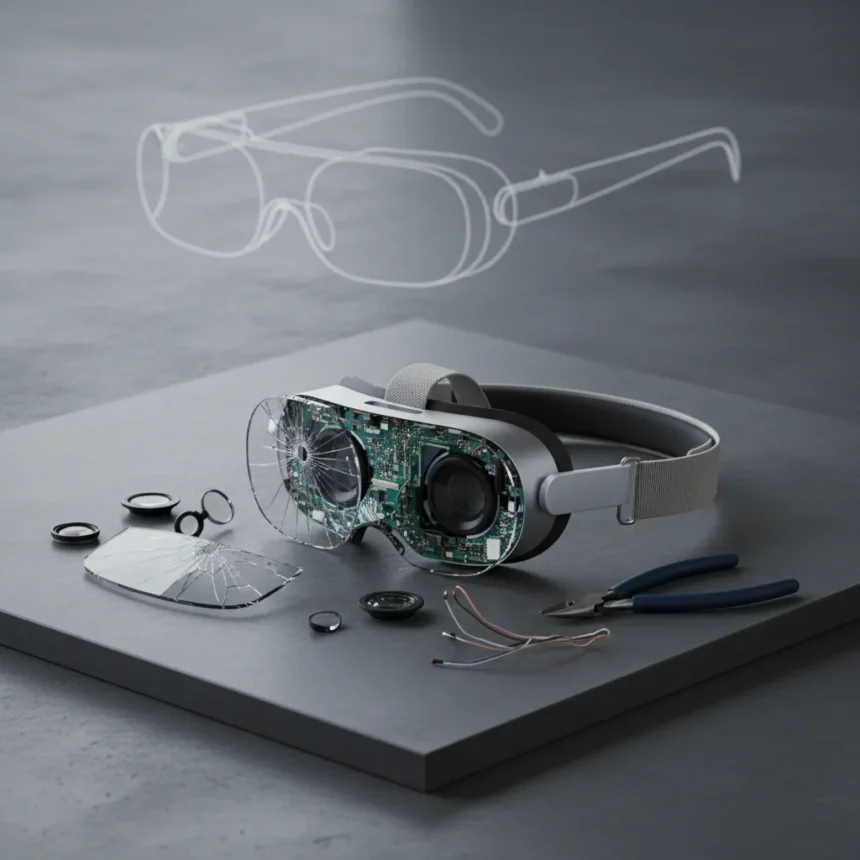
Apple’s Apple Vision Pro production halt represents one of the most dramatic reversals in recent tech history. The company that spent years developing a $3,500 mixed reality headset and positioning it as the future of computing has quietly wound down first-generation production, leaving 200,000 units in storage and shifting focus to cheaper alternatives.
Key Takeaways
- Apple discontinued first-gen Vision Pro (M2) production in late 2024 after sales fell to 370,000 units, missing initial 1 million unit projections by 63 percent.
- Production dropped from 2,000 units per day at peak to 1,000 units per day by summer 2024, with Luxshare assembler potentially winding down completely.
- High return rates exceeded 25 percent within the 14-day return window, signaling buyer remorse and insufficient content ecosystem.
- Apple suspended second-generation Vision Pro development for at least one year to prioritize a lower-cost $2,000 model expected in 2026.
- The strategy shift reflects competitive pressure from Meta Quest 3 dominance and the September 2025 launch of Meta Ray-Ban Display glasses.
How Apple Vision Pro production collapsed
The Apple Vision Pro production halt did not happen overnight. Starting in early summer 2024, Apple began cutting orders to Luxshare, the primary assembler responsible for the headset. Production fell from a peak of 2,000 units per day to 1,000 units per day by mid-summer, with the company potentially halting assembly entirely by November 2024. This was not a gradual wind-down—it was a full retreat.
By October 2024, suppliers had manufactured components for 500,000 to 600,000 headsets, but demand evaporated. Approximately 200,000 assembled units sat in storage, a glaring symbol of Apple’s miscalculation. The company had projected selling 500,000 units in the first year, then later revised that to 1 million. Actual sales landed around 370,000 units worldwide by late 2024, missing even the revised target by nearly two-thirds.
An M5 version launched in October 2025, but this represents a salvage operation rather than a new beginning. The updated processor cannot fix the fundamental problems that sank the original vision: weak demand, insufficient apps and content, a prohibitive $3,500 price tag, and a headset so heavy it caused discomfort after extended wear.


Why the Vision Pro failed where competitors thrived
Apple Vision Pro production halt happened because the company fundamentally misread the XR market. The headset launched into a software desert. Major streaming services like YouTube, Netflix, and Meta platforms lacked native support, leaving users with few compelling reasons to strap on a $3,500 device. Return rates exceeded 25 percent within the 14-day return window, indicating that even early adopters felt buyer’s remorse.
Meta Quest 3, by contrast, cost far less and integrated smoothly with existing Meta services and content libraries. Most VR consumers chose Meta over Apple, a humbling reality for a company that expected its brand prestige and design to overcome price and ecosystem disadvantages. The design itself became a liability—the Vision Pro was heavier than competing headsets, making it uncomfortable for sustained use, which further dampened engagement post-purchase.



Apple’s bet on spatial computing as the next computing paradigm was not wrong in principle. The execution was catastrophically wrong. The company priced for a market that did not exist, bundled features consumers did not value, and launched without the content ecosystem to justify the cost.
Apple’s pivot to cheaper AR and the Vision Air cancellation
With the Apple Vision Pro production halt in place, Apple is now chasing a different strategy: affordable augmented reality glasses. The company suspended second-generation Vision Pro development for at least one year, instead prioritizing a lower-cost headset priced around $2,000, expected to launch in 2026. This model will cut corners aggressively—lower-resolution displays, no Eyesight feature (the outward display that showed the wearer’s eyes to others), and other cost-saving measures.
Even more telling, Apple cancelled the Vision Air project entirely, a lighter variant that might have bridged the gap between the premium Vision Pro and future budget models. The company is essentially admitting that the Vision Pro’s form factor and price point were mistakes. A $2,000 alternative suggests Apple expects to sell more units at lower margins than it ever did at $3,500—a complete reversal of its premium positioning strategy.
The competitive landscape accelerated this pivot. Meta Ray-Ban Display glasses launched in September 2025, offering lightweight AR functionality at a consumer-friendly price point. This forced Apple to reconsider its roadmap. Rather than refining the Vision Pro, Apple is now racing to develop AR glasses competitive with Meta’s offering, potentially arriving in 2027. The company is licensing Google technology for Vision Pro, a sign it is willing to collaborate rather than dominate—a humbling shift for a company that usually insists on vertical integration.



What the Vision Pro collapse means for spatial computing
The Apple Vision Pro production halt does not kill spatial computing as a category. It kills the notion that consumers will pay $3,500 for a first-generation headset with limited content and no clear use case beyond entertainment. The market for spatial computing exists, but it is far smaller and far more price-sensitive than Apple assumed.
Suppliers had prepared for the Vision Pro to reach 4 million units over its lifetime, roughly half the original forecast. Even that revised estimate proved wildly optimistic. The real lesson is that premium positioning alone cannot overcome weak software, high friction, and price shock. Apple’s brand loyalty has limits, especially when competitors offer better value.
The company is now betting that a $2,000 AR glasses form factor will succeed where the $3,500 Vision Pro failed. Whether that is true depends entirely on software. If Apple can launch with robust app support, compelling use cases, and integration with its ecosystem, the cheaper model has a chance. If it repeats the Vision Pro’s mistake of launching hardware before the software is ready, the same fate awaits.
Did Apple really stop making the Vision Pro?
Not entirely. Apple discontinued the first-generation M2 Vision Pro in late 2024, but released an updated M5 version in October 2025, which remains in production and available for purchase. The Apple Vision Pro production halt refers specifically to the original model, not the product line entirely. However, the M5 launch is a maintenance release, not a signal of renewed confidence. Apple is keeping the Vision Pro alive for existing fans and professionals, but the company’s strategic focus has shifted decisively to cheaper AR glasses.
When will Apple release a cheaper Vision Pro alternative?
Apple expects to launch a lower-cost headset priced around $2,000 in 2026, with stripped-down features compared to the original Vision Pro. This model will feature lower-resolution displays and omit the Eyesight feature. Suppliers are preparing for potential production of this new device, though given the Vision Pro’s track record, Apple’s sales projections should be treated with skepticism.
Why did return rates for Vision Pro exceed 25 percent?
Return rates exceeded 25 percent in the 14-day window because the device failed to deliver value proportional to its $3,500 price tag. Users encountered limited content, uncomfortable fit during extended wear, and insufficient integration with popular services like Netflix and YouTube. High returns reflected a gap between marketing expectations and real-world experience.
The Apple Vision Pro production halt is not a temporary setback or supply chain issue. It is an admission that Apple misjudged the market, overestimated demand, and launched a product before its ecosystem was ready. The company is now playing catch-up with Meta in AR glasses while managing inventory and reputational damage from one of its most expensive failures. Whether the $2,000 alternative succeeds depends on whether Apple learned anything from this costly miscalculation.
Edited by the All Things Geek team.
Source: Tom's Guide