





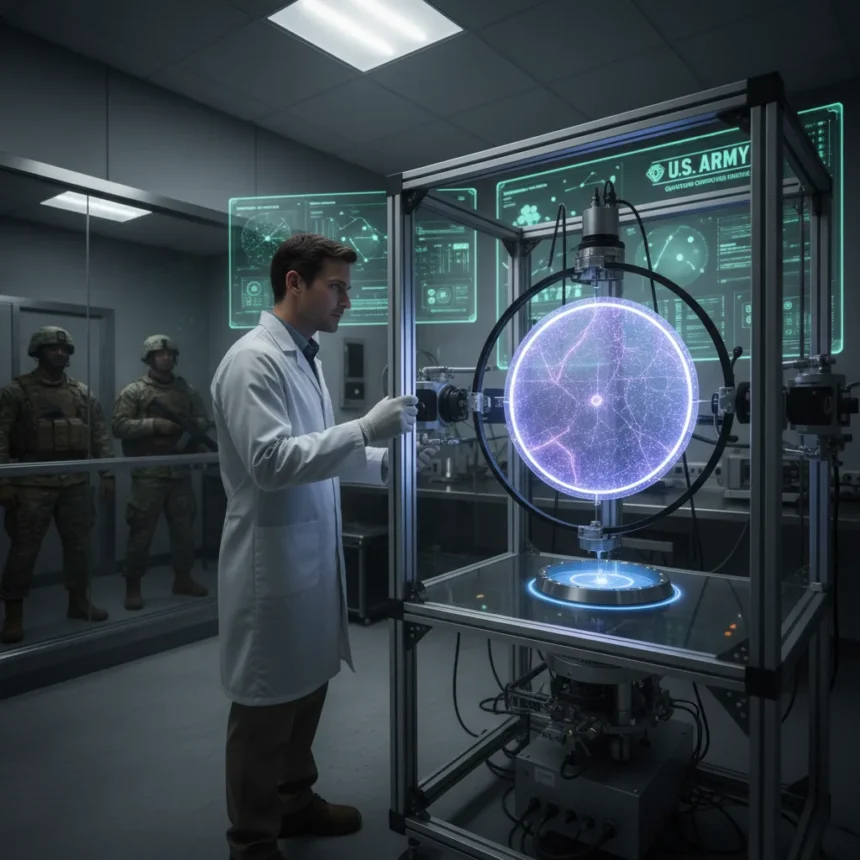
Quantum control research is reshaping how the US military thinks about future computing and energy generation, with Army-backed scientists now investigating how quantum vibrations in ultrathin materials could unlock capabilities that don’t yet exist in the field. The Combat Capabilities Development Command Army Research Laboratory (DEVCOM ARL) has become the centerpiece of this push, designated in June 2023 as one of four Department of Defense Quantum Information Science Research Centers. This isn’t theoretical physics locked in academic journals—it’s a deliberate military strategy to gain operational advantage through quantum science.
Key Takeaways
- DEVCOM ARL is the Army’s primary quantum information science research laboratory and has rapidly become a world leader in QIS.
- Quantum vibrations in ultrathin materials could influence future computing, communications, and energy technologies.
- The Army’s quantum effort aims to help warfighters measure better and decide faster through near-term advances in timekeeping and sensing.
- DEVCOM ARL has already demonstrated the world’s first quantum sensor for receiving radio-frequency communications signals.
- Quantum science already powers everyday military tools like atomic clocks for GPS systems.
What quantum control research actually means for the Army
Quantum control research focuses on understanding and manipulating quantum vibrations—the fundamental oscillations of particles in materials—to create new technological possibilities. For the Army, this translates into three immediate areas: timekeeping, sensing, and communications. QIS already underpins technologies the military relies on daily, such as atomic clocks for the Global Positioning System. But the real opportunity lies ahead. The Army’s vision frames this work as enabling warfighters to measure better and decide faster—a deceptively simple phrase that masks profound military implications.
The research direction splits into near-term and long-term horizons. In the nearer term, the Army expects revolutionary advances in timekeeping and sensing capabilities. These aren’t incremental improvements—they’re meant to be foundational shifts in how military systems perceive and respond to the battlefield. Longer-term, quantum computing and entanglement-enhanced quantum technologies could produce what the Army calls disruptive technological surprise, a term that signals a capability so unexpected it fundamentally changes military advantage.
How quantum control research differs from other military quantum initiatives
The broader US defense sector has multiple quantum research streams running in parallel. The Army’s quantum control work in ultrathin materials sits alongside other Pentagon initiatives focused on quantum computing, quantum sensing, and quantum communication systems. What distinguishes DEVCOM ARL’s quantum control research is its focus on fundamental materials science—understanding how to manipulate quantum vibrations at the nanoscale to influence practical systems. This differs from other military quantum projects like the Quantum Characterization, Calibration, and Control (QC3) program, which targets multi-qubit circuits and fault-tolerant thresholds.


The Army has also pursued distributed quantum information research for communications, synchronized clocks, and sensors. What ties these efforts together is a single strategic goal: leveraging quantum properties to create military capabilities that adversaries cannot easily replicate. China’s military has made quantum technology a strategic priority as well, making US Army investment in quantum control research not just scientifically ambitious but strategically essential to maintain technological parity.
Real achievements that prove quantum control research is advancing
The Army doesn’t frame this purely as future potential—it has already demonstrated tangible results. DEVCOM ARL achieved the world’s first quantum sensor capable of receiving radio-frequency communications signals. This breakthrough shows that quantum control isn’t speculative; it’s producing hardware. The Army also developed the Low-Cost Chip Scale Atomic Clock for battlefield timekeeping, proving that quantum-based technologies can be miniaturized and deployed in operational environments.



These achievements matter because they prove the pathway from laboratory discovery to field deployment is real. Secretary of the Army Christine E. Wormuth’s 2023 designation of DEVCOM ARL as a Quantum Information Science Research Center was not ceremonial—it formalized the Army’s commitment to making quantum control research a core military capability. The Army explicitly stated that DEVCOM ARL had rapidly become a world leader in QIS, a claim backed by hardware, not rhetoric.
Why the Army is betting on quantum control now
The timing reflects both opportunity and urgency. Quantum science has matured enough that practical applications are emerging. The Army sees quantum control research as essential to future military dominance because it addresses a fundamental challenge: how to process information and make decisions faster than adversaries. In modern warfare, speed of decision often determines outcome. Quantum-enhanced sensing and timekeeping could compress decision cycles and improve targeting accuracy, communications security, and operational awareness.
The framing of quantum control research as a path to disruptive technological surprise reveals the Army’s strategic thinking. Rather than pursuing incremental improvements to existing systems, the service is investing in foundational science that could produce capabilities adversaries haven’t anticipated. This is a long-term bet, but one the Army considers essential to maintaining technological edge.
What timeline should we expect for quantum control breakthroughs?
The Army distinguishes between near-term and longer-term outcomes. Revolutionary advances in timekeeping and sensing are expected in the nearer term, while quantum computing and entanglement-enhanced technologies are positioned as longer-term possibilities that could reshape military capabilities. The article’s reference to a huge leap in future energy generation and computing is promotional framing rather than a timeline commitment. Real deployment of quantum control research into operational systems will likely take years, not months.


How does quantum control research compare to civilian quantum computing efforts?
Military quantum research and civilian quantum computing pursue different goals. Civilian companies like IBM and Google focus on building general-purpose quantum computers with increasing qubit counts. The Army’s quantum control research targets specific military problems—better sensing, faster timekeeping, secure communications. This focused approach may allow military quantum breakthroughs to reach deployment faster than general-purpose quantum computers reach commercial viability. The Army’s emphasis on measuring better and deciding faster reflects military priorities that differ from Silicon Valley’s roadmap.
Will quantum control research lead to new Army weapons or defense systems?
The Army’s quantum control research is foundational science aimed at enabling future capabilities rather than producing weapons directly. Improvements in sensing, timekeeping, and communications could enhance everything from drone navigation to radar systems to encrypted battlefield networks. The real impact will likely emerge across multiple military domains rather than in a single new system. The Army framed this research as impacting the Army of 2040 and beyond, suggesting a multi-decade transformation rather than near-term operational deployments.
Is the US Army’s quantum control research ahead of other nations?
The Army claims DEVCOM ARL has rapidly become a world leader in Quantum Information Science, but global competition in quantum technology is intense. China’s military has prioritized quantum technology as a strategic advantage, and NATO allies are also investing in quantum research. The Army’s designation of DEVCOM ARL as a QIS Research Center and its demonstrated achievements like the world’s first quantum sensor for radio-frequency communications suggest the US maintains a lead, but sustained investment will be required to maintain that position.
The US Army’s quantum control research represents a deliberate shift from treating quantum science as academic curiosity to treating it as military necessity. With DEVCOM ARL now designated as the Army’s primary quantum information science laboratory and already producing breakthroughs in quantum sensing and atomic clocks, the service is moving from research to application. Whether quantum control in ultrathin materials truly delivers the huge leap in energy and computing the article promises remains to be seen, but the Army’s commitment to finding out is unmistakable.
Edited by the All Things Geek team.
Source: TechRadar




