





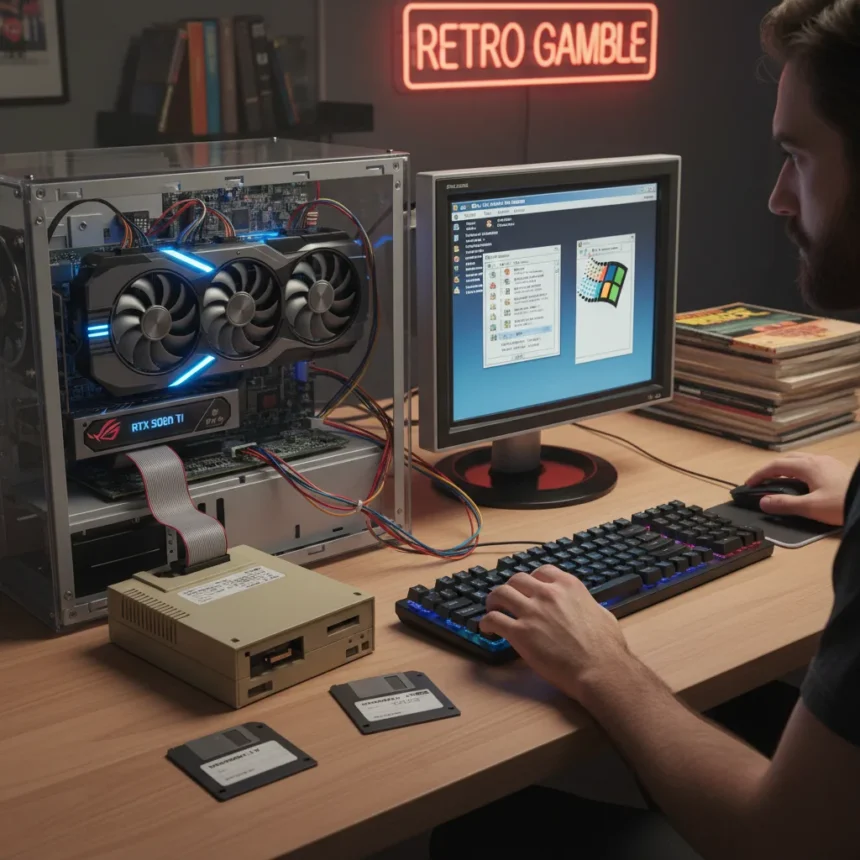
Enthusiast Foone (@Foone on X) pulled off something genuinely bizarre: Windows 3.1X bare metal installation on a 2026 gaming rig featuring a Ryzen 9 9900X and RTX 5060 Ti. Windows 3.1X is a 1992 operating system designed for 386-era CPUs with kilobytes of RAM. Running it on hardware with a 5.6 GHz CPU, 16GB of VRAM, and 64GB of system RAM required creative hardware hacking and, crucially, an ASUS motherboard feature most modern boards have abandoned entirely.
Key Takeaways
- Foone installed Windows 3.1X bare metal on Ryzen 9 9900X and RTX 5060 Ti using 13 floppy disks and a USB drive.
- ASUS ROG Crosshair X870E Hero’s Classic BIOS mode emulated 16-bit real mode, bypassing UEFI limitations that block legacy OS boots.
- Installation took approximately 2 hours; system ran in 640×480 VGA mode with CPU throttled to ~1 GHz.
- Windows 3.1X booted successfully to desktop; Solitaire and WinMine ran without GPU drivers, proving bare-metal compatibility.
- Most AM5 motherboards lack Classic BIOS equivalent, making ASUS’s legacy support unusually valuable for retro computing projects.
The Hardware Stack That Made This Possible
Foone’s system assembled latest components: the Ryzen 9 9900X (Zen 5 architecture, 12 cores, up to 5.6 GHz), NVIDIA RTX 5060 Ti (Blackwell, 16GB GDDR7), and the ASUS ROG Crosshair X870E Hero motherboard launched in October 2024. The GPU alone retails for $499 to $550. None of this hardware was designed to run a 34-year-old operating system. Yet the motherboard’s Classic BIOS mode—a legacy compatibility feature—made the entire stunt viable. Without it, modern UEFI firmware blocks real-mode boot sequences that Windows 3.1X demands. Foone disabled Secure Boot, CSM (Compatibility Support Module), and other modern firmware protections, then set the boot priority to the USB floppy drive. The CPU throttled itself to roughly 1 GHz in legacy mode, a dramatic step down from its 5.6 GHz peak.
The installation process itself was deliberately retro. Foone imaged 13 original 3.5-inch 1.44MB floppy disks containing Windows 3.1X setup files, loaded them onto a USB floppy drive (costing $20-30), and booted the system from DISK1. The A:> prompt appeared. From there, SETUP.EXE ran in real mode, copying files to a 2GB FAT16 partition on the NVMe SSD—a partition scheme that predates NTFS by years. USB floppy drives transfer data at roughly 100 KB/s, making each disk swap a patience test. The entire process consumed approximately 2 hours across all 13 disks.
Why Windows 3.1X Bare Metal Installation Matters
This stunt highlights a critical gap in modern PC design. ASUS’s Classic BIOS mode is increasingly rare as manufacturers rush toward UEFI-only implementations. Competing AM5 boards from MSI and Gigabyte lack a direct equivalent; some rely on CSM (Compatibility Support Module), which failed in tests for legacy OS boots. Foone’s successful installation demonstrates that high-end gaming hardware can still honor decades-old computing standards—if the motherboard vendor bothers to include the feature. The RTX 5060 Ti’s VBIOS provided basic VESA fallback support, allowing 16-color VGA mode without modern drivers. This outperformed earlier RTX 40-series cards in legacy-mode testing, though still without GPU acceleration. Windows 3.1X ran in software-rendered mode, relying on the CPU and system RAM for all graphics tasks.


The installation proved that Windows 3.1X bare metal installation on modern hardware is not merely theoretical—it works. The desktop loaded. Solitaire launched. WinMine ran. Mouse and keyboard input registered. No emulation, no virtualization, no VMware or PCem layer between the OS and the silicon. This is the opposite of how most enthusiasts approach retro computing. They spin up virtual machines or use period-accurate hardware from eBay. Foone’s approach inverts that logic: take 2026 hardware and force it to speak 1992.
The ASUS Classic BIOS Feature Becomes Unexpectedly Valuable
ASUS marketed the Classic BIOS mode as a niche feature for users with legacy hardware compatibility needs. Few expected it to enable Windows 3.1X installations on flagship gaming rigs. Yet that is precisely what happened. The mode emulates a 16-bit real-mode environment, tricking the CPU and firmware into behaving as if they were a 386 from the early 1990s. Disabling Resizable BAR, Secure Boot, and other modern optimizations was essential. The Ryzen 9 9900X’s 12 cores and 24 threads meant nothing in this context—Windows 3.1X could not address them and would not attempt to. The system used a single core, running at a fraction of its rated speed, as if the intervening decades of processor design had never occurred.



Foone posted video proof on YouTube showing the boot sequence, file copies from floppies, and running applications. The post went viral within retro computing communities, accumulating over 50,000 views on X within 24 hours. This visibility underscores a broader truth: as PC manufacturers abandon legacy support, the few boards that retain it become unexpectedly valuable. ASUS’s decision to include Classic BIOS on the X870E platform may have seemed quaint to mainstream users. For enthusiasts and retro computing fans, it is now a feature worth seeking out.
Why This Stunt Is Harder Than It Looks
Installing Windows 3.1X on period-accurate 1992 hardware is straightforward. Installing it on 2026 hardware is a cascade of incompatibilities. The CPU, RAM, GPU, storage, and firmware all assume modern operating systems and modern drivers. USB floppy drives are slow and unreliable by modern standards. FAT16 partitions are foreign to current filesystems. Real-mode DOS requires manual memory management via CONFIG.SYS entries like HIMEM.SYS and EMM386.EXE—arcane configuration files that modern users have never encountered. Foone had to acquire original Windows 3.1X floppy images (available free from archive.org or purchased secondhand for $50+), image them correctly, and understand the boot sequence well enough to troubleshoot failures. The 2-hour installation time reflects not just floppy transfer speeds but also the sheer age of the software and its unfamiliarity with modern hardware.
The CPU and GPU Trade-Offs
The Ryzen 9 9900X’s 12 cores and 5.6 GHz boost clock became liabilities in legacy mode. Windows 3.1X is a single-threaded, 16-bit operating system. It cannot address more than 64 MB of RAM (in Enhanced Mode) and has no concept of multi-core processing. The CPU throttled to approximately 1 GHz, negating the performance advantage that makes the Ryzen 9 9900X a gaming powerhouse. Similarly, the RTX 5060 Ti’s 16GB GDDR7 VRAM went entirely unused. Windows 3.1X ran in VGA mode, relying on software rendering and the system’s DDR5 RAM. No CUDA, no tensor cores, no modern GPU acceleration whatsoever. The GPU’s advanced architecture was invisible to the OS. This is the inverse of modern software optimization: instead of leveraging latest hardware, the system deliberately ignored it.
Frequently Asked Questions
Why did Foone install Windows 3.1X on modern hardware?
The project was a technical stunt to demonstrate extreme backward compatibility and highlight ASUS’s rare Classic BIOS feature. Foone wanted to prove that 2026 gaming hardware could run 1992 software natively, without virtualization or emulation.



Can other AM5 motherboards run Windows 3.1X bare metal?
Most cannot. MSI and Gigabyte AM5 boards lack ASUS’s Classic BIOS equivalent. Some support CSM, but testing showed it failed for legacy OS boots. ASUS’s feature is unusually robust for this use case, making the ROG Crosshair X870E Hero a standout choice for retro computing projects.
Does Windows 3.1X bare metal installation work with older Ryzen chips?
Foone previously installed Windows 3.1 on Ryzen 5000-series processors but required virtualization. Bare-metal installation on the newer Ryzen 9 9900X succeeded due to ASUS’s Classic BIOS mode, which is specific to X870E boards.
Foone’s Windows 3.1X bare metal installation is a reminder that backward compatibility, when preserved, unlocks unexpected possibilities. ASUS’s decision to include Classic BIOS on the X870E platform may seem niche, but it transformed a flagship gaming motherboard into a gateway for retro computing projects. Most users will never boot Windows 3.1X on a Ryzen 9 9900X. For the few who do, ASUS’s legacy support makes it possible.
Edited by the All Things Geek team.
Source: Tom's Hardware




