





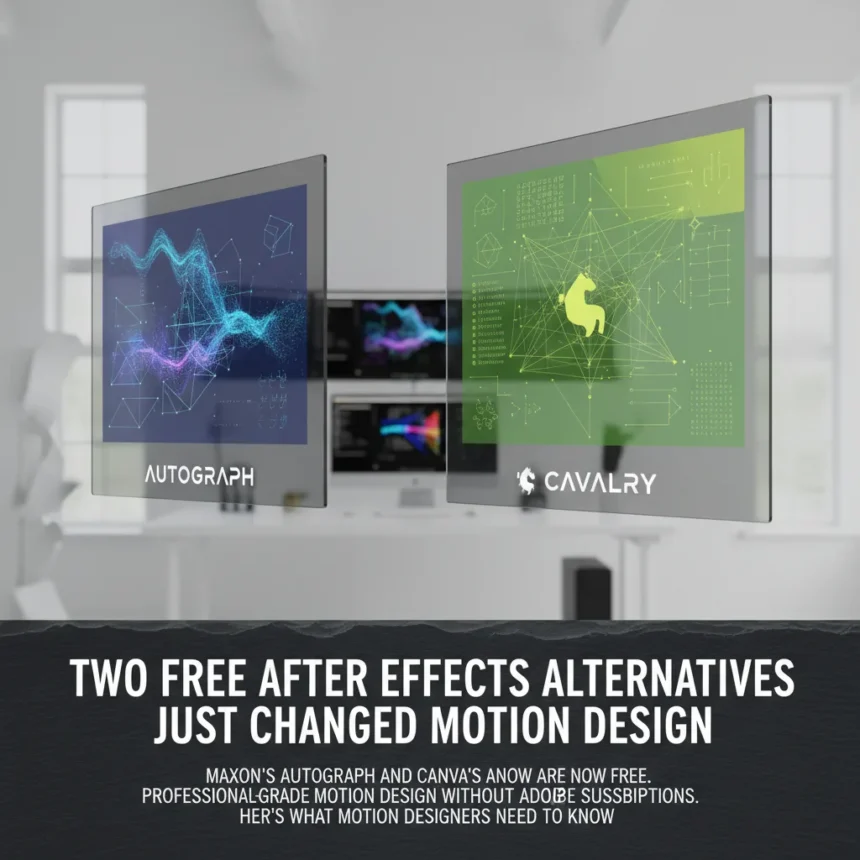
Two major free After Effects alternatives just landed, and motion designers are suddenly spoiled for choice. Maxon’s Autograph and Canva’s Cavalry both launched as completely free tools, challenging Adobe’s stranglehold on professional motion graphics workflows.
Key Takeaways
- Maxon Autograph is now free, offering procedural typography animation and vector shape tools for broadcast graphics.
- Canva’s Cavalry uses node-based generation instead of keyframing, positioning itself as faster for 2D motion work.
- Both tools are completely free on Windows and Mac, with no subscription required.
- Free After Effects alternatives now range from web-based tools like Pikimov to professional node-based software like Blackmagic Fusion.
- Cavalry ranks highly among 2026 comparisons for best free 2D motion graphics software.
What Makes These Free After Effects Alternatives Stand Out
Maxon Autograph and Canva Cavalry represent two fundamentally different approaches to motion design, each addressing specific frustrations with Adobe’s flagship tool. Autograph, created by Maxon (the company behind Cinema 4D), focuses on procedural workflows and typography animation, making it especially suited for broadcast graphics where text drives the visual narrative. Cavalry takes the opposite path, emphasizing node-based generation that lets designers build motion without relying on traditional keyframing—a workflow many consider outdated.
The timing matters. Both tools becoming free simultaneously expands the ecosystem beyond the usual suspects. Pikimov, a web-based alternative, processes locally for privacy and supports 4K with a timeline interface. PowerDirector appeals to beginners with AI-powered masking and tracking. Yet neither Autograph nor Cavalry existed in the free tier until now, leaving a significant gap for professionals unwilling to pay Adobe’s subscription fees.
How Autograph Compares to Node-Based Alternatives
Autograph’s strength lies in procedural text animation and vector-based broadcast work, positioning it differently from node-based tools like Blackmagic Fusion. Fusion, available free as part of DaVinci Resolve, excels in VFX compositing with its node architecture, and the 2026 version adds optimized vector shapes and OpenUSD support—features that push it beyond After Effects in professional 3D pipelines. Blender offers even broader capabilities, unifying 3D, motion graphics, and compositing in one free, open-source package, though its learning curve intimidates newcomers.


Autograph avoids this complexity. It targets motion designers who need fast, procedural text animation without diving into node-based thinking. For broadcast graphics, lower-third animations, and title sequences, this focus is a genuine advantage. Cavalry, by contrast, appeals to designers frustrated with After Effects’ keyframe paradigm, offering a faster path to 2D motion through procedural generation.
The Broader Free After Effects Alternatives Landscape
The free alternatives ecosystem is now mature enough to handle most professional workflows. HitFilm Express provides timeline-based editing with 400+ effects for VFX work, while its Pro version requires a one-time payment rather than subscription. Natron offers free, open-source node-based compositing with OpenFX support and 2D tracking for rotoscoping. CapCut Desktop targets influencers and social media creators with lightweight AI automation.


This fragmentation is intentional. After Effects tried to be everything—keyframing, expressions, plugins, 3D integration—but that generalist approach creates friction for specialists. Cavalry optimizes for procedural 2D. Autograph optimizes for typography. Fusion optimizes for VFX. Blender optimizes for unified 3D-to-composite pipelines. Motion designers no longer choose one tool; they choose the right tool for the job, and the price is now zero.
Why Motion Designers Should Care Right Now
Adobe’s subscription model has frustrated motion designers for years. A single seat of After Effects costs hundreds annually, and the software requires constant updates. Autograph and Cavalry being free removes that financial barrier while offering architectural advantages Over Effects can’t match without a complete rewrite. Cavalry’s node-based approach, for instance, makes procedural animation faster than keyframing for many 2D tasks. Autograph’s procedural text engine handles animation that would take hours in After Effects.
The risk is adoption friction. Motion designers with years of After Effects muscle memory may find Cavalry’s node paradigm alien. Autograph’s procedural workflow requires learning new thinking patterns. Yet for students, freelancers, and studios evaluating their toolchain, this friction is worth overcoming. The cost is zero, the capabilities are professional-grade, and the community is growing.
Should You Switch from After Effects?
Not immediately, but conditionally. If your workflow relies on After Effects expressions, plugins, and integration with Adobe’s suite, switching is costly. If you work primarily in 2D motion and keyframing feels slow, Cavalry deserves a serious trial. If broadcast graphics and typography animation dominate your output, Autograph’s procedural approach could accelerate your pipeline significantly. The best strategy: test both on a real project and measure time-to-finish against After Effects.



Can I use Cavalry or Autograph professionally?
Yes. Both are production-ready and used by studios. Cavalry ranks highly in 2026 comparisons for best free 2D motion graphics software, with full Windows and Mac support. Autograph, backed by Maxon’s professional reputation, is built for broadcast and commercial work. Neither tool is a hobbyist toy.
What’s the catch with free After Effects alternatives?
There isn’t one, beyond the usual: learning curve, ecosystem maturity, and plugin availability. Cavalry and Autograph are genuinely free with no hidden paywalls. However, they excel in specific niches rather than handling every task After Effects covers. Fusion is free but requires DaVinci Resolve. Blender is free but steep for motion designers coming from After Effects. Pick the tool that matches your workflow, not the tool trying to do everything.
Which free After Effects alternative should I learn first?
Start with your pain point. If keyframing frustrates you, try Cavalry. If text animation is your bottleneck, try Autograph. If you want an all-in-one 3D-to-composite pipeline, invest time in Blender. If you’re a VFX specialist, Blackmagic Fusion in DaVinci Resolve offers professional-grade node-based compositing. The 2026 landscape rewards specialization, not generalism.
Motion design in 2026 is no longer a one-tool industry. Autograph and Cavalry becoming free accelerates this shift, forcing Adobe to justify subscription costs through features, not monopoly. For motion designers, that’s a win regardless of which tool you choose.
Edited by the All Things Geek team.
Source: Creativebloq




