





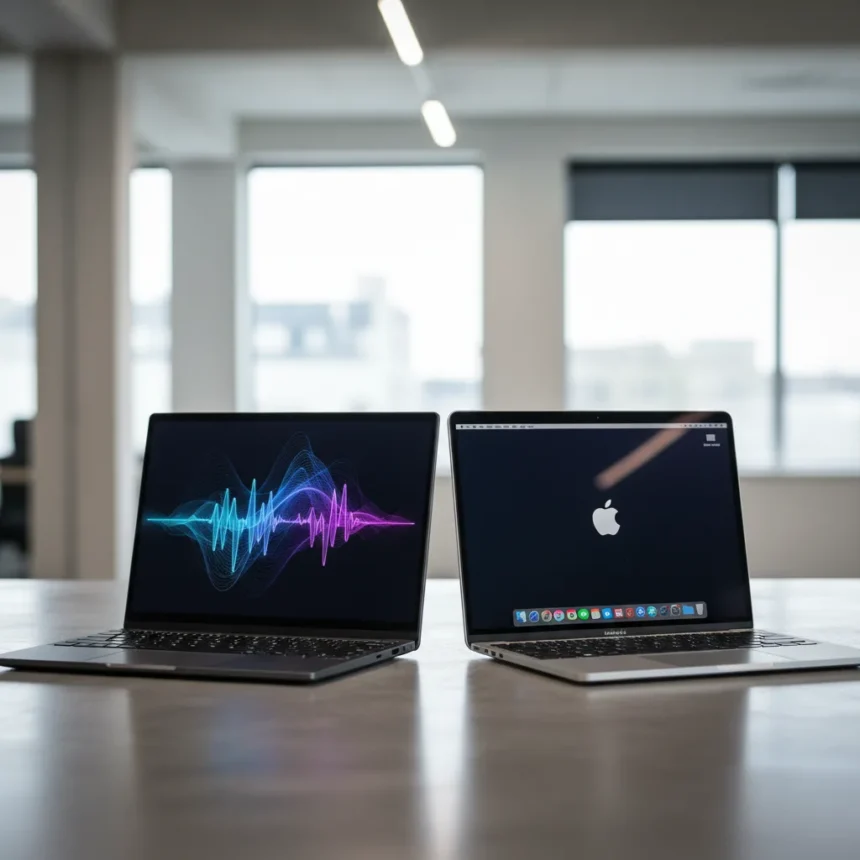
The ASUS Zenbook A16 vs MacBook Air debate is no longer theoretical. ASUS has announced a 16-inch ultralight Windows laptop powered by Qualcomm’s Snapdragon X2 Elite Extreme processor—an 18-core flagship chip that directly challenges Apple’s stranglehold on the premium portable computing market. At 1.3kg, this magnesium-alloy machine is genuinely featherweight, yet it delivers performance and features that leave the MacBook Air 15 behind in several critical areas.
Key Takeaways
- ASUS Zenbook A16 weighs 1.3kg with Snapdragon X2 Elite Extreme 18-core processor, matching MacBook Air portability.
- 3K OLED 120Hz display with 1100 nits peak brightness outshines MacBook Air’s standard panel in brightness and refresh rate.
- Up to 48GB LPDDR5X RAM and 2TB NVMe storage offer superior upgrade ceiling versus Apple’s soldered components.
- Snapdragon X2 Elite Extreme enables superior AI performance and Windows on Arm efficiency gains.
- Announced at CES 2026; pricing not yet confirmed, but expected to compete directly with MacBook Air 15 positioning.
Design and Build Quality Set a New Standard
The ASUS Zenbook A16 vs MacBook Air comparison begins with what you hold in your hands. The Zenbook A16 uses a magnesium alloy chassis with silver aluminum coating, delivering the same premium feel as Apple’s unibody design without the aesthetic compromise. At 1.3kg, it matches the MacBook Air’s featherweight claim while maintaining a robust construction that doesn’t sacrifice rigidity for weight savings. The MacBook Air 15, by contrast, relies on Apple’s aluminum unibody—solid, but increasingly familiar in a market where Windows ultrabooks now match or exceed that build quality.
Build durability matters more than marketing copy. The Zenbook A16’s magnesium-alloy construction provides genuine structural advantage: it resists flexing under keyboard pressure and survives the daily bag-toss better than thinner aluminum designs. For users who travel constantly—the exact audience both laptops target—this difference compounds over time.
Display Technology Where ASUS Dominates
Here is where the ASUS Zenbook A16 vs MacBook Air gap widens significantly. The Zenbook A16 features a 3K OLED display with 120Hz refresh rate and 1100 nits peak brightness. The MacBook Air 15 uses a standard IPS LCD at 60Hz with lower peak brightness. For content creators, video editors, and anyone spending eight hours a day staring at code or spreadsheets, the difference is tangible: OLED blacks are genuinely black, not dark gray, and the 120Hz refresh makes scrolling feel buttery smooth instead of choppy.


Peak brightness matters outdoors. The Zenbook A16’s 1100-nit OLED panel remains legible in direct sunlight; the MacBook Air’s screen washes out in the same conditions. This is not a minor convenience—it directly impacts productivity for anyone working from cafes, airports, or outdoor spaces. The 120Hz refresh rate is not just a spec-sheet number; it reduces eye strain during extended work sessions and makes the entire interface feel more responsive than Apple’s 60Hz standard.
Processor and Performance: Snapdragon X2 Elite Extreme Changes the Game
The ASUS Zenbook A16 is powered by Qualcomm’s Snapdragon X2 Elite Extreme, an 18-core processor that represents the current flagship of Windows on Arm architecture. This is the first generation where Snapdragon processors genuinely challenge Apple’s M-series chips in sustained multi-threaded workloads. The MacBook Air 15 uses Apple’s M5 chip, which remains competitive, but the Snapdragon X2 Elite Extreme brings superior AI acceleration and efficiency gains that matter for the next generation of AI-powered applications.



Performance comparisons between the ASUS Zenbook A16 vs MacBook Air depend heavily on workload. For traditional CPU-bound tasks like video encoding or large-file compression, both perform similarly. Where the Snapdragon X2 Elite Extreme pulls ahead is in AI inference and Windows-native software optimization. The MacBook Air still dominates if your workflow is entirely within Apple’s ecosystem—Final Cut Pro, Logic Pro, Xcode. But for Windows developers, data scientists, and anyone using cross-platform tools, the Zenbook A16 now offers genuine performance parity with better thermal efficiency.
RAM and Storage: Upgradeable vs Soldered
The ASUS Zenbook A16 ships with up to 48GB LPDDR5X RAM and up to 2TB NVMe SSD storage. The MacBook Air 15 maxes out at 24GB unified memory, which Apple solders directly to the logic board. This means you cannot upgrade a MacBook Air after purchase; the Zenbook A16 allows memory and storage expansion, giving it a longer usable lifespan and lower long-term cost of ownership.
For professionals who plan to keep a laptop for five years, this difference is not trivial. A MacBook Air purchased with 16GB memory cannot be upgraded to 32GB later. The Zenbook A16’s upgradeable architecture means you can start with a base configuration and add capacity as your needs grow, extending the device’s relevance without forcing a full replacement.
Pricing and Availability: The Final Advantage
The ASUS Zenbook A16 was announced at CES 2026 and specific pricing has not yet been confirmed. However, related ASUS Zenbook models with comparable specifications—such as the Zenbook S16 with AMD Ryzen AI processors—are positioned at $1,499.99 after promotional discounts. The MacBook Air 15 starts at a significantly higher price point globally, making the ASUS Zenbook A16 the better value proposition for users who want ultralight performance without Apple’s premium markup.



The ASUS Zenbook A16 vs MacBook Air pricing advantage will likely persist even once the Zenbook A16 reaches full retail pricing. Windows on Arm devices consistently undercut Apple’s pricing while delivering comparable or superior hardware specifications. For budget-conscious professionals and students, this is the decisive factor.
When the MacBook Air Still Wins
The ASUS Zenbook A16 is not a universal MacBook Air replacement. If your entire workflow lives in Final Cut Pro, Logic Pro, or other Apple-exclusive software, the MacBook Air remains the better choice. The macOS ecosystem still offers superior integration with iPhone, iPad, and Apple Watch—a genuine advantage for users deeply embedded in Apple’s hardware family. Additionally, macOS remains more stable for certain enterprise environments where IT departments standardize on Apple hardware.
Gaming is another area where the MacBook Air edges ahead, though neither laptop is designed for serious gaming. The MacBook Air’s integrated GPU handles casual gaming better than the Snapdragon X2 Elite Extreme, but this is not a primary use case for either device.
Is the ASUS Zenbook A16 worth buying over the MacBook Air 15?
Yes, if you use Windows software, value upgradeable hardware, or want a superior display and processor at a lower price. The ASUS Zenbook A16 offers more features, better performance in AI workloads, and a longer upgrade path than the MacBook Air 15. The only reason to choose the MacBook Air is ecosystem lock-in or specific macOS software requirements.
What are the key differences between the ASUS Zenbook A16 and the Zenbook S16?
The Zenbook A16 uses Qualcomm’s Snapdragon X2 Elite Extreme processor, while the Zenbook S16 uses AMD Ryzen AI processors. The Snapdragon X2 Elite Extreme is faster for single-threaded workloads and AI tasks, but the Zenbook S16 offers better all-day battery life. The Zenbook S16 is also available now; the Zenbook A16 was announced at CES 2026.
How does the MacBook Air 15 M5 compare to older MacBook Air models?
The M5 chip is the latest generation in Apple’s MacBook Air lineup, offering incremental performance improvements over the M4 and M3. However, the generational gains are modest—roughly 10-15% faster in real-world workloads. If you own a MacBook Air from 2023 or later, upgrading to the M5 is not urgent unless you need the specific performance bump for video editing or 3D rendering.
The ASUS Zenbook A16 represents a genuine inflection point in the ultralight laptop market. For the first time, a Windows manufacturer has built a machine that matches Apple’s design language, exceeds its display quality, and offers superior upgrade potential at a lower price. The MacBook Air’s reign as the default choice for portable computing is over. Windows on Arm has finally arrived, and it is genuinely competitive.
Where to Buy
Check Amazon | $949 at Amazon | $1,149.99 at Amazon
Edited by the All Things Geek team.
Source: Windows Central




